
Introduction
IVF has given many people a new path toward parenthood, and genetic testing can provide additional information about embryos before transfer. But what happens when a genetic test reports that an embryo is mosaic?
The word can sound worrying. Does a mosaic embryo mean the embryo is unhealthy? Does it mean pregnancy is impossible? Not necessarily. Mosaic embryo results are more complicated than a simple “normal” or “abnormal” label.
Understanding what the test actually measures, what the result can and cannot tell you, and how doctors interpret it can help you make a more informed decision. If you are considering IVF or comparing options such as the best ivf services in new delhi knowing how embryo genetic testing works is an important part of the process.
1. What Is a Mosaic Embryo?
A mosaic embryo is an embryo in which genetic testing detects a mixture of cells with different chromosome patterns.
For example, some cells sampled from an embryo may appear to have the expected number of chromosomes, while other sampled cells may show an extra or missing chromosome.
Think of the embryo as a large book containing thousands of pages. A genetic test examines only a small number of pages rather than reading the entire book. If some pages look different from others, the laboratory may report the embryo as mosaic.
This is one reason mosaic embryo results need careful interpretation.
A mosaic result does not automatically mean that the entire embryo has abnormal cells. It also does not guarantee that the embryo will develop normally. Instead, it indicates that the sampled cells produced a mixed genetic result.
2. How Genetic Testing Works During IVF
Mosaic embryo results are most commonly associated with preimplantation genetic testing for aneuploidy (PGT-A).
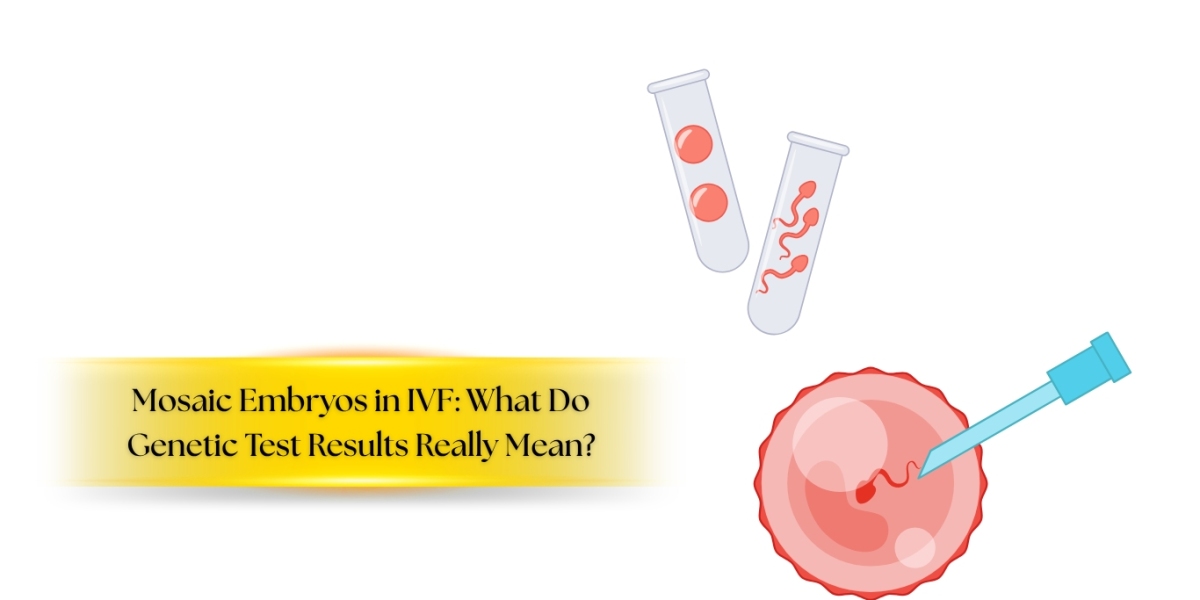
During IVF, eggs are collected and fertilized in a laboratory. Embryos are allowed to develop until the blastocyst stage. At this point, a small number of cells are removed from the outer layer of the embryo, called the trophectoderm.
The embryo is generally frozen while the genetic laboratory analyzes the sample.
The test looks mainly for chromosome abnormalities. Human cells typically contain 46 chromosomes arranged in 23 pairs. An embryo with an extra or missing chromosome may be classified as aneuploid.
Results may broadly be reported as:
- Euploid: The tested cells show the expected chromosome number.
- Aneuploid: The tested cells show a chromosome abnormality.
- Mosaic: The sample contains signals suggesting more than one chromosome pattern.
It is important to understand that PGT-A is a screening test, not a complete genetic diagnosis of the future baby.
3. What Does a Mosaic Result Really Mean?
This is perhaps the most important question for patients.
A mosaic result means that the genetic laboratory detected evidence of different chromosome patterns within the tested sample.
However, the result does not necessarily tell us exactly what is happening in every cell of the embryo.
Why? Because the test examines a limited sample of cells from the embryo's outer layer. The cells that eventually form the fetus come primarily from the inner cell mass.
Therefore, there can be a difference between the genetic result from the biopsy and the genetic makeup of the developing fetus.
This does not mean the test is useless. It provides valuable information. But it should be interpreted alongside other factors, including embryo quality, the specific chromosome involved, the level and type of mosaicism, and the patient's individual circumstances.
4. Why Does Embryo Mosaicism Happen?
Embryo mosaicism can occur because of chromosome changes during early cell division.
After fertilization, the embryo repeatedly divides. Ideally, each new cell receives the correct genetic material. Sometimes, however, errors occur during chromosome separation.
If an error happens after fertilization, different groups of cells can develop with different chromosome patterns.
This can result in mosaicism.
Chromosomal errors are not unusual during early embryo development. Their likelihood can also be influenced by factors such as egg age and overall reproductive biology.
However, it is important not to assume that mosaicism happened because someone made a lifestyle mistake. In many cases, these chromosome-related events occur naturally and are outside a person's control.
5. Are Mosaic Embryos Abnormal?
There is no simple yes-or-no answer.
A mosaic embryo is not equivalent to a clearly euploid embryo, but it also should not automatically be treated as identical to a completely aneuploid embryo.
Research and clinical experience have shown that some mosaic embryos can implant and result in ongoing pregnancies and healthy births.
At the same time, outcomes can vary depending on the type of mosaic result.
This is why fertility specialists generally avoid treating all mosaic embryos as one category.
A mosaic result needs context.
For someone going through IVF, this can be emotionally difficult. You may see a report filled with percentages, chromosome numbers and technical terms and wonder, “Is my embryo healthy or not?”
The answer often requires a detailed discussion with your fertility specialist and, where appropriate, a genetic counselor.
6. Can a Mosaic Embryo Become a Healthy Baby?
Yes, some mosaic embryos can result in healthy pregnancies and live births.
However, this does not mean every mosaic embryo has the same potential as a euploid embryo.
Studies have reported successful pregnancies after mosaic embryo transfer, but outcomes depend on the specific mosaic finding and other clinical factors.
One reason is that embryos have some developmental flexibility. Cells with abnormal chromosome patterns may not necessarily contribute to the fetus in the same way as cells in the tested biopsy.
In some situations, abnormal cells may be reduced, eliminated, or confined to tissues outside the developing fetus.
Scientists are still studying exactly how these processes occur.
Therefore, patients should avoid two extremes:
“A mosaic embryo can never produce a healthy baby.”
and
“A mosaic embryo is always completely safe.”
Neither statement accurately reflects the complexity of current evidence.
7. Understanding Low-Level and High-Level Mosaic Results
Mosaic reports may sometimes describe the estimated proportion of abnormal cells detected in the biopsy.
You may encounter terms such as low-level mosaic and high-level mosaic.
Generally, a lower proportion of abnormal cells detected in the biopsy may be considered more favorable than a higher proportion. However, there is no universal percentage that can perfectly predict the outcome of an embryo.
Laboratories may also use different reporting thresholds and testing methods.
For example, one laboratory's reporting categories may not be directly comparable with another laboratory's categories.
This is why patients should not compare embryo reports based solely on percentages found on the internet.
Your IVF specialist should explain exactly how your laboratory defines its mosaic categories and what the particular result means.
8. What Are Segmental Mosaic Embryos?
Not all mosaic findings involve an entire chromosome.
A report may identify a segmental abnormality, meaning that only part of a chromosome appears to have an abnormal copy number.
Segmental mosaic results can be different from whole-chromosome mosaic findings.
Their clinical significance may depend on factors such as:
- The chromosome involved
- The size of the affected segment
- Whether the finding is considered mosaic
- The laboratory's testing method
- The quality of the embryo
- Other available embryos
- The patient's reproductive history
Because the interpretation can be complicated, patients should discuss segmental mosaic findings directly with a qualified fertility specialist and genetic counselor.
9. How Doctors Rank Mosaic Embryos for Transfer
If a patient has both euploid and mosaic embryos, a fertility team may generally consider the euploid embryo first, depending on the clinical situation.
If no euploid embryo is available, however, a mosaic embryo may still be considered for transfer.
Doctors may look at several factors, including:
Type of mosaicism: Some chromosome findings may be viewed differently from others.
Level of mosaicism: The estimated proportion of abnormal cells in the biopsy can influence interpretation.
Whole-chromosome versus segmental findings: These may carry different considerations.
Embryo morphology: The embryo's appearance and development can provide additional information.
Patient history: Age, previous IVF outcomes, miscarriage history and other factors may be relevant.
Number of embryos available: Having several embryos can affect the options available to a patient.
There is no universal ranking system that works perfectly for everyone.
10. What Are the Risks of Transferring a Mosaic Embryo?
Mosaic embryo transfer may carry different considerations compared with transfer of a euploid embryo.
Potential concerns may include:
- Lower implantation potential in some circumstances
- Higher risk of miscarriage for certain mosaic findings
- Possibility that the pregnancy may have chromosomal abnormalities
- Greater need for genetic counseling
- The possibility of additional prenatal testing
Importantly, the risk is not identical for every mosaic embryo.
The specific chromosome involved can matter greatly. Some chromosome abnormalities may be more compatible with development than others.
Because of this, transferring a mosaic embryo should be an individualized decision rather than a decision based solely on a laboratory label.
11. What Happens After Mosaic Embryo Transfer?
If a mosaic embryo is transferred and pregnancy occurs, your fertility team may recommend additional genetic counseling.
Prenatal testing can provide information about the developing pregnancy.
Depending on the situation, options may include screening tests or diagnostic procedures. Screening and diagnostic testing are not the same thing.
Screening estimates the possibility of a chromosome condition, whereas diagnostic testing can provide a more definitive assessment of fetal chromosomes.
Your obstetrician, maternal-fetal medicine specialist or genetic counselor can explain which options are appropriate.
It is also important to remember that prenatal testing has its own benefits, limitations and risks. Decisions should be made with qualified medical professionals rather than based on an online article alone.
12. Should You Transfer a Mosaic Embryo?
There is no single answer that applies to every patient.
If you have a euploid embryo available, your doctor may recommend considering that embryo before a mosaic embryo.
If mosaic embryos are the only embryos available, the decision becomes more nuanced.
Your specialist may discuss:
- The exact mosaic result
- The chromosome involved
- The estimated mosaic level
- Whether the finding is whole-chromosome or segmental
- Embryo morphology
- Your reproductive history
- Your age and other fertility factors
- Whether additional embryos are available
- Potential prenatal testing
- Your personal preferences and risk tolerance
This is where choosing an experienced IVF centre becomes particularly important.
Patients researching the best ivf services in new delhi should look beyond advertising claims and consider whether the centre has qualified reproductive specialists, experienced embryology teams, reliable genetic-testing support and appropriate counseling services.
13. Questions to Ask Your IVF Specialist
If your embryo report says “mosaic,” don't hesitate to ask questions.
You could ask:
What type of mosaicism was detected?
Understanding whether the result involves a whole chromosome or a segment can be important.
What percentage of mosaicism was reported?
Ask how the laboratory defines low- and high-level mosaicism.
Which chromosome is involved?
Different chromosome findings may have different clinical implications.
How reliable is this particular result?
Your doctor can explain the limitations of the biopsy and testing method.
Are there euploid embryos available?
If there are, ask how the clinic recommends prioritizing them.
What are the expected implantation and pregnancy outcomes?
Ask for information relevant to your specific embryo rather than relying on general statistics.
Would genetic counseling be appropriate?
For complex results, counseling can help you understand both reproductive options and prenatal testing considerations.
14. Choosing the Right IVF Centre
When you're comparing fertility clinics, it can be tempting to focus only on success rates.
But IVF is more than one number.
Look at the complete treatment pathway.
A good IVF centre should have appropriate laboratory facilities, qualified embryologists, experienced fertility specialists and access to genetic counseling when needed.
If you are searching for the best ivf services in new delhi, consider asking clinics about:
- Their embryology laboratory standards
- Experience with PGT-A
- How mosaic results are reported
- Their approach to mosaic embryo counseling
- Availability of genetic counselors
- Embryo freezing and storage procedures
- How they communicate treatment outcomes
- Whether success rates are explained transparently
A trustworthy clinic should be willing to explain uncertainty rather than promising guaranteed results.
15. Conclusion
A mosaic embryo result can be confusing and emotionally overwhelming, but it does not automatically mean that an embryo cannot result in a healthy pregnancy. Mosaic embryos contain complex genetic information, and the biopsy represents only a small sample of cells.
The most important step is to understand the specific mosaic finding, rather than treating the word “mosaic” as a final verdict.
If you are considering embryo transfer, discuss the report with your fertility specialist and, when appropriate, a genetic counselor. They can help you weigh the potential benefits, uncertainties and available alternatives based on your individual situation.
When evaluating the best ivf services in new delhi, choose a centre that combines experienced fertility care with strong embryology, transparent communication and appropriate genetic counseling.
Frequently Asked Questions
1. Can a mosaic embryo result in a healthy baby?
Yes. Some mosaic embryos have resulted in healthy pregnancies and live births. However, outcomes vary depending on the specific chromosome finding, mosaic level and other factors.
2. Is a mosaic embryo worse than a euploid embryo?
A mosaic embryo generally presents more uncertainty than a euploid embryo because the biopsy has detected mixed chromosome signals. However, mosaic does not automatically mean that the embryo cannot develop successfully.
3. Does mosaicism mean the baby will have a genetic disorder?
Not necessarily. The genetic result comes from a small biopsy and does not perfectly represent every cell of the embryo or fetus. Appropriate genetic counseling and prenatal testing can help assess the pregnancy.
4. Should I transfer a mosaic embryo if I have no euploid embryos?
A mosaic embryo may be considered when no euploid embryo is available, but the decision should be individualized. Your fertility specialist and genetic counselor can explain the specific risks and alternatives.
5. How do I choose the best IVF centre for mosaic embryo treatment?
Look for an IVF centre with experienced reproductive specialists, a strong embryology laboratory, PGT-A expertise, transparent outcome reporting and access to qualified genetic counseling. Ask how the clinic specifically handles mosaic embryo results.