
Data Center Energy Storage Systems Market: What Is Changing in 2026?
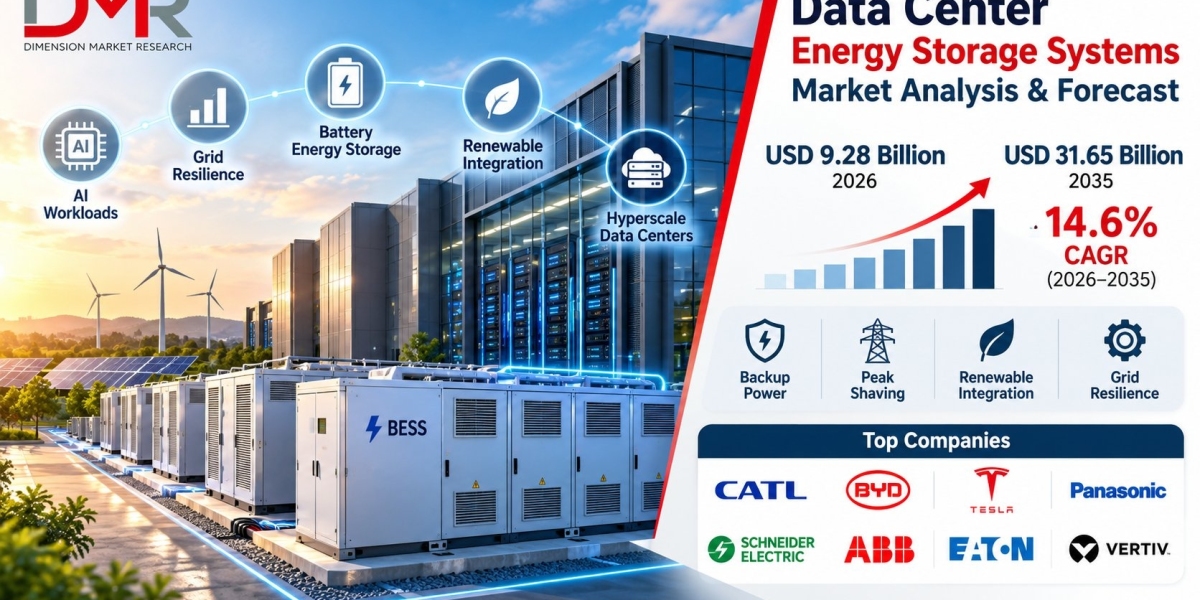
The Global Data Center Energy Storage Systems Market is entering a major infrastructure transition as artificial intelligence increases data center power density and puts additional pressure on electricity grids. According to Dimension Market Research, the market is estimated at USD 9.28 billion in 2026 and is projected to reach USD 31.65 billion by 2035, expanding at a CAGR of 14.6% during the forecast period.
The important shift is simple: energy storage is moving from a backup-only function to a core part of data center power infrastructure. Operators increasingly need systems that can support outage protection, power quality, peak shaving, renewable energy integration and grid services. This is particularly relevant for hyperscale and AI data centers, where electricity availability can become a constraint on expansion.
Get insight you need (request free sample)
Why AI Is Accelerating Data Center Energy Storage Adoption
AI training and inference workloads are changing the economics of data center power. High-density computing can require substantially more electricity within a relatively small physical footprint. When utility interconnection capacity cannot expand at the same speed as computing demand, storage can provide operators with another layer of flexibility.
Traditional lead-acid UPS systems remain important, but lithium-ion batteries and broader battery energy storage systems are gaining attention because of their energy density, response speed, footprint and operational flexibility. Storage can also work alongside renewable generation and intelligent energy management platforms, allowing operators to use the same asset for several power-management objectives.
Key Market Indicators
● 2026 market value is estimated at USD 9.28 billion.
● Market revenue is projected to reach USD 31.65 billion by 2035.
● The market is expected to expand at a 14.6% CAGR.
● BESS held a 70.3% technology share in 2026.
● Cloud and hyperscale centers held a 51.3% share.
● Extended backup power led applications with 40.6% share.
● North America represented 44.6% of the market in 2026.
Battery Energy Storage Systems Remain the Market Leader
Battery Energy Storage Systems are expected to remain the leading technology category. BESS accounted for 70.3% of the energy storage technology segment in 2026, supported by the need for fast-response and space-efficient energy storage in modern data center environments.
Lithium-ion technology is particularly suited to facilities seeking to modernize UPS infrastructure while improving usable space and operational efficiency. Meanwhile, alternative technologies such as flywheels and supercapacitors have opportunities in applications where rapid power response and high cycling capability are more important than long-duration energy storage.
Hydrogen, compressed air and other long-duration technologies represent emerging opportunities. Their role could become more significant as operators look beyond short outage bridging toward multi-hour and multi-day resilience.
Hyperscale Data Centers Drive Demand
Cloud and hyperscale data centers represented 51.3% of the market in 2026. Their position reflects the scale of investment in cloud computing, AI infrastructure and digital services. Large operators can also justify sophisticated storage systems because a single power asset can support multiple operational objectives across a large campus.
Colocation facilities face a different challenge. Many are located in space-constrained environments, making compact data center battery storage and modular energy storage solutions particularly attractive. Enterprise data centers are also transitioning toward modern UPS battery architectures as existing equipment reaches replacement cycles.
Extended Backup Power Leads Applications
Extended Backup Power and UPS Companion applications accounted for 40.6% of application demand in 2026. Reliability remains the first reason data center operators deploy energy storage. Even a short interruption can affect mission-critical computing, networking and digital services.
However, the role of storage is expanding. Operators can increasingly use energy storage for peak shaving, load management, renewable integration, power quality conditioning and grid services. This creates the possibility of improving resilience while also generating economic value from an asset that previously served primarily as emergency infrastructure.
5-20 MW Systems Hold the Largest Capacity Segment
The 5-20 MW capacity range led the market with a 39.8% share in 2026. This segment fits the requirements of many hyperscale data halls and medium-sized colocation campuses while offering a more standardized deployment model than very large custom installations.
Demand for systems above 20 MW is also increasing as AI clusters become larger and data center campuses require greater power capacity. Larger installations, however, generally require more extensive engineering, grid coordination and thermal and safety planning.
North America Leads While Asia Pacific Expands Rapidly
North America led the Data Center Energy Storage Systems Market with a 44.6% share, representing approximately USD 3.6 billion in 2026. Strong hyperscale investment, AI infrastructure expansion and grid interconnection challenges support the region's leadership.
Asia Pacific is positioned for strong growth as data center construction accelerates across China, Japan, South Korea and India. In several markets, limited grid capacity and growing electricity demand make on-site energy storage increasingly relevant during new facility development rather than only during later modernization projects.
Regional Market Focus
● North America benefits from large-scale hyperscale investment.
● Asia Pacific is supported by rapid data center construction.
● Europe is focused on resilience and energy transition.
● Latin America offers developing infrastructure opportunities.
● Middle East and Africa offer emerging storage potential.
Get detailed market insight: https://dimensionmarketresearch.com/report/data-center-energy-storage-systems-market/
Leading Companies in the Market
The competitive landscape includes battery manufacturers, UPS providers, power infrastructure companies and energy storage specialists. Key participants include:
● Tesla, Inc.
● Contemporary Amperex Technology Co., Limited (CATL)
● LG Energy Solution
● Samsung SDI Co., Ltd.
● Panasonic Holdings Corporation
● BYD Company Ltd.
● Schneider Electric SE
● Vertiv Group Corp.
● Eaton Corporation
● ABB Ltd.
● Siemens Energy AG
● Delta Electronics, Inc.
● Hitachi Energy Ltd.
● Fluence Energy, Inc.
● Saft
● ZincFive, Inc.
● Active Power, Inc.
● Skeleton Technologies
● Piller Power Systems
● Caterpillar Inc.
What Are the Biggest Opportunities in Data Center Energy Storage?
The next phase of the market is likely to focus on flexibility rather than storage capacity alone. Modular BESS platforms can allow data center operators to add capacity as computing loads increase, while software can coordinate battery health, backup requirements, demand response and energy market participation.
Hybrid energy storage is another important opportunity. Combining lithium-ion batteries with long-duration technologies could help operators address resilience requirements that cannot be economically solved through a single chemistry. This creates opportunities for suppliers developing integrated power management platforms rather than standalone battery hardware.
Major Growth Themes
● AI workloads are increasing data center electricity requirements.
● Grid constraints are strengthening the case for on-site storage.
● Modular BESS can support phased data center expansion.
● Energy management software adds value beyond backup power.
● Hybrid storage can target longer-duration resilience.
Challenges That Could Affect Market Expansion
Despite strong growth potential, energy storage deployment presents technical and financial challenges. High-density lithium-ion installations require careful thermal management, fire protection and facility design. Operators must also consider battery degradation, replacement cycles and the total cost of ownership.
Supply chain conditions remain another consideration. Battery cell availability, raw material pricing and trade policies can influence project economics. These factors are encouraging diversification of manufacturing capacity and greater interest in regional battery supply chains.
How AI Could Reshape Energy Storage Management
AI is not only increasing demand for storage. It is also creating opportunities to operate storage more intelligently. AI-enabled battery management and energy management systems can analyze load patterns, battery health, power prices and grid conditions to coordinate storage assets.
For data center operators, this can transform storage from a passive backup resource into a flexible power-management asset. The ability to balance reliability requirements with demand response, renewable integration and energy cost optimization could become an important competitive factor as AI infrastructure expands.
Report Also Cover
What is the Data Center Energy Storage Systems Market size in 2026?
What will be the Data Center Energy Storage Systems Market size by 2035?
What is the CAGR of the Data Center Energy Storage Systems Market?
Which energy storage technology leads the data center market?
Why are hyperscale data centers adopting battery energy storage systems?
Which application holds the largest share of the market?
Which region dominates the Data Center Energy Storage Systems Market?
What are the major companies operating in the market?
How are AI workloads affecting data center energy storage demand?
What are the emerging opportunities in data center battery storage?
Data Center Energy Storage Systems Market Outlook
The Data Center Energy Storage Systems Market is moving toward a broader role in digital infrastructure. The combination of AI-driven electricity demand, grid constraints, renewable energy targets and growing reliability requirements is changing how operators think about power storage.
With the market projected to grow from USD 9.28 billion in 2026 to USD 31.65 billion by 2035, the opportunity extends beyond conventional UPS batteries. BESS, modular storage, intelligent energy management, hybrid chemistries and long-duration technologies are creating new pathways for data centers to manage power more reliably and efficiently.
For companies assessing procurement, investment or expansion opportunities, understanding the market by technology, data center type, application, capacity, enterprise vertical and region can help identify where demand is developing fastest.
Get 10% instant discount on report purchase
Similar Topic
● Battery Energy Storage Management System Market
● Residential Solar Energy Storage Market
About Us
Dimension Market Research (DMR) is a global market intelligence and consulting firm delivering data-driven insights that help organizations make informed strategic decisions. With expertise across 12+ industries and global markets, DMR provides syndicated reports, custom research, competitive analysis, white space analysis, and business strategy consulting.
Our research solutions combine analytical rigor, industry expertise, and forward-looking intelligence to identify opportunities, reduce risks, and support sustainable growth. Trusted by clients across diverse sectors, DMR is committed to delivering accurate, actionable insights that enable businesses to navigate evolving market landscapes with confidence.
Contact Us
Phone USA: +17323699777
Phone India: +919310023843
E-mail: enquiry@dimensionmarketresearch.com
Address USA: 957 Route 33, Suite 12 #308, Hamilton Square, NJ-08690
Address India: D44, Sector 6, Noida 201301, India