
When people compare solar systems, the first question is often: “How much will it cost?” That is understandable. Solar is a significant investment, and everyone wants a reasonable price.
But there is another question that can be even more important: “What am I getting for that price?”
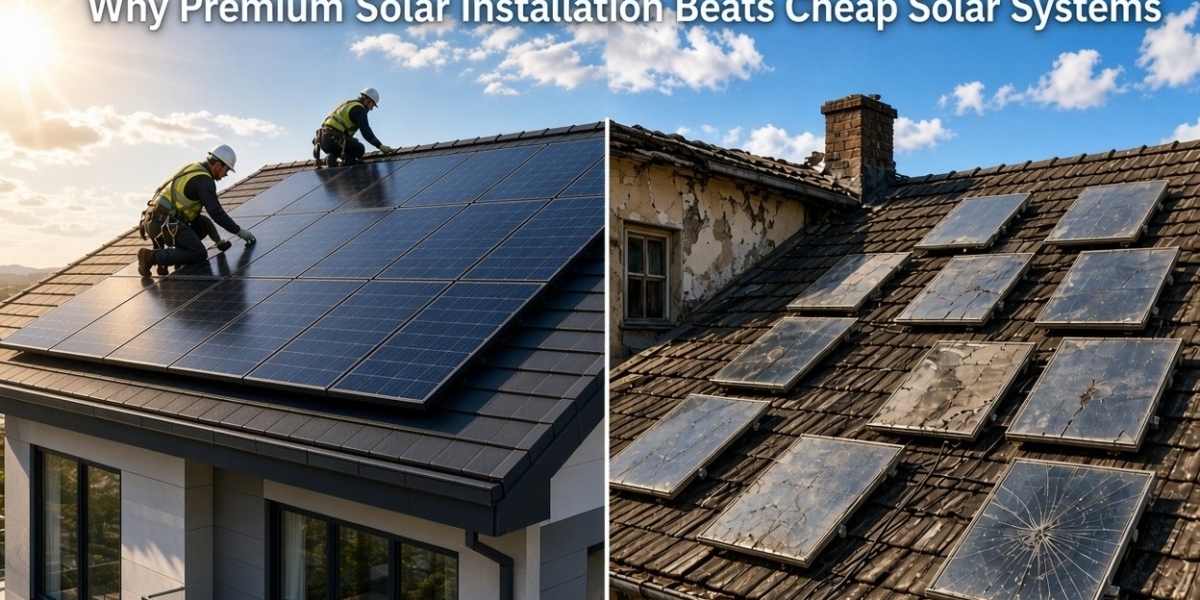
A cheaper solar system is not automatically a bad system, just as a more expensive system is not automatically better. The real difference often comes down to the quality of the components, system design, installation workmanship, warranties and long-term support.
For homeowners considering rooftop solar, choosing quality over the lowest quotation can help reduce avoidable problems and create a more reliable long-term investment. This is particularly relevant as India's solar market continues to expand. According to the International Energy Agency, India added almost 50 GW of solar PV capacity in 2025, highlighting the country's rapidly growing adoption of solar energy.
What Does “Premium Solar Installation” Actually Mean?
Premium solar installation should not simply mean an expensive solar package.
Instead, it means a carefully planned system where attention is given to the entire project—from the initial site assessment to installation, testing and after-sales support.
A quality-focused installation typically considers:
- Roof condition and available installation area
- Roof orientation and potential shading
- Appropriate system sizing
- Panel and inverter compatibility
- Mounting structure quality
- Safe electrical connections and cable management
- System testing and commissioning
- Monitoring and maintenance
- Applicable approvals and documentation
- Equipment and workmanship warranties
The goal is straightforward: build a solar system that performs reliably rather than simply installing the lowest-cost equipment available.
1. Better Components Can Support Long-Term Reliability
Solar panels and inverters spend years exposed to outdoor conditions. Heat, moisture, dust, rain and temperature changes can all affect equipment over time.
That makes component quality important.
The cheapest quotation may use components that appear similar on paper but differ in efficiency, reliability, warranty terms or long-term support. Buyers should therefore compare the exact models and specifications, rather than comparing only the total system price.
For eligible government-supported projects in India, equipment requirements can also matter. MNRE maintains an Approved List of Models and Manufacturers (ALMM), and states that listed module models and manufacturers are required for specified government and government-assisted projects, as well as certain net-metering and open-access projects.
This is why a responsible solar buyer should ask:
Which exact panel and inverter models are included in my quotation?
A good installer should be comfortable answering that question clearly.
2. The Lowest Upfront Cost May Not Be the Lowest Lifetime Cost
A low initial price can be attractive, but solar should be evaluated as a long-term investment.
Solar panels naturally lose some output as they age. Research from the National Renewable Energy Laboratory (NREL), based on a large body of research, has found typical PV degradation rates in the range of roughly 0.5%–1% per year, depending on the technology.
That gradual degradation is normal.
However, owners also need to consider other potential costs, including avoidable repairs, equipment replacement, downtime and maintenance.
Imagine two homeowners install similarly sized systems.
Homeowner A chooses the cheapest quotation without closely comparing components, installation methods or service terms.
Homeowner B pays somewhat more for detailed site assessment, appropriate components, professional installation, system testing and clearly defined support.
The second homeowner has spent more initially, but that does not automatically mean the system will produce more savings. The important point is that the owner has potentially reduced some avoidable installation and service risks.
The actual return on investment will still depend on electricity consumption, tariffs, solar resource, system size, financing, equipment and other factors.
The lesson is not “always buy the most expensive system.” It is “compare lifetime value, not just the initial price.”
3. Installation Quality Directly Affects System Performance
Even high-quality solar panels cannot perform properly if the overall system is poorly designed or installed.
For example, shading that was overlooked during the site assessment can reduce generation. Poor cable routing can create maintenance concerns. Incorrect mounting can introduce unnecessary structural or water-ingress risks. Poor electrical connections can cause faults and downtime.
NREL's residential PV analysis notes that actual system performance is influenced by factors including the solar resource, technology, expected downtime, inverter losses and system design.
This is why professional installation involves much more than putting panels on a roof.
A quality installer should assess the property and design the system around its real conditions.
For example, if a section of a roof receives shade for part of the day, the installer should account for that when planning the array rather than simply filling the available roof space.
4. Skilled Installation Helps Protect Your Property
A solar system becomes part of your property for many years. Installation therefore needs to consider both the equipment and the building.
Mounting structures should be suitable for the roof and local environmental conditions. Cable routes should be organized. Electrical equipment should be installed appropriately. Where roof penetrations are necessary, they should be handled carefully to reduce the risk of water-related problems.
These details may not be obvious when comparing two quotations.
They become much more important after installation.
A professional installer should also leave sufficient access for inspection and maintenance rather than treating installation as a one-time job.
5. Warranty Is Important—but Read the Fine Print
Another major difference between solar quotations can be the support available after installation.
Solar buyers may encounter several different types of warranty coverage, including:
- Product warranties
- Performance warranties
- Inverter warranties
- Mounting-component warranties
- Installation or workmanship warranties
These are not necessarily the same thing.
A long equipment warranty does not automatically mean that every installation-related problem is covered.
Before signing a contract, ask:
Who will handle a warranty claim if something goes wrong?
Also ask whether the installer provides documentation, commissioning records and post-installation support.
This can be particularly important for homeowners who do not want to coordinate between several manufacturers and contractors when a problem occurs.
6. Cheap Does Not Always Mean Poor—and Premium Does Not Always Mean Better
One misconception worth addressing is that every inexpensive solar system is unreliable.
That is not true.
A competitively priced system can provide excellent value if it uses appropriate equipment and is professionally designed and installed.
Similarly, simply calling a system “premium” does not prove that it is better.
Consumers should look for evidence:
- What equipment is being supplied?
- What warranties apply?
- Who is performing the installation?
- How is the system designed?
- What testing is included?
- What happens after commissioning?
- Are expected savings based on realistic assumptions?
These questions provide a much better basis for comparison than price alone.
7. Government Support Makes Proper Installation Even More Important
India's rooftop solar ecosystem also includes government-supported programmes.
MNRE's rooftop solar programme explains that eligible residential consumers can access applicable Central Financial Assistance through specified mechanisms, with successful installation and verification involving empanelled vendors and the relevant DISCOM.
For homeowners considering schemes such as PM Surya Ghar, it is therefore important to understand the applicable requirements, vendor process and documentation rather than assuming that every solar quotation follows the same process.
Government schemes and eligibility requirements can change, so consumers should always verify current details through official sources before making a financial decision.
A Simple Way to Compare Solar Quotations
Instead of creating a comparison based only on price, make a checklist.
What to Compare | Why It Matters |
Solar panel model | Helps verify equipment quality and specifications |
Inverter model | Influences system conversion and functionality |
System capacity | Should match your electricity requirements |
Installation method | Affects safety and long-term reliability |
Warranty | Defines protection and support |
Monitoring | Helps track system performance |
Installation workmanship | Can influence reliability and maintenance |
After-sales service | Important when problems occur |
Approvals/documentation | Helps with compliance and applicable schemes |
Total lifetime value | Provides a better comparison than upfront price |
This approach makes it easier to identify what you are actually paying for.
The Bottom Line: Choose Value, Not Just a Low Price
Solar energy is a long-term decision. The panels may remain on your roof for decades, so focusing exclusively on the lowest installation price can overlook factors that matter throughout the system's life.
A premium solar installation is valuable when the additional investment provides better planning, appropriate equipment, skilled workmanship, stronger documentation, meaningful warranty coverage and dependable support.
For homeowners and businesses exploring solar solutions, Solar 365 offers services covering solar system design, supply, installation, commissioning and after-sales support for residential, commercial and industrial applications.
The smartest approach is not to ask:
“Who offers the cheapest solar system?”
Instead, ask:
“Which solar system offers the right balance of quality, performance, safety, support and long-term value?”
That shift in thinking can help buyers make a more informed solar investment—and avoid discovering later that the cheapest quotation was not necessarily the best value.