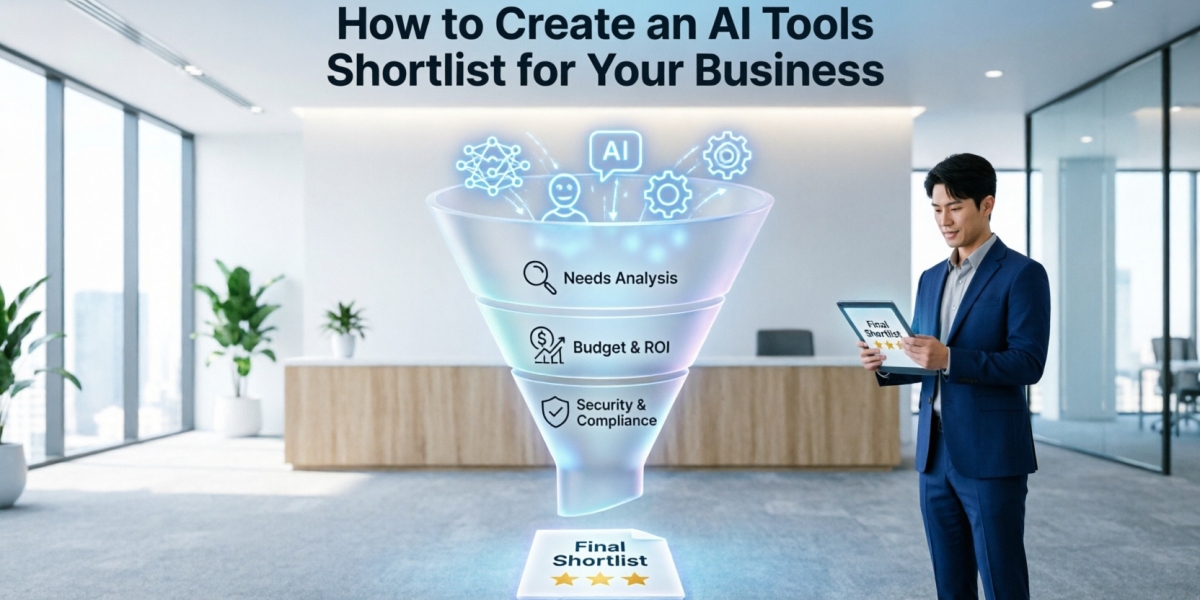

A 40-person accounting firm wants to find an AI tool to help their staff draft emails for clients and summarize lengthy tax documents. A search finds more than thirty products: some are writing assistants, some are features of software they already pay for and a few are for accounting specifically. The firm doesn't have time to test out thirty tools and it can't just make up a random shortlist. The process of narrowing down from thirty to two or three is where this shortlist is built - and the stages it undergoes.
Decide What You Are Hiring the Tool to Do
The firm's first step does not even include a search. It is a single sentence: "Reduce the time associates spend drafting routine client emails and summarizing documents, without client data leaving approved systems."
This sentence serves two purposes. It states the task to avoid chasing features and use cases that aren't related to the firm's needs and it includes a hard constraint about data.
Your version may have different requirements, but the same structure should hold: the work to be done, done by whom, and one or two conditions that cannot be ignored. Write it down before looking at any products.
Cast a Wide Net, Then Cut Fast
Having a sentence is the firm's first filter - and it's a wide one. All products that fit are placed on a single spreadsheet. This part of the process requires variety in sources to hit every possible angle: recommendations from other firms, review communities, the vendors of software the firm already pays for, and directories of AI products.
Marketplaces are a good place to start searching, as they often list tools by category. A roundup of the Top 10 AI Tools Marketplaces can show how they categorize and display products, which will help if you don't yet know the vendor names in your category. Remember that a listing is a lead and not an endorsement. Quality and vetting vary between marketplaces.
The filtering process comes next, based only on information on public websites. The firm's two questions are: does the product clearly do the job and does the vendor explain what happens to customer data? A vendor with no readable data policy, or one whose product is aimed at an unrelated use, falls off. In this example, thirty candidates become twelve.
Apply Your Non-Negotiables
The firm now applies its hard requirements to the twelve survivors. These are the points where a "no" is a dealbreaker, regardless of how good the product looks otherwise.
The non-negotiables for the accounting firm are short: data must not be used to train the vendor's models, the tool must work with the firm's document storage and the vendor must be able to provide current security documentation. Each can be checked through the vendor's documentation or a brief email.
Be careful to differentiate non-negotiables from preferences. If everything is mandatory, nothing is, and you'll be cutting good candidates for trivial reasons. Keep the list to what would genuinely stop you from buying. Which requirements count as non-negotiables depends on your industry, your clients and your regulatory obligations, so consider working with legal or compliance staff if you handle sensitive information.
The firm's twelve candidates are now down to six at the end of this stage.
Compare Cost at Your Actual Scale
Pricing screens can mislead - the headline number rarely reflects what the product will actually cost. The firm estimates that about 25 people will use the tool and that each will make several dozen requests a week. It then works out what each of the remaining vendors would charge at that scale.
Two of the six products charge per seat, which makes the math simple. Three charge by usage and one blends both. The usage-priced tools are cheap at pilot volume, but less predictable at adoption, so the firm asks each vendor for a written estimate and available spending caps. It also asks about extras that tend to appear later: onboarding fees, premium support, charges for connecting other systems.
If your purchase has a regional angle, such as a need for US-based support or terms, check that early as well. A page for Buy AI Software in the US can show how offerings and regional details can be presented, which shows what to ask each vendor to confirm.
One of the six turns out to be unaffordable at its volume, so it's cut. Five remain.
Score What Is Left
Five candidates is a manageable set to compare in detail. The firm makes a simple scorecard, with the criteria on one axis and the vendors on the other. The criteria are fit for the task, ease of use, integration effort, data handling, total cost and quality of support. Each is given a weight and the firm sets the weights before looking at the results so the scores reflect its priorities and not the best demo.
Two associates who will use the tool daily contribute to the scoring and their input shifts the results. A product that looked strong on paper has a clumsy interface that both dislike. Another, less polished on its website, handles messy documents better than expected.
The value of the numbers doesn't need to be mathematically rigorous. They're useful because they force the same comparison across vendors and make visible any disagreements.
Choose Two or Three and Plan the Test
The firm settles on three finalists. It keeps its notes on the two that fell short and why, as this saves time if a finalist fails its trial. If the pilot goes badly and the search has to reopen, a guide to Exomatter Alternatives can show how competing tools in a space can be compared side by side, which is a helpful model for starting over.
Before contacting vendors, the firm plans a test: a set of real, anonymized documents and email scenarios, a defined trial period and measures for success such as time saved per task and how often outputs need correcting.
Testing on real material matters as AI tools can perform differently on your messy data than on a vendor's prepared examples.
Keeping the Process Reusable
The most useful by-product of building a shortlist is the template itself. Save the problem statement, criteria, scorecard and notes on rejected tools. The next time a department asks for an AI product, you can start from the completed framework.
As a practical first step, open a blank spreadsheet today and write your one-sentence problem statement at the top. List your non-negotiables underneath it. With those two items in place, the rest of the shortlist usually falls in place quickly.