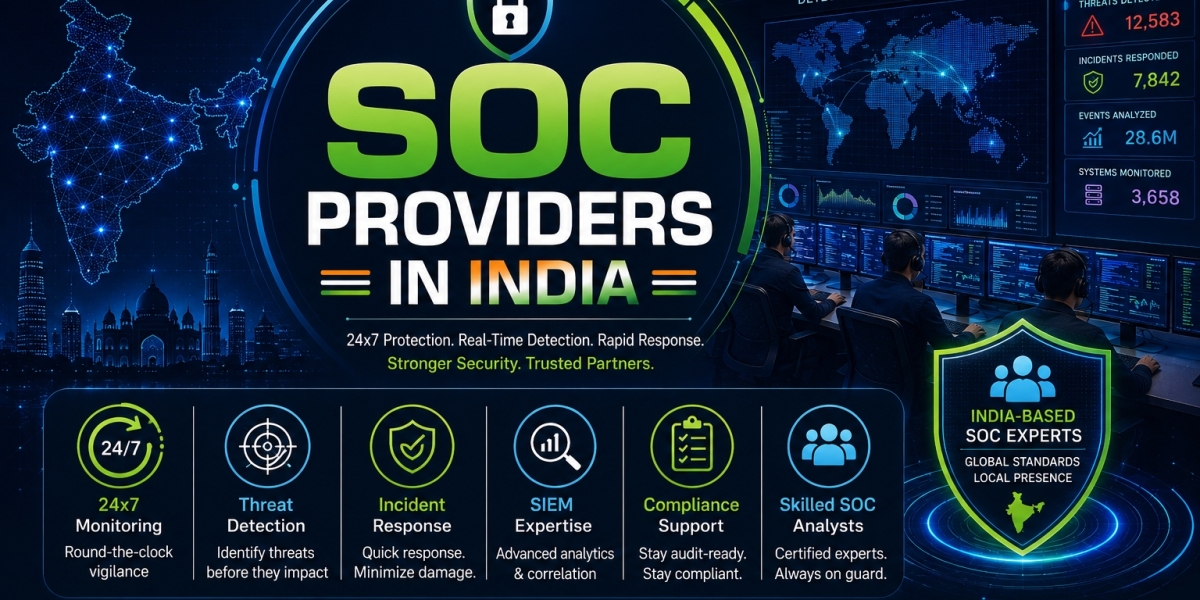

SOC Providers in India: Retail Cost Decisions
Indian e-commerce and retail businesses often receive SOC quotations that look similar but cover very different levels of service. soc providers in india usually price their work around monitored systems, coverage hours, analyst involvement and incident response support. Understanding these cost drivers helps a retailer invest in protection that matches its actual business risk.
Why retail SOC pricing varies so much
Two providers may quote different amounts for what appears to be the same service. One may include only alert monitoring for a fixed set of log sources. The other may include threat hunting, incident coordination, compliance reporting and regular detection tuning.
The difference usually lies in scope. A retailer with multiple websites, mobile apps, cloud workloads, payment integrations, warehouses and store systems needs more analyst attention than a single online store. More log sources, more identities and more business-critical systems naturally increase the work required to investigate alerts properly.
Before requesting quotations, the retailer should list its priority systems, expected log volume, coverage hours and internal escalation team. Many soc companies can then quote against the same baseline, making the comparison meaningful rather than confusing.
What affects the cost of SOC providers in India?
The cost of SOC providers in India is affected by monitoring scope, log volume, coverage hours, response expectations and the complexity of the retailer’s technology environment. Additional services such as threat hunting, compliance reporting and incident coordination also increase cost.
A retailer should ask each provider to separate these components in the proposal. This makes it easier to see whether the price reflects genuine coverage or simply a standard bundle with limited flexibility.
The cost components that matter
Monitoring coverage is usually the foundation. The retailer should confirm which endpoints, network devices, identity systems, cloud accounts and business applications will generate security events. Coverage should include systems that handle customer data, payments, orders and fulfilment.
Analyst coverage is the next major component. Continuous monitoring requires shift-based capacity, investigation procedures and escalation support. If the retailer needs immediate escalation for high-severity events outside business hours, the provider must maintain the people and process to deliver that response.
Then comes response support. Some providers stop at notifying the retailer. Others help investigate, preserve evidence, coordinate with internal teams and support post-incident review. The latter requires more senior capability and usually costs more, but it can reduce the burden on an internal team during a live incident.
Cost component | What the retailer should confirm | Why it changes the price |
Log sources | Which systems, cloud accounts and applications are monitored | More sources require more ingestion, storage and analysis |
Coverage hours | Whether monitoring is business-hours only or continuous | Round-the-clock coverage requires shift-based analysts |
Alert triage | Who reviews alerts and how false positives are handled | Skilled triage reduces noise but needs experienced analysts |
Incident response | Whether the provider only alerts or assists investigation | Deeper response support requires more senior capability |
Reporting | What management and compliance reports are included | Custom reporting and evidence retention add ongoing work |
Detection tuning | How often rules are reviewed and adjusted | Regular tuning improves relevance but requires analyst time |
A retailer should not treat the lowest quote as the best value. A cheaper service that misses critical log sources or delays escalation can cost far more after a security event.
How should retailers compare SOC companies?
Retailers should compare SOC companies using a common scope, identical priority systems and clearly defined response expectations. The comparison should cover monitoring coverage, escalation times, analyst qualifications, reporting, data-handling arrangements and the process for changing detection rules.
It also helps to ask each provider to describe a realistic incident workflow. The quality of that explanation often reveals whether the provider understands retail operations or is selling a generic monitoring package.
Hidden costs that retail buyers often miss
The visible monthly fee is rarely the whole cost. Retailers should ask about onboarding charges, log ingestion limits, additional log sources, custom integrations, retention of investigation records and charges for out-of-scope incident support.
Integration effort is a frequent surprise. A provider may need access to identity platforms, cloud audit logs, endpoint agents, network devices and business applications. If those sources require custom work, the cost may appear as a separate project rather than part of the recurring fee.
Data retention is another area to clarify. Incident investigations, audit requests and internal reviews often require historical records. If the provider charges separately for extended retention or evidence extraction, the retailer should factor that into the total cost of ownership.
Finally, consider internal effort. Even a managed service requires the retailer to provide context, approve changes, participate in reviews and maintain escalation contacts. Underestimating this internal commitment can make an otherwise affordable service difficult to operate.
Can a smaller retailer afford a SOC provider?
A smaller retailer can often afford a SOC provider by starting with a focused scope. The business can prioritise customer-facing applications, identity systems, cloud infrastructure and critical payment-related systems before expanding coverage.
The key is to avoid buying broad coverage that the retailer cannot govern. A smaller, well-defined scope with clear escalation and reporting usually delivers better value than a large package with unused features.
How to build a realistic budget
Start with risk, not price. Identify the systems where an incident would affect customers, revenue, payments or operational continuity. These systems should receive the strongest monitoring and the clearest escalation path.
After that, define the operating model. Decide whether internal staff will handle final incident decisions, customer communication and fraud actions, while the provider handles continuous analysis and first-line investigation. This division keeps the retailer in control and prevents duplicated effort.
Then request proposals using the same scope document. Ask each provider to state what is included, what is excluded and what would trigger additional charges. A transparent provider should be able to explain its assumptions without hesitation.
A practical retail example
Imagine a mid-size online retailer evaluating three proposals. The first is the cheapest but monitors only network devices and endpoints. The second includes cloud and identity logs but offers limited after-hours escalation. The third includes priority application monitoring, continuous analyst coverage, incident coordination and quarterly detection reviews.
The third proposal may look expensive on paper. Yet if the retailer’s main risks involve customer portals, payment integrations and privileged cloud access, the broader scope may align better with actual exposure. The right decision depends on which gaps the business can accept and which it cannot.
A useful test is to ask each provider how it would handle a suspicious privileged-access event at night. The answer should include evidence gathering, escalation contacts, communication expectations and the division of responsibility between provider and retailer.
Questions to ask before signing
Ask for a written scope document before commercial discussions progress too far. The document should name monitored systems, log sources, escalation contacts, response-time expectations, reporting frequency and the process for handling new systems.
Ask about service governance as well. A provider should offer regular reviews where the retailer can assess alert quality, incident handling, coverage gaps and planned improvements. Without this feedback loop, pricing becomes difficult to justify over time.
Finally, ask how the provider handles changes in the retailer’s environment. New applications, cloud accounts and third-party integrations are normal in retail. The contract should explain when these changes require a scope revision and how costs will be assessed.
Frequently asked questions
Is SOC pricing usually fixed or variable?
It can be either. Some providers offer a fixed recurring fee for a defined scope, while others use variable pricing based on log volume, assets monitored or additional response support. Retailers should request a clear breakdown of both recurring and one-time costs.
What is the biggest reason SOC proposals differ in price?
The biggest reason is scope. Differences in monitored systems, coverage hours, analyst involvement, incident support and reporting can create large price gaps even when proposals appear similar.
Should a retailer choose the provider with the lowest monthly cost?
Not automatically. The lowest cost may exclude critical log sources, after-hours escalation or incident support. The retailer should compare value against its own risk exposure and operational requirements.
IBN Technologies provides managed SOC and SIEM services with configurable monitoring, incident response support and compliance-oriented reporting for Indian e-commerce and retail organisations.
Contact Us
IBN Technologies
Phone: +91 20 6768 0404
Email: sales@ibntech.com