
SIEM SOC Services for Indian Retail Compliance
Indian e-commerce and retail businesses must protect customer data, payment flows and operational systems while meeting growing security expectations from customers, partners and regulators. siem soc services combine centralised log visibility with analyst-led monitoring, helping retailers detect suspicious activity early and maintain evidence of response. For compliance-minded retail leaders, continuous oversight is becoming a business requirement rather than an optional investment.
Why retail compliance needs continuous evidence
Compliance is often treated as an annual activity: complete a questionnaire, collect documents, pass a review and move on. That approach no longer reflects how retail risk behaves. Customer accounts, payment integrations, vendor connections and cloud systems change throughout the year.
A retailer may have strong policies on paper but weak operational proof. If no one monitors alerts after business hours, investigates unusual access or documents incident handling, it becomes difficult to demonstrate that controls actually work.
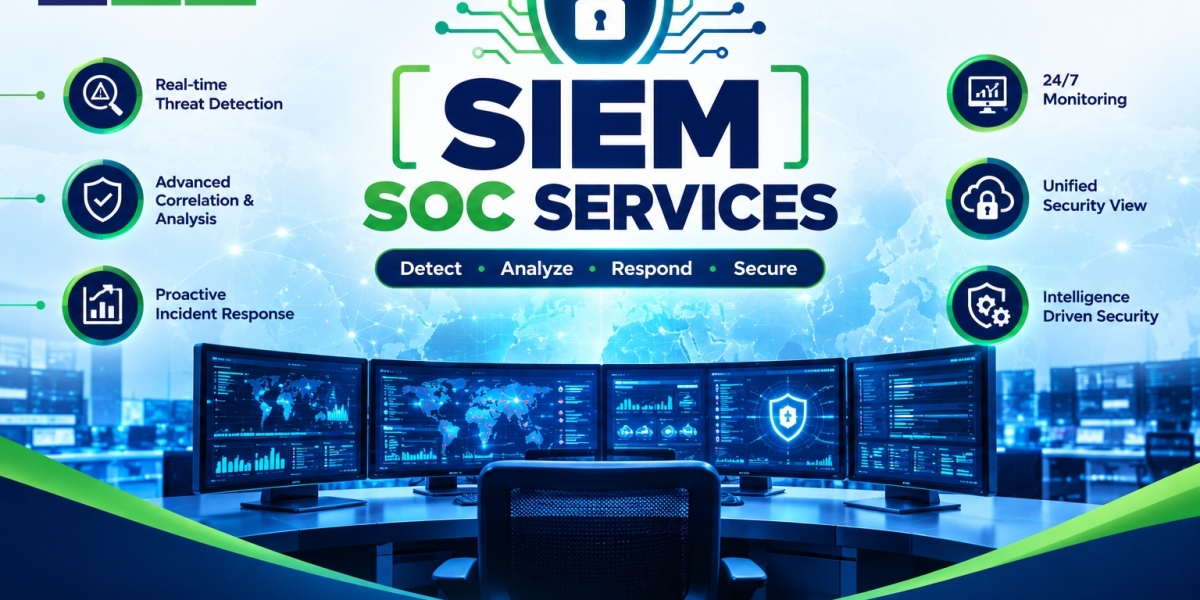
SIEM SOC services help close this gap by collecting security events from multiple systems, correlating related activity and maintaining records of investigation and response. Strong soc managed service providers begin by understanding the retailer’s environment rather than offering a standard monitoring package.
How do SIEM SOC services support retail compliance?
SIEM SOC services support retail compliance by monitoring security events continuously, documenting incident handling and providing reports that demonstrate operational control. They help retailers show that threats are detected, assessed and escalated through a defined process.
The retailer remains responsible for compliance decisions, policies and regulatory communication. The service strengthens those responsibilities by supplying monitoring evidence and response records.
What a SIEM SOC service monitors in retail
A SIEM collects security-related logs from multiple systems and correlates them into meaningful events. In retail, those sources may include customer-facing applications, identity systems, cloud platforms, network devices, endpoints and selected business systems.
Logs alone do not improve security. Someone must review the signals, understand normal behaviour and decide which events deserve attention. SOC services add that operational layer by providing analysts who triage alerts and escalate genuine concerns.
Retail signal | What correlation can reveal | Why it matters |
Repeated failed logins followed by success | Possible credential testing or account takeover | Protects customer accounts and prevents fraudulent orders |
Sudden administrative role change | Possible privilege misuse or unauthorised access | Limits access to customer data and critical systems |
Unusual bulk data access | Possible data extraction or compromised account | Helps protect customer and order information |
Unexpected remote access | Possible vendor misuse or exposed access path | Reduces risk around third-party maintenance and integrations |
Abnormal system errors | Possible misconfiguration or targeted activity | Helps protect checkout and order-fulfilment continuity |
Correlation does not prove fraud or compromise. It gives the retailer enough context to decide quickly whether an event needs investigation, containment or acceptance as normal business activity.
How do SOC managed service providers handle retail incidents?
SOC managed service providers handle retail incidents by correlating related activity, preserving relevant evidence and escalating high-priority events to security, fraud or engineering contacts. They help the retailer understand what happened, which systems were involved and what immediate actions may be appropriate.
The retailer still owns decisions involving customer communication, fraud actions and business continuity. A capable provider makes those decisions easier by supplying a clear timeline and technical context.
Why round-the-clock coverage matters in retail
Retail activity does not stop at the end of the business day. Customers shop late at night, payment systems process transactions continuously and third-party integrations may access systems at any time. Security events often appear outside office hours.
An internal team may handle daytime alerts well but struggle to maintain coverage during nights, weekends and festive sale periods. This creates a gap precisely when transaction volumes and attacker activity can increase.
SIEM SOC services provide consistent analyst coverage. The provider monitors agreed sources, triages alerts and escalates credible events according to a documented process. The retailer’s internal team retains authority over fraud decisions, customer communication and business continuity.
Can SIEM SOC services reduce account takeover risk?
SIEM SOC services can reduce account takeover risk by identifying suspicious login patterns, unexpected account changes and unusual activity following authentication. They give security teams earlier visibility into accounts that may have been compromised.
The service does not replace fraud controls or customer verification rules. It complements them by adding security context that can trigger a review before fraudulent orders or data misuse spread.
A practical retail scenario
Imagine an online retailer running a festive campaign. Late at night, the SIEM detects several customer accounts changing delivery addresses shortly after login from unfamiliar devices. The activity is spread across different accounts but follows a similar pattern.
The provider correlates the login events, account changes and subsequent order activity. It escalates the pattern to the retailer’s security and fraud contacts with a concise summary, affected accounts and recommended checks. The retailer can require additional verification, review recent orders and contact affected customers where appropriate.
Without centralised correlation, each event might look isolated. The SIEM turns scattered signals into a pattern that the business can act on quickly.
Building a compliance-ready monitoring model
Start by mapping critical revenue paths and data stores. Include the website, mobile app, checkout flow, payment integrations, customer database, order management platform and store systems. Identify where customer data is stored, who can access it and which third parties connect to these systems.
After that, define monitoring priorities. Systems that handle payments, customer records and order fulfilment should receive the strongest coverage. Administrative access, remote connections and vendor accounts also deserve attention because they can become paths into sensitive environments.
Then agree on escalation and documentation. The provider should know who to contact, what information the retailer needs and which actions require internal approval. The retailer should retain incident timelines, decisions and corrective actions in a format that supports future reviews.
What to look for in a provider
Start with coverage. Ask which systems will be connected, which logs will be retained and how the provider handles new applications or cloud accounts. A retail environment changes often, so the service must be able to adapt.
Then examine alert quality. Ask how the provider reduces noise, correlates related events and decides when to escalate. A service that forwards every raw alert will create fatigue rather than clarity.
Finally, review reporting. Retail leadership needs to understand coverage, incident trends and recurring weaknesses. The provider should offer reports that support both operational improvement and compliance discussions.
Best practices for retail leaders
Keep fraud, security and compliance teams connected. A suspicious account pattern may begin as a security event and become a fraud issue, or the reverse. Shared context helps all three functions act sooner.
Review monitoring scope whenever the business changes. Seasonal campaigns, new delivery options, new payment methods and third-party integrations all change normal behaviour. Detection logic should evolve with the business rather than remain static.
Test the response process before an incident. A tabletop exercise involving security, fraud, IT and customer-service representatives will reveal unclear ownership, missing evidence and slow handoffs while there is still time to fix them.
Frequently asked questions
Are SIEM SOC services the same as fraud monitoring?
No. SIEM SOC services focus on security event collection, correlation and threat detection, while fraud monitoring focuses on transaction and customer-risk rules. The two functions work best when they share relevant alerts and context.
Can SIEM SOC services monitor both e-commerce platforms and store systems?
Yes, if those systems produce usable security logs and can be integrated. The retailer should confirm coverage for online platforms, identity systems, cloud infrastructure, store networks and point-of-sale environments.
How should a retailer measure the value of SIEM SOC services?
Measure escalation relevance, response time, false-positive trends, incident documentation quality and coverage across critical systems. These indicators show whether the service is improving security operations and compliance readiness.
IBN Technologies provides managed SOC and SIEM services that help Indian e-commerce and retail organisations centralise security visibility, improve threat detection and respond faster across digital commerce and retail operations.
Contact Us
IBN Technologies
Phone: +91 20 6768 0404
Email: sales@ibntech.com