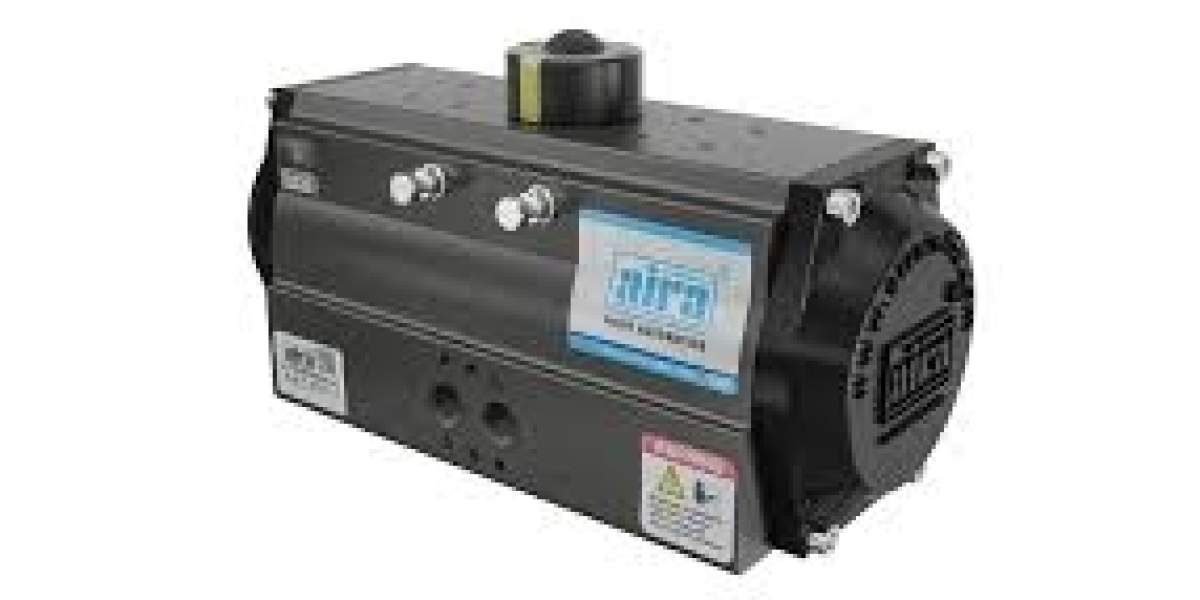

A pneumatic actuator is an important component in modern industrial automation. Companies use it to operate valves, control machinery, and automate mechanical movements with the help of compressed air. Its simple operating principle, reliable performance, and suitability for demanding industrial environments make it a popular choice across different industries.
As businesses look for ways to improve productivity, reduce manual operations, and maintain consistent processes, pneumatic actuators provide a practical solution for controlling industrial equipment.
What Is a Pneumatic Actuator?
A pneumatic actuator is a mechanical device that converts compressed air energy into movement. This movement can be linear or rotary, depending on the actuator's design.
In valve automation, pneumatic actuators are commonly used to open, close, or position valves. They are available in different configurations, including rack-and-pinion and scotch-yoke rotary designs, as well as linear cylinder-based actuators.
The actuator receives compressed air from a pneumatic system. Internal components convert the air pressure into mechanical force, allowing connected equipment to perform its required operation.
Why Do Companies Prefer Pneumatic Actuators?
Companies select pneumatic actuators for several operational advantages.
Reliable Industrial Operation
Pneumatic actuators are designed for repeated operation in industrial environments. When properly selected, installed, and maintained, they can support regular machine cycles and automated processes.
Fast Operating Speed
Many pneumatic actuators provide quick movement, making them suitable for applications that require frequent opening and closing. Their operating speed depends on factors such as air pressure, actuator size, valve design, and air supply capacity.
Simple Construction
Pneumatic actuators generally have a straightforward mechanical design. This can make installation, operation, and maintenance easier when compared with more complex drive arrangements.
Suitable for Certain Hazardous Areas
Pneumatic actuators do not require an electric motor at the actuator itself to generate movement. This can make appropriately selected pneumatic equipment useful in certain hazardous environments. However, the complete installation must meet the relevant area classification and safety requirements.
Easy Integration with Automation Systems
Pneumatic actuators can work with solenoid valves, control panels, sensors, and other automation components. This allows companies to operate equipment through electrical signals and automated control systems.
Common Industrial Applications
Pneumatic actuators are used across several industries where controlled mechanical movement and valve operation are required.
Chemical Processing: Used to automate suitable process valves for controlling compatible liquids and gases.
Water Treatment: Helps operate valves in water distribution, filtration, and treatment systems.
Food and Beverage: Used in suitable automated processing and fluid-handling equipment.
Pharmaceutical Manufacturing: Supports valve automation in process systems where appropriate hygienic and operational requirements are met.
Oil and Gas: Used in selected pipeline and process applications with actuators designed for the required pressure, environment, and safety conditions.
General Manufacturing: Helps automate machinery, material handling equipment, and production processes.
Types of Pneumatic Actuators
Different actuator designs are available to meet specific operating requirements.
Rack and Pinion Actuator: Converts linear piston movement into rotary motion. It is commonly used for quarter-turn valve automation.
Scotch Yoke Actuator: Uses a yoke mechanism to generate rotary torque. It is selected for applications requiring particular torque characteristics.
Linear Pneumatic Actuator: Produces straight-line movement and is commonly used in machinery, clamping equipment, and other automation systems.
The correct type depends on the required movement, operating force, torque, available air pressure, and application.
Factors to Consider Before Choosing a Pneumatic Actuator
Selecting the right actuator helps support safe and efficient equipment operation. Companies should evaluate the following factors:
Required Torque or Force: The actuator must provide sufficient output for the connected equipment.
Operating Air Pressure: Confirm that the available compressed air supply matches the actuator's specifications.
Movement Type: Choose between linear and rotary movement according to the application.
Operating Environment: Consider temperature, moisture, dust, and other environmental conditions.
Control Requirements: Check compatibility with solenoid valves, positioners, and automation systems.
Maintenance Needs: Review service requirements and the availability of replacement components.
Choosing a Suitable Pneumatic Actuator Solution
A reliable actuator solution should match the application's technical requirements rather than being selected on size or price alone. Buyers should review torque specifications, air consumption, operating pressure, mounting arrangements, and safety features before making a decision.
4ma Valves Automation is a name associated with industrial valve solutions. When evaluating actuator options, companies should confirm the product specifications and ensure compatibility with the valves and automation systems being used.
Conclusion
Companies use pneumatic actuators because they provide practical and efficient mechanical movement for industrial automation. Their straightforward construction, fast operation, and compatibility with automated control systems make them useful in manufacturing, water treatment, chemical processing, and many other industries.
By selecting an actuator that meets the required torque, pressure, movement, and environmental conditions, businesses can support dependable valve operation and improve overall process control.









