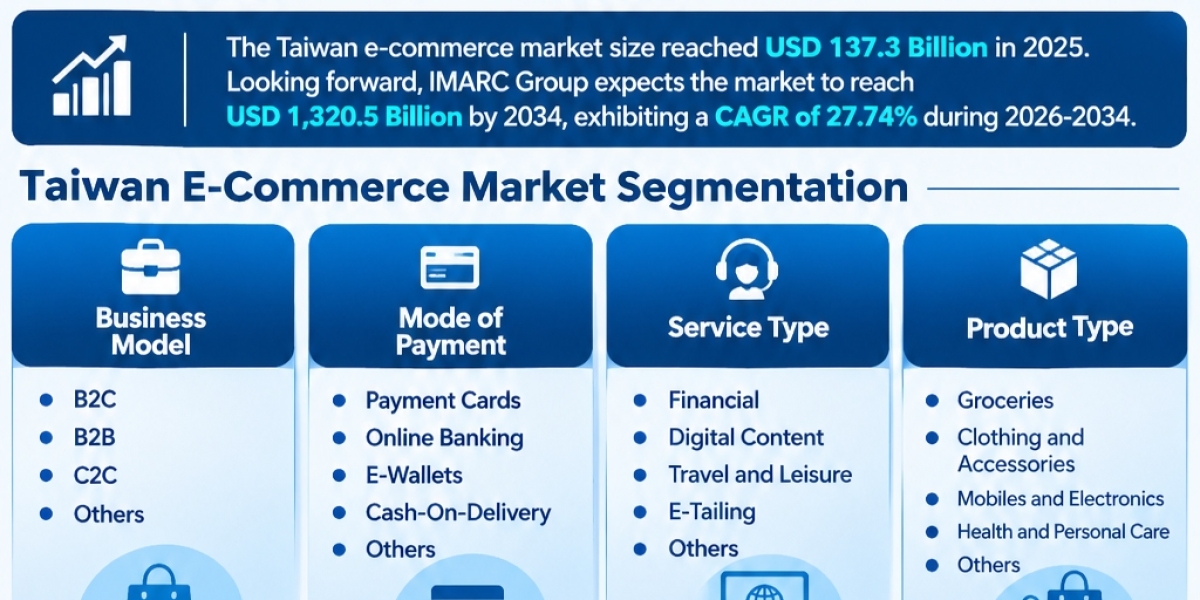

IMARC Group has recently released a new research study titled “Taiwan E-Commerce Market Report by Business Model, Mode of Payment, Service Type, Product Type, and Region, 2026-2034,” offers a detailed analysis of the market drivers, segmentation, growth opportunities, trends and competitive landscape to understand the current and future market scenarios.
Taiwan E-Commerce Market Size, Growth, and Forecast (2026-2034)
The taiwan e-commerce market size reached USD 137.3 Billion in 2025 and is projected to reach USD 1,320.5 Billion by 2034, growing at a CAGR of 27.74% during 2026-2034. Rising demand for sustainable products and strong government support for the digital economy are the primary factors driving the taiwan e-commerce market.
E-commerce refers to buying and selling goods and services over the internet, spanning online retail, digital content, financial services, and travel. It connects consumers and businesses through marketplaces, brand websites, mobile apps, and social platforms.
Strong mobile adoption, digital payments, and convenience store pickup networks are expanding the taiwan advanced connectivity in e-commerce & retail market. Together, they shape taiwan ecommerce market share as platforms compete on convenience, trust, and delivery speed.
Explore Growth Opportunities in the Taiwan E-Commerce Market - Grab Your Sample Report for Evaluation: https://www.imarcgroup.com/taiwan-e-commerce-market
Key Trends Driving the Taiwan E-Commerce Market
- Growing demand for eco-friendly and sustainable products: Shoppers increasingly seek ethically produced goods, pushing brands to adopt sustainable materials, packaging, and processes. In 2024, Rakuten Rakuma launched a second-hand luxury fashion collection in Taiwan with Bibian and the FamilyMart app, tapping rising demand for reused fashion.
- Government support and digital economy initiatives: Digital literacy programs, tax incentives, e-payment improvements, and wider internet access are helping businesses of all sizes go online. In 2025, MODA required platforms such as Line and TikTok to publish anti-fraud transparency reports, strengthening user trust.
- Connected payments and convenience store logistics: E-wallets, card cashback programs, and store pickup networks make online shopping seamless. Most e-commerce deliveries in Taiwan are picked up in stores, which keeps convenience chains central to the ecosystem.
Taiwan E-Commerce Market Report Segmentation:
The Taiwan E-Commerce Market report provides a detailed segmentation analysis to help businesses identify key growth segments and evolving industry dynamics. The market is categorized based on business model, mode of payment, service type, product type, and region, offering comprehensive insights across the taiwan e-commerce market.
Business Model Insights:
- B2C: Business-to-consumer platforms sell directly to shoppers and form the most visible part of online retail.
- B2B: Business-to-business commerce covers online trade between companies, suppliers, and distributors.
- C2C: Consumer-to-consumer marketplaces enable peer-to-peer and second-hand sales.
- Others: Other models complete the picture of how transactions are conducted online.
Mode of Payment Insights:
- Payment Cards: Credit and debit cards remain a core online payment method, supported by cashback offers such as the JCB Panda Card.
- Online Banking: Online banking supports direct, secure transfers for e-commerce purchases.
- E-Wallets: E-wallets such as Line Pay and JKO Pay are gaining traction through app-based convenience and rewards.
- Cash-On-Delivery: Cash-on-delivery serves shoppers who prefer to pay at pickup or on receipt.
- Others: Other payment methods round out the checkout options available to online buyers.
Service Type Insights:
- Financial: Financial services such as online payments and card offers are increasingly linked to e-commerce ecosystems.
- Digital Content: Digital content includes online media, games, and downloadable products.
- Travel and Leisure: Travel and leisure covers online bookings for transport, accommodation, and entertainment.
- E-Tailing: E-tailing covers online retail of physical goods across marketplaces and brand stores.
- Others: Other service types complete the market’s service mix.
Product Type Insights:
- Groceries: Groceries are supported by demand for quick delivery of household necessities.
- Clothing and Accessories: Fashion benefits from second-hand and circular offerings alongside new collections.
- Mobiles and Electronics: Electronics buyers value spec comparison, trusted sellers, and reliable after-sales service.
- Health and Personal Care: Health and personal care products are a steady category for repeat online purchases.
- Others: Other product categories complete the market’s product mix.
Regional Insights:
- Northern Taiwan: Northern Taiwan is analyzed as a major regional market in the report.
- Central Taiwan: Central Taiwan is covered as a distinct regional e-commerce market.
- Southern Taiwan: Southern Taiwan is assessed alongside the other major regions.
- Eastern Taiwan: Eastern Taiwan is included to complete the national regional picture.
Taiwan E-Commerce Market: Recent News and Developments
- January 2025: JCB and Taiwan Rakuten Card launched the JCB Panda Card, offering up to 3% cashback in Taiwan via Line Pay and JKO Pay, which expands Rakuten’s e-commerce-linked financial services.
- September 2026: Coupang was reported to be turning to Taiwan as a key hub for global growth, with its Taiwan unit registering more than 1,100 patents in AI, logistics, and commerce since entering the market.
Challenges Impacting the Taiwan E-Commerce Market
Competition among major platforms is intensifying, and rising costs for advertising, vouchers, and free shipping are putting pressure on growth and margins.
Online fraud remains a concern, and regulators are asking platforms to publish anti-fraud transparency reports and verify prevention plans, which adds compliance work.
Investment Opportunities in the Taiwan E-Commerce Market
The taiwan e-commerce market presents compelling investment opportunities supported by its projected growth from USD 137.3 Billion in 2025 to USD 1,320.5 Billion by 2034. Sustainable and second-hand commerce is a differentiating niche as consumer awareness grows.
Digital payments, convenience store logistics, and cross-border shopping services are also attractive areas. Players that strengthen the taiwan advanced connectivity in e-commerce & retail market, through connected payments and fulfillment, can build lasting customer loyalty.
Outlook of the Taiwan E-Commerce Market (2026-2034)
The outlook for the taiwan e-commerce market is positive, supported by sustainability demand, government digital initiatives, and growing connected retail. The market is projected to grow from USD 137.3 Billion in 2025 to USD 1,320.5 Billion by 2034 at a CAGR of 27.74%.
Eco-conscious shopping, expanding digital payments, and convenience-driven logistics will be the defining trends shaping the taiwan e-commerce market through 2034.
Key Players in the Taiwan E-Commerce Market
The taiwan e-commerce market is highly competitive, with domestic and global platforms competing on price, delivery speed, and customer trust. Shopee, momo, and PChome are widely seen as the leading B2C platforms.
- Shopee Taiwan: Shopee is one of Taiwan’s top e-commerce platforms, known for its massive user base, active promotional campaigns, and built-in marketing tools that help sellers attract customers.
- momo (Fubon Multimedia): Backed by Fubon Group, momo is a major platform that leads in lifestyle goods and combines TV commerce with online retail and aggressive promotions.
Frequently Asked Questions (FAQs): Taiwan E-Commerce Market
1. What is the current taiwan e-commerce market size?
The taiwan e-commerce market size reached USD 137.3 Billion in 2025 and is projected to reach USD 1,320.5 Billion by 2034, growing at a CAGR of 27.74% during 2026-2034.
2. What is e-commerce?
E-commerce is the buying and selling of goods and services online, including retail, digital content, financial services, and travel.
3. What are the key drivers of the taiwan e-commerce market?
Key drivers include demand for eco-friendly products and government support through digital literacy, tax incentives, e-payment improvements, and infrastructure upgrades.
4. What influences taiwan ecommerce market share?
Taiwan ecommerce market share is shaped by platform trust, pricing, delivery speed, payment convenience, and logistics reach, including convenience store pickup.
5. How does connectivity shape the taiwan advanced connectivity in e-commerce & retail market?
Mobile apps, e-wallets, and store pickup networks link online and offline retail, making shopping faster and more convenient for consumers.
6. Who are the key players in the taiwan e-commerce market?
Key players include Shopee Taiwan, momo, PChome, and Coupang, among other domestic and global platforms.
Author IMARC Group
IMARC Group is a global management consulting firm that helps the world's most ambitious changemakers to create a lasting impact. The company provide a comprehensive suite of market entry and expansion services. IMARC offerings include thorough market assessment, feasibility studies, company incorporation assistance, factory setup support, regulatory approvals and licensing navigation, branding, marketing and sales strategies, competitive landscape and benchmarking analyses, pricing and cost research, and procurement research.
Contact Us
IMARC Group,
134 N 4th St. Brooklyn, NY 11249, USA,
Email: sales@imarcgroup.com,
United States: +1-201971-6302