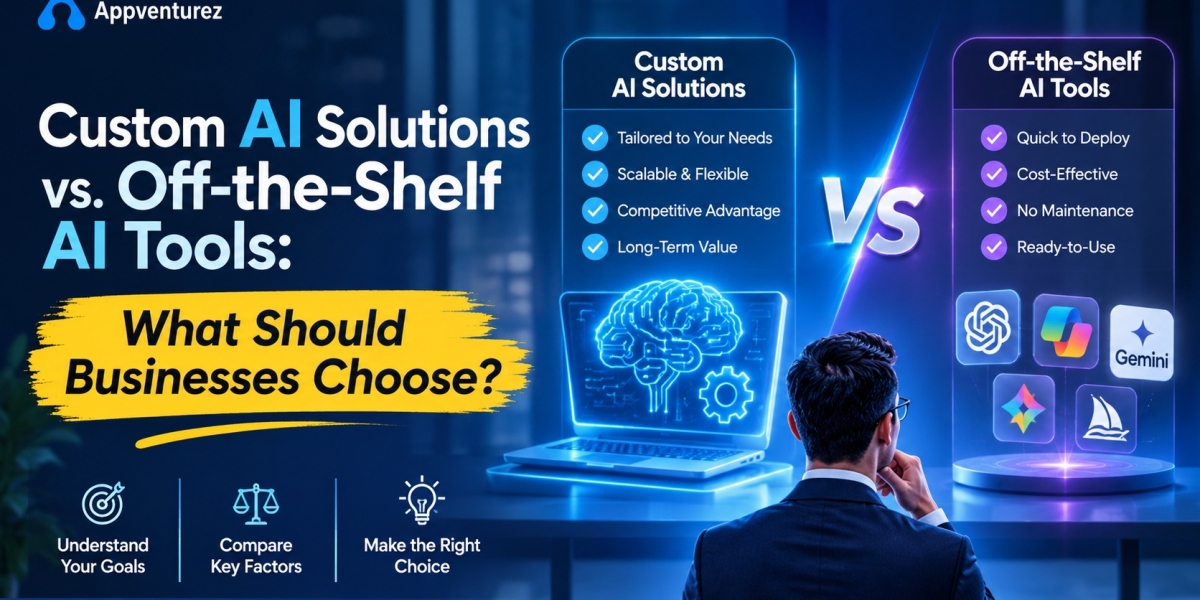

Off-the-shelf AI tools are ready-made products built for a broad market and offered as subscriptions or licenses. You sign up, configure some settings, and start using them. Examples of categories include:
General-purpose AI assistants and chatbots
AI writing and content tools
Meeting transcription and summarization tools
AI features embedded in CRM, help desk, and productivity software
Image, video, and design generators
Prebuilt analytics and forecasting tools
Plug-and-play customer support bots
Strengths
Fast start. Often live in hours or days
Low entry cost. Predictable monthly pricing
No technical build. The vendor handles models, hosting, and updates
Proven for common tasks. Large user bases and polished interfaces
Frequent improvement. The vendor continuously upgrades features
Limitations
Limited adaptation to your specific data, terminology, and processes
Less control over how data is stored, used, and protected
Shallow integration with your internal systems
Pricing that grows with users or usage
Dependence on the vendor’s roadmap, pricing, and continued existence
Little competitive differentiation, since competitors can buy the same tool
What Are Custom AI Solutions?
Custom AI solutions are AI systems designed and built for one organization. They are shaped around its data, workflows, systems, security rules, and business goals. A custom solution may use commercial or open-source models under the hood, but the surrounding system is tailored.
Examples include:
A RAG-based assistant that answers questions from your internal documents with permission-aware access
An AI agent that processes claims across your insurance systems
A recommendation engine trained on your customer behavior
A computer vision system that inspects your specific products
A forecasting model tuned to your supply chain
A fine-tuned language model that speaks your industry’s terminology
An AI-powered mobile app that serves your customers or field teams
Strengths
Fit. Built around your processes and data
Accuracy. Tuned and tested on your real cases
Integration. Connects deeply with CRM, ERP, and internal systems
Control. You decide where data lives and how it is used
Differentiation. Capabilities competitors cannot simply subscribe to
Ownership. Code, workflows, and tuned assets belong to you
Limitations
Higher upfront cost
Longer time to first value
Need for skilled partners or in-house talent
Responsibility for monitoring, maintenance, and improvement
Delivery risk if requirements or partner selection are poor
Custom AI vs. Off-the-Shelf AI: The Key Questions
Instead of a table, it helps to work through the questions that actually decide the outcome.
Which Is Faster to Start?
Off-the-shelf wins. If you need results this month, a ready-made tool is the pragmatic choice. A custom solution typically needs discovery, data preparation, prototyping, integration, and testing, which means weeks for a proof of concept and months for production.
Which Costs Less?
It depends on the time horizon. Off-the-shelf tools cost less at the start. Over several years, however, per-seat fees, usage charges, premium tiers, integration consultants, and workarounds can add up. Custom AI costs more upfront but can become more economical for high-volume or core use cases because you control infrastructure and avoid escalating licensing.
Which Is More Accurate for My Business?
Custom usually wins on business-specific tasks. A generic tool knows general information, not your product catalog, contracts, policies, or customers. A custom system grounded in your data through RAG, fine-tuning, or purpose-built models tends to give more relevant and verifiable results.
Which Is Better for Data Privacy and Security?
Custom gives more control. You can choose hosting, encryption, access rules, retention, and whether data ever leaves your environment. Off-the-shelf tools vary: some offer strong enterprise controls, while others use inputs in ways that conflict with your policies. Always read data-handling terms carefully either way.
Which Integrates Better?
Custom is stronger when you rely on multiple internal systems. Off-the-shelf tools offer standard connectors, which work for common setups but may not handle your specific workflows or legacy systems.
Which Scales Better?
Both can scale, but differently. Off-the-shelf tools scale easily in users but may become costly or constrained. Custom systems scale according to the architecture you choose, with cost and performance under your control.
Which Creates Competitive Advantage?
Custom. If everyone uses the same tool, you gain efficiency but no differentiation. Proprietary AI capabilities built on your unique data and processes are difficult to copy.
Which Is Less Risky?
The risks differ. Off-the-shelf risks include vendor lock-in, price increases, policy changes, and product discontinuation. Custom risks include delivery failure, cost overrun, and maintenance burden. Phased development, strong partner selection, and clear contracts reduce custom risks substantially.
Which Is Easier to Maintain?
Off-the-shelf, because the vendor handles updates. Custom solutions need monitoring, retraining, prompt and knowledge updates, and security patches, which should be planned from the start.
The Hidden Costs on Both Sides
A fair comparison counts costs that rarely appear in a proposal.
Hidden costs of off-the-shelf AI tools
Per-seat and usage growth. Pricing that seems small for ten users becomes significant for a thousand.
Premium tiers. Features you need, such as single sign-on, audit logs, or higher limits, often sit in expensive plans.
Integration work. Connecting the tool to your systems may require consultants or custom code anyway.
Workarounds. Staff compensate for missing features with manual steps.
Shadow AI. Employees adopt unapproved tools, creating security and compliance exposure.
Switching cost. Moving away later means migrating data and retraining people.
Hidden costs of custom AI solutions
Data preparation. Cleaning and organizing knowledge often takes more effort than the model work.
Evaluation and testing. Building reliable test sets and review processes takes real time.
Model and infrastructure usage. Inference, hosting, and monitoring continue after launch.
Maintenance. Prompts, knowledge, integrations, and models need regular updates.
Governance. Security reviews, documentation, and compliance work add effort.
Talent. You need engineers, data specialists, and product owners, in-house or through a partner.
When both lists are counted honestly, the gap between the two options is usually smaller than the sticker prices suggest, and the better choice depends on the use case.
When Off-the-Shelf AI Tools Are the Right Choice
Buy when the need is common and speed matters more than perfect fit. Good candidates include:
General productivity. Drafting emails, summarizing meetings, brainstorming, and basic research
Standard content creation. Marketing copy, social posts, and image generation where brand risk is low
Commodity functions. Transcription, translation, spell-checking, and scheduling
Early experimentation. Testing whether AI helps a workflow before investing in a build
Small teams and tight budgets. When there is no capacity to maintain a custom system
Non-sensitive data. Tasks that do not involve confidential, regulated, or proprietary information
AI features already built into software you own. CRM, help desk, or design tools often include useful capabilities at no extra build cost
In these cases, building from scratch is often wasteful.
When Custom AI Solutions Are the Smarter Investment
Build when AI is central to your product, your operations, or your competitive position. Strong indicators include:
Proprietary data advantage. You have unique data, such as transaction histories, sensor streams, or domain documents, that can power better predictions
Core business processes. AI touches revenue, risk, or customer experience at scale
Strict security or compliance requirements. Healthcare, finance, legal, government, and defense often demand tight control
Deep integration needs. The AI must read and write across several internal systems
High volume. Large usage makes per-call or per-seat pricing expensive
Specialized domain language. Your industry has terminology and rules generic models handle poorly
Differentiation goals. You want capabilities competitors cannot simply buy
Customer-facing intelligence. AI features are part of your product, not only your back office
Edge or offline needs. Devices must run AI locally or without constant connectivity
The Middle Path: Hybrid and Configurable AI
The choice is rarely all or nothing. Many organizations succeed with a spectrum of approaches.
Level 1: Use off-the-shelf tools as they are. Fast and cheap for common tasks.
Level 2: Configure and extend commercial platforms. Use APIs, plugins, and workflow builders to adapt a product to your needs.
Level 3: Build on foundation models. Use hosted or open-source models with your own prompts, retrieval, tools, and interface. This is where most custom business AI sits today.
Level 4: Fine-tune or train specialized models. Justified when you need higher accuracy, lower cost at scale, domain-specific behavior, or on-premises deployment.
Level 5: Build proprietary models and systems. Rare and expensive, usually reserved for AI-native companies or highly specialized problems.
A sensible strategy is to start at the lowest level that meets your needs and move up only when evidence shows the extra investment pays off.
How Custom AI Is Actually Built
Understanding the process helps you judge effort and cost.
Discovery and use-case selection. Identify a measurable problem, assess data readiness, and define success metrics.
Data preparation. Collect, clean, structure, and secure the information the AI will use.
Architecture and model selection. Choose among hosted models, open-weight models such as LLaMA, retrieval-augmented generation, fine-tuning, or classical machine learning.
Prototype. Build a narrow working version and test it on real cases.
Guardrails and security. Add access control, input and output checks, and limited tool permissions.
Evaluation. Measure accuracy, groundedness, safety, latency, and cost against real examples.
Integration. Connect to CRM, ERP, ticketing, data platforms, and user channels.
Deployment. Release in stages, starting with a small group.
Monitoring and improvement. Track quality and cost, refresh knowledge, and iterate.
Technologies commonly involved include Python, TensorFlow, PyTorch, Hugging Face, LangChain, LlamaIndex, vector databases, cloud platforms such as AWS, Microsoft Azure, and Google Cloud, Kubernetes, and MLOps tools such as MLflow.
Delivering AI Through Mobile Apps
Whether you buy or build, AI creates value only when people can use it where they work. For customers, field teams, and mobile-first markets, that usually means a mobile app. A tailored mobile front-end can turn an AI model into an everyday product with notifications, camera input, voice, location awareness, and offline support.
This is another place where the custom-versus-ready-made question appears. Template app builders and generic AI apps are quick, but they limit design, integration, and data control. Businesses with serious mobile plans typically work with a specialist development partner.
Why Android Matters
Android is the dominant mobile platform in many markets, including India and much of Asia, Africa, and Latin America. If your customers or field workers are on Android, a native app lets you use the full capabilities of their devices and deliver a smooth AI experience.
An experienced Android app development company can build AI-powered features such as chat assistants, voice commands, on-device machine learning, image recognition, personalization, and smart notifications. When comparing providers, businesses often search for the best Android app development company, a top Android app development company, or the top Android app development companies, but rankings should be the start of research, not the end.
Look for the following in an Android application development company:
Relevant portfolio. Live apps on Google Play with real ratings, ideally with AI or data-driven features
Technical depth. Kotlin, Java, Jetpack Compose, clean architecture, REST and GraphQL APIs, Firebase, and cloud integration
AI integration skill. Experience connecting apps to LLM backends, using on-device models, and handling latency and offline cases
Design quality. Material Design expertise and user-centered thinking
Testing rigor. Coverage across many devices, screen sizes, and Android versions
Security. Secure storage, authentication, encryption, and safe handling of AI requests
Post-launch support. Updates for new Android releases, monitoring, and continuous improvement
Custom Android App Development Services typically include discovery, UI/UX design, native or cross-platform development, backend and API work, AI feature integration, testing, Google Play release, and maintenance. Many global businesses hire an Android app development company in India or an Android app development agency in India for strong engineering talent and competitive pricing, and an Android mobile app development company with proven AI delivery experience can shorten the path from idea to launch. If you want a tailor-made product instead of a template, look specifically for Custom Android App Development Services, and compare an Android App Development Agency on process transparency, references, and long-term support.
Why Cross-Platform Development Is Often the Smart Choice for AI Apps
Most businesses need their AI experience on both Android and iPhone. Building two fully separate native apps doubles cost and effort. Cross-platform development uses frameworks such as Flutter and React Native to build one codebase that runs on both platforms, with native performance and device access in most cases.
Benefits of cross-platform AI apps
Lower cost. One team and one codebase instead of two
Faster launch. Features ship to both platforms at once
Consistent experience. Matching design and behavior across devices
Easier maintenance. Fixes and updates apply once
Backend reuse. The same AI and API layer serves both apps
Good fit for MVPs. Test the idea on both platforms quickly
Trade-offs to consider
Very demanding graphics or deep platform-specific features may still favor native development
Some on-device AI capabilities rely on platform-specific libraries, which require native bridging
Framework updates and plugin quality need active management
How to choose a cross-platform partner
A strong cross-platform app development company should show real Flutter or React Native apps in production, backend and AI integration experience, strong testing, and a clear plan for performance and updates. When searching, you may see phrases such as cross-platform app development company in India, cross-platform app development services, top cross-platform app development company, best cross-platform app development company, or top cross-platform app development companies. Use them to build a shortlist, then verify with case studies, references, and a pilot.
If you need ongoing capacity, you can hire cross-platform app developers as a dedicated team that works under your product roadmap, or engage a cross-platform app development agency for end-to-end delivery. Reputable cross-platform mobile app development services will cover discovery, design, development, QA, deployment to both app stores, and post-launch support. India is a popular source for this work because of its large pool of Flutter and React Native engineers and cost advantages, which is why many businesses compare a cross-platform app development company in India with local alternatives.
Native or cross-platform for AI features?
Choose cross-platform when you need both platforms quickly, have a limited budget, and mostly rely on cloud-based AI. Choose native Android, or native iOS, when you need maximum performance, heavy on-device AI, advanced hardware access, or platform-specific experiences. Many teams start cross-platform for speed and add native modules where required.
A Practical Decision Framework
Work through these questions with your team. The more answers point to the right-hand side, the stronger the case for custom AI.
1. Is this a commodity task or a differentiator? Commodity points to buying. Differentiator points to building.
2. How sensitive is the data? Public or low-risk data suits off-the-shelf. Confidential, regulated, or proprietary data favors custom or private deployment.
3. How unique are our processes and terminology? Standard processes fit ready-made tools. Unusual ones need customization.
4. How deeply must it integrate with our systems? Light integration is fine for tools. Deep, multi-system integration favors custom.
5. What is the expected scale and volume? Small volume favors buying. High volume often makes custom cheaper.
6. How fast do we need results? Urgent needs favor off-the-shelf as a first step.
7. Do we have the skills to maintain it? If not, plan for a partner or choose a managed product.
8. What is the three-to-five-year cost? Compare licenses, usage, integration, and workarounds with build and maintenance costs.
9. How important is control and ownership? High importance favors custom.
10. Can we start small? If yes, pilot a ready-made tool or a narrow custom prototype and decide with evidence.
Security, Privacy, and Governance Considerations
Whichever path you choose, apply the same discipline.
Know where data goes. Understand what is sent to external services, how long it is kept, and whether it is used for training.
Apply access control. AI should never expose information to people who are not allowed to see it.
Defend against prompt injection. Treat content from emails, web pages, and documents as untrusted data.
Limit permissions. Give AI tools and agents only the access they need.
Keep humans in the loop for high-stakes decisions.
Log and audit. Maintain records of usage and decisions.
Comply with laws. Align with applicable regulations such as GDPR, India’s DPDP Act, HIPAA, and PCI DSS.
Set an AI policy. Define approved tools, acceptable use, and review processes so shadow AI does not grow unchecked.
Illustrative Scenarios
The following are hypothetical examples, not client case studies.
Scenario 1: A small marketing agency. The team needs faster copy drafts and meeting summaries. Off-the-shelf tools cover the need within days at low cost. Building custom AI would be wasteful.
Scenario 2: A mid-sized insurer. Claims handling is slow, data is sensitive, and the process spans three internal systems. A custom AI agent with document intelligence and strict access control delivers measurable time savings and keeps data in a controlled environment.
Scenario 3: A retail chain with a loyalty app. A generic recommendation plugin gives mediocre results. A custom recommendation engine trained on purchase history, delivered through a cross-platform mobile app, improves repeat purchases and reaches both Android and iPhone users from one codebase.
Scenario 4: A field-service company. Technicians need instant answers from equipment manuals, often offline. A custom RAG assistant with an Android-first app and cached knowledge supports them in low-connectivity sites.
Scenario 5: A growing SaaS startup. The team starts with an off-the-shelf support bot, learns which questions matter most, and later replaces it with a custom assistant integrated into its product and billing systems.
Common Mistakes to Avoid
Choosing a tool before defining the problem. Technology should follow the use case.
Assuming custom is always better, or always too expensive. Both are false in general.
Ignoring data quality. Poor data hurts both bought and built AI.
Skipping a pilot. Evidence beats assumptions.
Overlooking data-handling terms in vendor contracts.
Underestimating integration effort with either approach.
Neglecting change management. Adoption depends on training and trust.
Forgetting mobile. Many users will reach your AI through phones.
Locking into one vendor with no exit plan.
Treating launch as the end. Monitoring and improvement determine long-term value.
Choosing a Custom AI Development Partner
If you decide to build, the partner matters as much as the technology. Evaluate candidates on:
Production AI experience, not just demos
Engineering depth in integration, security, cloud, and MLOps
Evaluation discipline and a clear approach to measuring quality
Domain knowledge relevant to your industry
Full-stack delivery, including web and mobile, Android and cross-platform where needed
Transparent process and pricing, with phased milestones
Security and compliance practices
Client references and case studies
Post-launch support and improvement plans
Clear ownership of code, prompts, models, and data
Begin with a paid discovery phase or a narrow pilot to see how the team works before committing to a larger program.
Trends Shaping the Build-Versus-Buy Decision in 2026
Foundation models are becoming commodities. Access to capable models is easier and cheaper, shifting differentiation to data, workflows, and integration.
Off-the-shelf tools are getting more configurable. Platforms add agents, connectors, and custom instructions, narrowing the gap for simple cases.
Agentic AI raises the stakes. As AI takes actions, not just answers, control, permissions, and governance matter more.
Smaller, specialized models. Compact models make custom and on-device AI more affordable.
Regulation and governance. Privacy laws and AI policies push companies toward stronger control over data and auditability.
Mobile-first AI. Users increasingly expect AI inside apps they use daily, increasing demand for Android, iOS, and cross-platform development.
Hybrid becomes the norm. Most mature organizations combine bought tools with custom AI for strategic use cases.
Frequently Asked Questions
What is the difference between custom AI and off-the-shelf AI tools?
Off-the-shelf tools are ready-made products for a broad audience, quick to adopt but limited in customization. Custom AI solutions are built for a specific organization, using its data, workflows, and systems, offering better fit and control at higher upfront cost.
Is custom AI more expensive than off-the-shelf tools?
Upfront, yes. Over several years, custom AI can be more economical for high-volume or core use cases, while off-the-shelf tools often remain cheaper for simple, low-volume needs.
Can small businesses afford custom AI?
Often yes, through phased projects, focused prototypes, and cost-effective development partners. Many small businesses begin with off-the-shelf tools and build custom AI only for their most valuable use cases.
How long does it take to build a custom AI solution?
A proof of concept may take four to eight weeks. A production system with integrations, security, and monitoring usually takes several months.
Is a hybrid approach better?
For most organizations, yes. Use ready-made tools for common tasks and custom AI where differentiation, control, or integration matter most.
How do I protect my data when using AI tools?
Review data-handling and retention terms, choose enterprise plans with proper controls, avoid sending sensitive data to unapproved tools, apply access control, and consider private or on-premises deployment for highly sensitive use cases.
Do I need a mobile app for my AI solution?
Not always, but a mobile app is valuable when customers or employees work on the go, or need notifications, camera, voice, and offline features. An Android app development company or a cross-platform team can build one that connects securely to your AI backend.
Should I choose native Android or cross-platform?
Choose cross-platform for speed, budget, and reaching Android and iPhone users together. Choose native when you need maximum performance, heavy on-device AI, or deep platform-specific features.
How do I choose the best Android or cross-platform development partner?
Review live apps and ratings, check technical skills and AI integration experience, speak to past clients, confirm testing and security practices, compare transparent pricing, and begin with a discovery phase or pilot.
Who owns a custom AI solution?
You should, if the contract says so. Make sure it covers source code, prompts, configurations, and any fine-tuned models or datasets created for you.
Conclusion
The question is not whether custom AI beats off-the-shelf tools in general. It is which approach fits each use case. Ready-made tools are excellent for common tasks, quick experiments, and low-risk work. Custom AI is the stronger choice when your data is unique, your processes differ from the norm, security and integration matter, and AI is part of your competitive advantage.
For most businesses, the best answer is a hybrid strategy: buy what is commodity, build what differentiates, and revisit the balance as tools and needs evolve. Start with a clear problem, pilot before committing, count the full cost over several years, and protect your data throughout. And remember that the value of AI is realized in the hands of users, so plan the delivery channel early, whether that means a web platform, a native Android app, or a cross-platform mobile experience built by a capable development partner.
Choose deliberately, measure honestly, and invest where AI can make your business genuinely different.