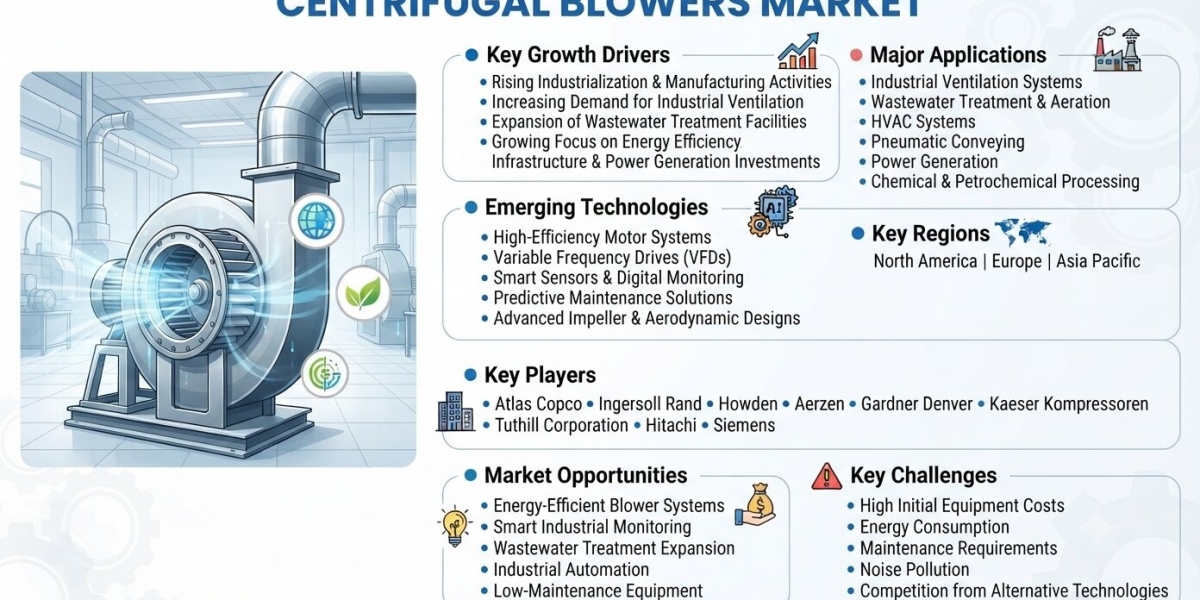

According to Transpire Insight, the Centrifugal Blowers Market size is estimated at USD 3.4 Billion in 2026 and is anticipated to reach USD 4.8 Billion by 2033, growing at a CAGR of 5.05 % from 2026 to 2033. The growth will be fueled by increasing industrialization, rising demand for efficient ventilation systems, expansion of wastewater treatment facilities, and the growing need for energy-efficient air handling solutions.
The market is expected to benefit from increasing investments in industrial infrastructure, manufacturing facilities, and power generation projects. Improvements in blower efficiency, advanced impeller designs, variable frequency drives, and smart monitoring technologies are also creating new opportunities for manufacturers.
Why the Centrifugal Blowers Market Is Influencing the Industrial Equipment Industry
The growing need for reliable ventilation and air handling systems is influencing the adoption of centrifugal blowers across industrial facilities. These systems help maintain airflow, support combustion processes, remove dust and fumes, and improve ventilation in production environments. Their applications across industries make them an important component of industrial infrastructure.
Furthermore, increasing investment in wastewater treatment, power generation, and manufacturing facilities is supporting demand for efficient air-moving equipment. Industries are also focusing on reducing energy consumption and improving equipment performance, encouraging the adoption of advanced centrifugal blower systems.
Read more: https://www.transpireinsight.com/report/centrifugal-blowers-market
Key Factors Supporting Centrifugal Blowers Market Growth
Rising Industrialization and Infrastructure Development
The expansion of manufacturing, chemical processing, power generation, and construction activities is increasing the need for industrial air handling equipment. Centrifugal blowers support ventilation, cooling, combustion, and process air requirements. Growing investments in industrial infrastructure are therefore creating additional demand across multiple sectors.
Increasing Focus on Energy Efficiency
Energy consumption is an important consideration for industrial operators. Businesses are increasingly looking for equipment that delivers reliable airflow while minimizing operating costs. High-efficiency motors, optimized impeller designs, and variable frequency drives help improve blower performance and reduce unnecessary energy consumption.
Growing Demand for Wastewater Treatment and Environmental Management
Wastewater treatment facilities use centrifugal blowers to supply air during biological treatment processes. Increasing attention to water quality, pollution control, and industrial wastewater management is supporting demand for aeration equipment. Industrial ventilation and dust-control requirements are also contributing to market expansion.
Key Players in the Centrifugal Blowers Market
Atlas Copco
Ingersoll Rand
Howden
Aerzen
Gardner Denver
Kaeser Kompressoren
Tuthill Corporation
Hitachi
Siemens
Continental Industrie
Segmentation of the Centrifugal Blowers Market
Product Type
Single-Stage Centrifugal Blowers
Multi-Stage Centrifugal Blowers
Pressure
Low Pressure
Medium Pressure
High Pressure
Application
Industrial Ventilation
Wastewater Treatment
HVAC Systems
Pneumatic Conveying
Power Generation
Chemical Processing
End User
Manufacturing
Water and Wastewater Treatment
Power and Energy
Chemicals and Petrochemicals
Food and Beverage
Mining and Construction
How Technological and Industry Developments Are Changing Demand
Advancements in Blower Design and Motor Efficiency
Manufacturers are improving impeller designs, aerodynamic performance, and motor technologies to deliver better airflow and operational efficiency. These developments help reduce energy consumption, noise, and maintenance requirements while supporting reliable performance in demanding industrial environments.
Automation and Smart Monitoring
The integration of sensors, variable frequency drives, and digital monitoring systems is improving blower operation and maintenance. These technologies help operators monitor performance, identify potential equipment issues, and adjust airflow according to changing process requirements. Predictive maintenance capabilities can also reduce unexpected downtime.
Regional Patterns and Emerging Demand in the Centrifugal Blowers Market
North America remains an important market due to its established industrial base, investments in wastewater treatment, and demand for efficient ventilation systems. Europe also presents opportunities through industrial modernization, energy-efficiency initiatives, and environmental regulations.
Meanwhile, Asia-Pacific is emerging as a significant growth region, supported by rapid industrialization, manufacturing expansion, infrastructure investments, and growing wastewater treatment requirements. Regional differences in industrial development, energy costs, and environmental standards continue to influence purchasing decisions and product demand.
Challenges Companies Need to Consider in the Centrifugal Blowers Industry
Despite favorable growth opportunities, the industry faces challenges related to high initial equipment costs, energy consumption, and maintenance requirements. Industrial operators must select suitable blower configurations based on airflow, pressure, operating conditions, and application requirements.
Additionally, competition from alternative air-moving technologies, noise concerns, and the need for skilled maintenance personnel can influence adoption. Manufacturers must also maintain product reliability and meet changing energy-efficiency and environmental standards.
Future Opportunities in the Centrifugal Blowers Market
The market offers opportunities through the development of energy-efficient blowers, advanced motor systems, and digitally connected equipment. Growing investments in wastewater treatment, industrial automation, and infrastructure modernization are expected to support demand.
Manufacturers can also explore compact blower designs, low-maintenance systems, and customized solutions for specialized industrial applications. Partnerships with industrial operators and investments in research and development may help companies improve product performance and expand their market presence.
What This Means for the Centrifugal Blowers Industry
The expansion of the Centrifugal Blowers Market highlights the growing importance of efficient air movement and industrial ventilation across multiple sectors. As manufacturing, wastewater treatment, and infrastructure activities continue to develop, demand for reliable and energy-efficient blower systems is expected to create opportunities for equipment manufacturers. Companies investing in advanced designs, automation, energy efficiency, and after-sales services will be better positioned to address changing industrial requirements. Going forward, monitoring technological developments, environmental standards, and industrial investment trends will be essential for stakeholders aiming to remain competitive in the evolving centrifugal blowers industry.
Latest Reports:
https://in.pinterest.com/pin/1083819466608251121/
https://in.pinterest.com/pin/1083819466608208476/
https://in.pinterest.com/pin/1083819466608124660/
https://in.pinterest.com/pin/1083819466608093791/
https://www.quora.com/What-is-the-difference-between-Nutanix-and-VMware/answer/Devashish-217
https://www.quora.com/What-are-the-benefits-brought-by-the-railways/answer/Devashish-217