
Every time a user visits your website, submits a form, or makes an API request, they leave behind an IP address. But not all IP addresses are what they seem. Some are spoofed, masked behind proxies, or generated by bots. If you are building a web application, security tool, or analytics platform, knowing how to programmatically verify whether an IP address is real is a critical skill. One of the most effective and developer-friendly ways to do this is by using a free geolocation API JSON response to cross-reference IP data against known databases and behavioral patterns. In this guide, we will walk you through everything you need to know, from the basics of IP validation to using modern APIs that make the process simple and reliable.
What Does It Mean for an IP Address to Be "Real"?
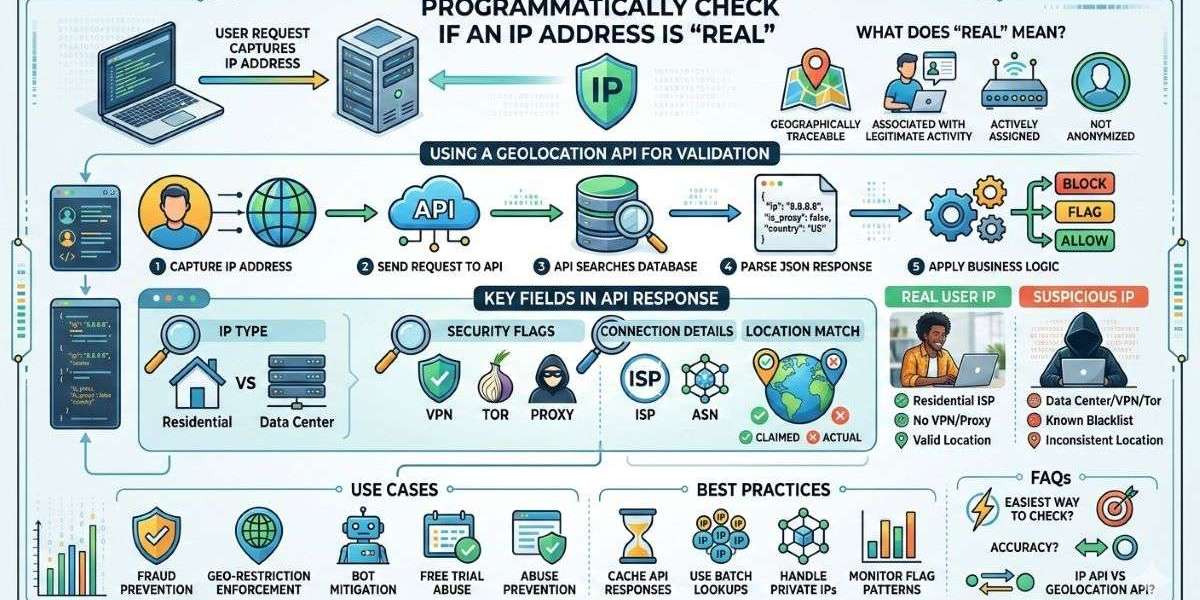
Before diving into the technical side, it is important to understand what makes an IP address "real" in the first place. A real IP address is one that is actively assigned, geographically traceable, and associated with legitimate internet activity. On the other hand, an IP might be considered fake or problematic if it belongs to a VPN, Tor exit node, data center proxy, or if it has been spoofed entirely. When developers talk about checking if an IP is real, they are typically asking whether the address belongs to a genuine end user rather than an automated system or anonymizing service. This is where an ip geolocation API becomes incredibly useful, as it provides metadata about the IP that helps you determine its legitimacy.
Here are some common signs that an IP address may not be real or trustworthy:
- It belongs to a known VPN or proxy service provider
- It originates from a data center rather than a residential ISP
- It is listed on public blacklists or abuse databases
- Its geolocation is inconsistent with the user's claimed location
- It is a Tor exit node used to anonymize browsing traffic
Why Validating IP Addresses Programmatically Matters
IP address validation has real-world consequences for your application. Fraudsters often hide behind fake or rotating IPs to bypass rate limits, commit payment fraud, or scrape data. Without proper IP validation, your system is vulnerable to abuse. A reliable validate IP address API helps you detect suspicious activity in real time, enabling you to block bad actors before they cause harm. According to industry research, over 40% of all internet traffic in 2023 was generated by bots, and a significant portion of that traffic used masked or illegitimate IP addresses. For businesses running e-commerce platforms, SaaS tools, or content platforms, this represents a significant risk that programmatic IP validation can help mitigate.
How an IP Geolocation API Works
An ip location API works by accepting an IP address as input and returning structured data about it. This data typically includes the country, region, city, latitude, longitude, ISP (Internet Service Provider), and additional flags such as whether the IP belongs to a proxy, VPN, or Tor network. When you make a request to a geolocation IP API, the service queries its database of IP ranges and associated metadata, then returns a JSON response you can use in your application logic. For example, if the API response shows the IP is registered to a known data center and has no associated residential ISP, that is a strong signal that the IP might not belong to a real user. Services like IPstack provide exactly this kind of detailed, actionable data through a simple HTTP request, making it easy to integrate into any codebase.
Step-by-Step: Checking If an IP Address Is Real
The process of programmatically checking an IP address involves a few key steps. First, you capture the IP address from your incoming request and it is usually available in HTTP headers. Second, you send that IP to an ip address API endpoint to retrieve geolocation and metadata. Third, you analyze the response to determine whether the IP exhibits characteristics of a real user. A sample API call is straightforward using a JSON IP API, you simply send a GET request to the endpoint with your IP address and API key, and you receive a structured JSON object with all the relevant details. This makes the ip geolocation API approach one of the most practical and scalable solutions available.
A typical IP validation workflow involves the following steps:
- Capture the client IP address from the incoming HTTP request headers
- Send the IP to a real-time lookup endpoint using a GET request
- Parse the JSON response to extract geolocation and security fields
- Evaluate flags such as is_proxy, is_vpn, is_tor, and is_crawler
- Apply your business logic to block, flag, or allow the request based on results
- Log all suspicious IPs for further review and pattern analysis
Key Fields to Look For in an IP API Response
When you receive a response from a geolocation ip API, several fields are especially useful for determining authenticity. The "type" field often tells you whether the IP is residential, corporate, or data center. Residential IPs are far more likely to belong to real users. The "security" object in many APIs includes flags like "is_proxy,""is_vpn,""is_tor," and "is_crawler," all of which signal that the IP is being used to anonymize traffic. Additionally, the "connection" field can reveal the ASN (Autonomous System Number) and ISP name, giving you further context. If the ISP is a well-known cloud provider like AWS or Google Cloud, the IP is likely from an automated service rather than a real person.
The most important fields to evaluate in any IP API response include:
- type: indicates whether the IP is residential, corporate, or data center
- is_proxy: flags whether the IP routes traffic through a proxy server
- is_vpn: identifies usage of a virtual private network
- is_tor: detects Tor network exit nodes used for anonymous browsing
- isp: reveals the internet service provider assigned to the IP block
- country_code and city: useful for geo-matching against user claims
Using a Validate IP Address API for Security Layers
Integrating a validated IP address API into your application is not just about blocking bad actors. It is also about building intelligent security layers. For example, you might allow a user to log in even from a VPN, but require additional authentication steps if their IP is flagged. Alternatively, you might silently log suspicious IPs for review rather than immediately blocking them. This kind of nuanced approach allows your application to remain user-friendly while still protecting against abuse. You can follow a practical guide on how to use the IPstack API to set up these validation flows quickly. By incorporating this data into your security logic, you build a more resilient system without sacrificing user experience.
Common Use Cases Across Industries
Programmatic IP validation is used across many industries and applications. E-commerce platforms use it to detect fraudulent transactions, especially when the billing address country does not match the IP's geolocation. Content platforms use it to enforce regional licensing restrictions. Security-focused applications use it to identify and block malicious bots. SaaS tools use it to prevent abuse of free trials. Even marketing teams use ip location API data to personalize content based on a visitor's geographic location. In each of these cases, the underlying principle is the same: use the data returned by the ip address API to make smarter, more informed decisions in real time.
Some of the most common real-world use cases for IP validation include:
- Fraud prevention in e-commerce checkout and payment flows
- Geo-restriction enforcement for streaming or licensed content platforms
- Bot detection and mitigation for web scraping protection
- Free trial abuse prevention for SaaS and subscription products
- Personalized content delivery based on visitor location and language
- Regulatory compliance and data residency enforcement
Tips for Getting the Most Out of IP Geolocation APIs
To maximize the value you get from a geolocation ip API, there are several best practices worth following. Always cache API responses for a short period (e.g., 5 to 10 minutes) to reduce the number of API calls and stay within rate limits. Use batch lookup features if your API provider offers them, as this is far more efficient than making individual requests for each IP. Make sure to handle edge cases like private IP addresses (192.168.x.x or 10.x.x.x), which are typically internal network addresses and will not return useful geolocation data. If you are just getting started, you can try a free IP API to test your integration before committing to a paid plan.
Follow these best practices to get the best results from your IP validation setup:
- Cache API responses for 5 to 10 minutes to avoid unnecessary repeated calls
- Use batch endpoints when processing large volumes of IPs simultaneously
- Always handle private and reserved IP ranges gracefully in your logic
- Combine IP signals with device fingerprinting for multi-layer fraud detection
- Monitor flagged IPs over time to identify patterns and emerging threats
Frequently Asked Questions (FAQs)
1. What is the easiest way to check if an IP address is real?
The easiest method is to use an ip geolocation API that returns detailed metadata about the IP, including its type, ISP, and any security flags like VPN or proxy usage. A real-time IP lookup API provides this data through a simple HTTP request, making integration straightforward for developers of all experience levels.
2. Can a free geolocation API JSON response detect VPNs and proxies?
Yes, many ip location API providers include security fields in their responses that flag whether an IP is associated with a VPN, proxy, Tor exit node, or bot. However, the depth of security data available often depends on the plan you choose, with more comprehensive detection typically available on paid tiers. You can check available options on the IPstack pricing page to compare plans.
3. How accurate is IP geolocation data?
IP geolocation accuracy varies by level of detail. Country-level detection is typically 95 to 99% accurate, while city-level accuracy ranges from 70 to 90% depending on the database and provider. A reliable geolocation API uses regularly updated databases to maintain the highest possible accuracy across IP ranges.
4. Is there a difference between an IP address API and a geolocation API?
An ip address API generally refers to any service that provides data about an IP address, which may include geolocation, ISP information, and security flags. A geolocation API specifically focuses on mapping the IP to a physical location. In practice, many modern APIs combine both functions into a single endpoint for developer convenience. You can learn more about the structure of these responses through a JSON IP API guide to understand the full range of fields available.
5. What should I look for when choosing an IP geolocation API?
When evaluating options, consider data accuracy, response speed, rate limits, the availability of security fields, and of course IP geolocation API pricing. Look for providers that offer a free tier for testing, comprehensive documentation, and SDKs for your preferred programming language. You can get started quickly by exploring the free IP API tier to test capabilities before scaling up. Also check whether the provider updates its IP database frequently, as IP allocation changes constantly and stale data can lead to incorrect results.
Programmatically checking whether an IP address is real is no longer optional for modern web applications. It is a necessity. With the right tools and approach, you can quickly and efficiently validate IP addresses at scale, protect your users, and maintain the integrity of your platform. Whether you are just getting started with a free geolocation API JSON response for a personal project, or evaluating IP geolocation API pricing to find a plan that fits your traffic needs, the ecosystem of available tools makes it easier than ever to get started. You can review flexible options on the IPstack pricing page to find a plan that suits your scale. Services like IPstack offer developer-friendly access to accurate, real-time IP intelligence. Start validating IP addresses today and take control of your application's security posture.
Recommended Resources: