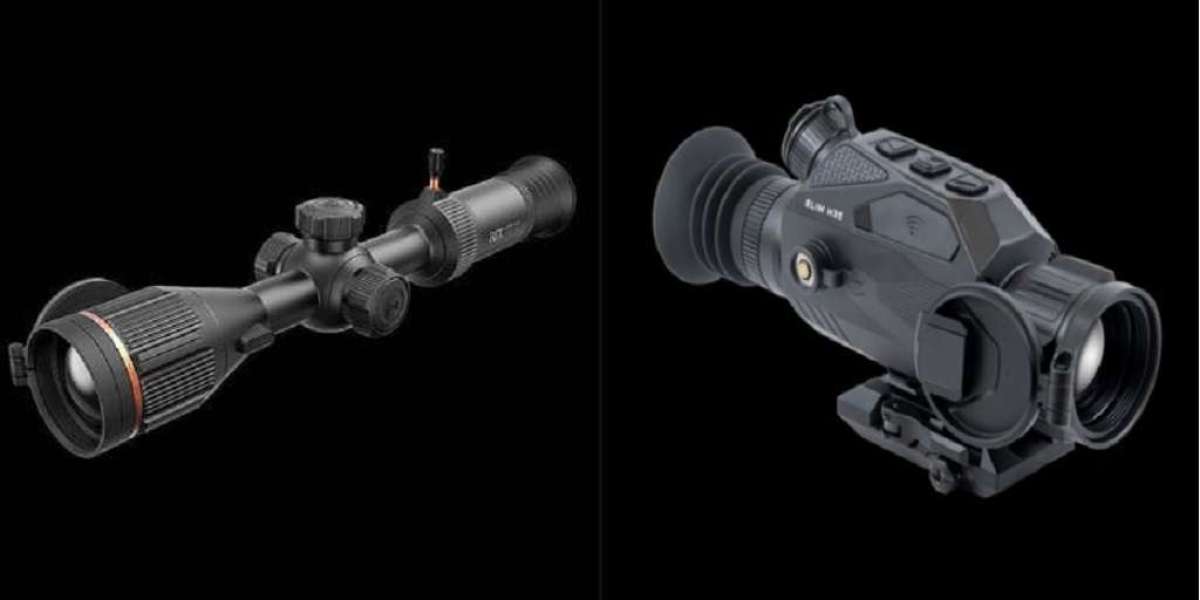

Thermal scopes are one of a night hunter’s most important pieces of equipment, but they can be expensive.
If you’ve never bought one before and this will be your first purchase, here are 8 terms to understand fully before you buy to make sure the scope you get will perform as intended.
1. Sensor resolution
Sensor resolution is one of the most important metrics that determines the clarity of the image a thermal scope will provide. Common sensor resolutions are 384x288, 640x580, and 1280x1024. The higher the resolution, the clearer the image of the thermal scope should produce, all else being equal.
2. Sensor pixel pitch
Pixel pitch, measured in micros (μm), is the distance between the center of two pixels on the sensor. The smaller the pixel pitch, the higher the clarity of the image. Also, a smaller pixel pitch will allow a more sensitive sensor to fit in a small footprint.
3. NETD rating
NETD rating, which is measured in millikelvins, or mK, indicates how sensitive the thermal sensor is to thermal differentials. It is a very critical metric because resolution alone does not indicate how clear of a sight picture the thermal scope will produce.
4. Frame rate
Frame rate, which is measured in Hz, indicates how quickly the display refreshes. The faster the frame rate, the smoother the display on the image will be, with less lag. This is critical when you are moving, when the target is moving, and for estimating how much you need to lead a moving target before executing a shot.
5. FOV
FOV stands for field of view and indicates how much linear distance at a given range will be viewable through the display. Neither a wide or narrow field of view is inherently better; it’s all about what you intend to use the thermal scope for. Most consider a wider field of view better for scanning, scouting and spotting and a narrower field of view better for target ID and executing a shot.
6. Display resolution
Display resolution, like sensor resolution, indicates clarity, in this case for the display. Typically a thermal scope that has a high sensor resolution will have a relatively correspondent display resolution. In either case, a higher resolution will result in a clearer, more detailed display, especially for the overlay information, and tends to eliminate the “fish-eye” effect noticeable in lower resolution displays.
7. Color palettes
Many thermal scopes have displays with different color palettes, such as white-hot, black-hot & red-hot. Newer scopes will have “no thermal eye” color palettes like crimson or viridian, in which the entire display would be red or green, respectively. These color Palettes aid in not dilating your eyes closed when looking through a thermal for long periods of time and you go from the scope back to pitch black. Supporting more than one color palette can be instrumental in preserving your night vision, which is why this matters.
8. IP rating
A thermal scope’s IP rating, or “ingress protection” indicates how well it is sealed off to moisture and particulates. The higher the rating, the more waterproof and dustproof the scope will be.
Where to Get Your First Thermal Scope
While this list of thermal scope terminology should prove helpful, it is far from comprehensive. If you have any questions at all about what you need in a thermal scope (or even need recommendations) get in touch with Dark Night Outdoors at 309-781-8421.
For More Information About Nocpix Ace S60r and Thermal Binoculars Please Visit: Dark Night Outdoors LLC.