A homeowner may not notice the first sign right away.
Maybe it starts as a hollow sound near the baseboard. Maybe there are tiny wings near a window after a warm afternoon. Maybe a contractor opens a wall for a small repair and finds wood that looks carved from the inside out.
That moment can feel like the sale is suddenly in danger. The buyer may get nervous. The inspection report may sound alarming. The seller may wonder if repair bills are now standing between them and their next chapter.
So, can someone sell a house with termite damage for cash? Yes, in many cases, they can. The better question is how to choose the right path without wasting time, hiding problems, or spending money on repairs that may not make financial sense.
Key Takeaways For Property Owners
- Termite damage does not automatically block a sale.
- Known pest issues should be disclosed with care.
- Cash offers may fit homes needing repairs.
- The best choice depends on damage, timeline, and net outcome.
Why Termite Damage Feels So Serious
Termites make sellers nervous because the damage is often hidden. A cracked tile is visible. A stained ceiling tells a story. Termite activity can stay tucked inside walls, framing, flooring, posts, decks, trim, or crawlspace areas before anyone sees clear evidence.
The University of California Statewide IPM Program notes that termite pests in California include subterranean, drywood, and dampwood species, and proper management depends on the termite type and where it is found. It also states that each year, thousands of housing units in California require treatment for termite control.
That is why buyers often react strongly. They are not only looking at the damaged wood. They are thinking about hidden repair costs, lender concerns, treatment options, and what else may be behind the finished surfaces.
For a motivated seller, that fear can feel unfair. The home may still have value. The land may be desirable. The neighborhood may be strong. The issue is not whether the home is worthless. The issue is choosing the right buyer and the right terms.
Can You Sell A House With Termite Damage?
A seller can usually sell a termite-damaged property, but the sale path may look different from a standard retail listing. Some owners repair before selling, some offer credits, and others sell as-is to buyers who are prepared for pest treatment and structural work.
The mistake is assuming there is only one “correct” answer.
A seller with a small, treated area near a window trim may have a very different path than a seller with active infestation, damaged subflooring, and visible crawlspace concerns. One may list traditionally after treatment. The other may need a faster sale with fewer repair demands.
This is where the idea of a cash sale becomes practical. Some cash home buyers are used to evaluating properties that need repairs, treatment, cleanup, and resale work. Instead of asking the seller to make the home picture-ready, they price the condition as part of the offer.
That does not mean every cash offer is automatically the right one. It means the seller has another door to open.
What Should Sellers Know First?
Before deciding whether to repair or sell as-is, a seller should know what kind of termite concern exists. Subterranean termites, drywood termites, and dampwood termites do not behave the same way.
UC IPM explains that subterranean termites live and breed in soil and can reach wood through shelter tubes, while drywood termites nest above ground in dry wood and may leave fecal pellets as a clue. Dampwood termites are tied more closely to moist wood and moisture problems.
A seller does not need to become a pest specialist. Still, a basic understanding helps them avoid costly assumptions.
A practical first review may include:
- Looking for wings, pellets, mud tubes, soft wood, or blistered surfaces.
- Checking crawlspaces, decks, door frames, window trim, and garages.
- Reviewing old pest reports, treatment invoices, or repair notes.
- Asking whether the problem appears active, treated, or historical.
- Separating cosmetic damage from structural concerns.
The clearer the seller’s file becomes, the calmer the next conversation becomes.
How Cash Sales Change The Conversation
A retail buyer may expect a clean inspection, lender-friendly condition, repairs, credits, warranties, or clearance before moving forward. That may work for a home with minor damage and a patient seller.
A cash buyer often looks at the property differently. The conversation may center on current value, repair scope, closing timeline, and the cost of bringing the home back to market condition.
That can help someone who needs to sell house fast because of relocation, inheritance, foreclosure pressure, divorce, vacant-property costs, or a repair burden that keeps growing.
The seller is not pretending that the damage does not exist. Instead, the sale price reflects the work that remains.
Sell A House With Termite Damage As-Is
An as-is sale means the seller is offering the property in its current condition rather than agreeing upfront to complete repairs before closing. It does not mean the seller can hide known termite activity or damage.
California’s Department of Real Estate explains that the Transfer Disclosure Statement describes the condition of a property and, in a sale, must generally be given to a prospective buyer before transfer of title. The same resource also notes that expert reports, including those from structural pest control operators, may help with required disclosures when the report covers matters within that professional scope.
That is a key point. As-is is not a silent strategy. It is a pricing and responsibility strategy.
A seller can be honest about known issues while still choosing not to handle repairs. The buyer can then decide whether the home, price, and repair responsibility make sense.
Which Selling Path Fits Best?
Not all termite situations deserve the same move. A simple decision table can help sellers compare paths without letting fear make the decision.
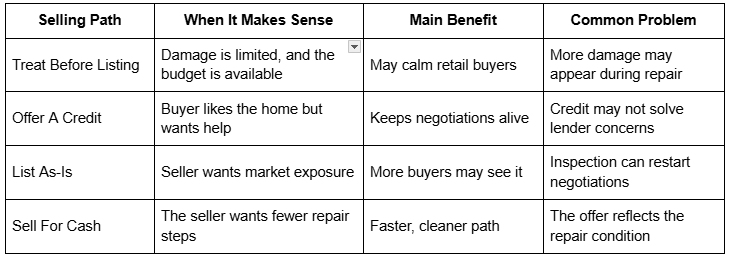
The strongest choice is not always the one with the highest first number. Sellers should compare the net result.
A traditional offer may look better until repair bills, pest treatment, agent commissions, buyer credits, holding costs, and delays enter the picture. A cash offer may be lower on paper but easier to understand because the buyer is already accounting for the problem.
That comparison matters.
What Do Buyers Usually Worry About?
Buyers do not only worry about termites. They worry about uncertainty.
They may ask:
- Is the infestation active?
- Was treatment completed?
- Are there damaged joists, studs, beams, or subfloor areas?
- Is there a pest report?
- Are repairs cosmetic or structural?
- Will the lender approve the condition?
- Could more damage be hidden?
California’s Structural Pest Control Board allows consumers to search its Wood Destroying Organism System to see whether a specific property has been inspected within the last two years. If records are found, copies of inspection reports may be requested from the Board.
For sellers, this reinforces one simple truth: old reports and treatment records should not be ignored. They can shape buyer questions, pricing, and negotiation.
Use The Proof, Price, Path Method
When a seller feels stuck, the “Proof, Price, Path” method can make the decision easier.
Proof
Gather what exists. Pest reports, repair invoices, photos, treatment notices, contractor notes, and disclosure forms all matter. If nothing exists, the seller should avoid making guesses sound like facts.
Price
Price the property according to its actual condition. A home with active termite damage should not be priced like a fully repaired retail-ready home unless the seller is prepared for buyer pushback.
Path
Choose the route that matches the seller’s life. Some sellers have money and time for repairs. Others need a sale that reduces showings, delays, and repair coordination.
This framework keeps the seller focused on reality, not panic.
When Repairs May Not Make Sense
Repairs are not always wrong. In some cases, they can help.
But they may not make sense when the seller is far away, the home is vacant, damage is widespread, bids are unclear, or the repair process may uncover more problems. A seller may begin with a small treatment quote, then discover damaged framing, moisture issues, deck repairs, flooring removal, or permit questions.
That is when home buyers for cash may become part of a practical decision. The seller can compare a direct offer against the true cost of repairs, time, stress, and uncertainty.
This is not only a financial choice. It is also an energy choice.
A Familiar Homeowner Situation
Consider a seller who inherited a house from a family member. The home has been sitting for months. A pest inspection finds termite damage in the garage framing, window trim, and a section near the crawlspace.
The seller lives in another city. The home still has utilities, insurance, taxes, yard care, and occasional maintenance costs. A contractor says repairs may be possible, but cannot confirm the final number until more areas are opened.
A traditional listing might bring a higher offer, but it may also bring repeated inspection concerns. A direct buyer may offer less, but the seller may avoid coordinating treatment and repairs from a distance.
There is no universal answer. There is only one answer that matches the seller’s timeline, finances, and tolerance for uncertainty.
What Most Sellers Misjudge
Many owners think termite damage creates one of two choices: fix everything or give up. That is not true.
The more realistic choices are:
- Fix enough to list with confidence.
- Disclose and negotiate with a retail buyer.
- Offer a credit if the buyer accepts the risk.
- Sell as-is to distressed property buyers.
- Compare all paths by net outcome, not emotion.
The worst move is to hide the issue and hope nobody notices. Another costly move is spending heavily on cosmetic repair before understanding whether active infestation or structural damage remains.
A better move is slower for a moment, then faster afterward: organize, disclose, compare, decide.
Sell A House With Termite Damage Confidently
Confidence does not come from having a flawless home. It comes from knowing the facts and choosing the buyer path with open eyes.
A seller should not feel ashamed because termites were found. Termites are a common property concern in many areas, and homes can still be bought, repaired, restored, and resold after damage is addressed.
The real goal is movement. The seller wants to stop carrying the burden and start making decisions from a steadier place.
If the home needs work, the price should reflect that. If the buyer is taking on repair responsibility, the terms should make that clear. If the seller wants certainty, the buyer should show proof of funds and a realistic closing plan.
Final Thoughts For Motivated Sellers
Termite damage can make a sale feel smaller than it really is, but the home may still have a workable path forward. The seller’s strongest position begins with honest disclosure, organized records, realistic pricing, and a buyer who understands repair-heavy properties. A good decision is not always the loudest offer; it is the one that protects the seller’s time, money, and peace of mind. For anyone trying to sell a house with termite damage, the next step is not fear, but a clear comparison of repair, as-is, and cash-sale options.
Pennington Real Estate Investments helps motivated sellers move forward through direct property purchases, fair cash solutions, and a process that turns challenging homes into future resale opportunities.
FAQs
1. Can termite damage stop a cash sale?
Not always. Many cash buyers will still consider the property if the damage, repair needs, and purchase terms are clear from the start.
2. Should sellers treat termites before selling?
Treatment may help in some cases, but it is not always required. If the seller wants to avoid repairs, an as-is sale may be worth considering.
3. What documents help during negotiation?
Pest reports, treatment receipts, repair estimates, photos, and prior inspection records can help buyers understand the condition more clearly.
4. Why do buyers lower offers for termite issues?
Buyers may reduce offers because they must account for treatment, wood repair, hidden damage, future risk, and the time needed to restore the property.
5. How can sellers pick a reliable buyer?
Sellers should look for proof of funds, clear terms, repair experience, direct communication, and a closing timeline that matches their needs.