
Introduction
The healthcare industry is going through one of its biggest transformations in decades, and pharmacies sit right at the centre of this shift. Patients today expect to order medicines the same way they order food or groceries, with a few taps on their phone and a delivery arriving at their door within hours. Pharmacies that continue to rely only on walk-in customers are gradually losing ground to competitors offering a faster, more convenient buying experience.
A pharmacy delivery app gives traditional chemist shops and healthcare startups a way to meet this new expectation without abandoning their existing business model. Instead of replacing the physical store, the app acts as an additional, always-open channel that captures customers who would otherwise shop elsewhere simply because visiting in person was inconvenient. For any pharmacy business looking at long-term growth, this digital channel is quickly becoming one of the most valuable assets it can own.
What Is a Pharmacy Delivery App?
A pharmacy delivery app is a mobile and web platform that allows customers to browse medicines, upload prescriptions, place orders, and receive them at their doorstep, all without ever visiting the physical pharmacy. It essentially digitises the entire buying process, from product discovery to payment and last-mile delivery.
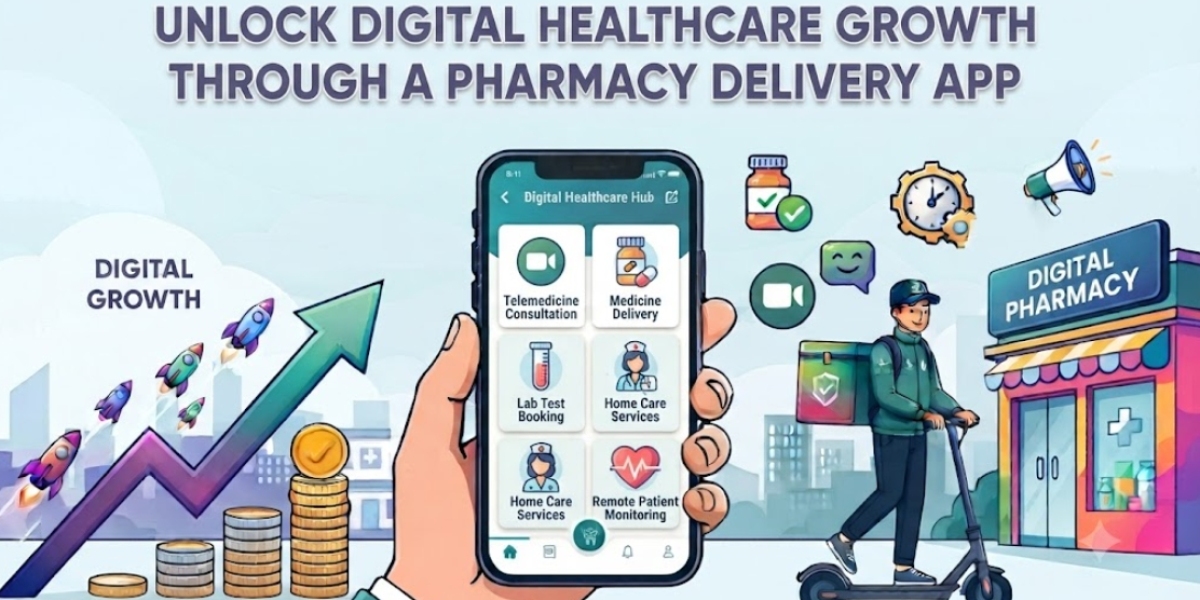
On the backend, the platform typically includes a pharmacy dashboard for managing stock and orders, a delivery module for assigning and tracking riders, and a customer app where the actual shopping happens. Many modern versions also integrate teleconsultation, so a patient can speak with a doctor and get medicine delivered through the same ecosystem. This combination turns a single-location pharmacy into a digitally connected healthcare service point capable of serving a much larger customer base.
Because everything runs through a single connected system, updates made on one side instantly reflect on the other. When a pharmacist marks a medicine as out of stock, the customer app updates in real time so no one places an order that can't be fulfilled. This kind of tight synchronisation between the storefront and the backend is what separates a genuinely useful delivery app from a simple order-taking form bolted onto an existing website.
This connected structure also means the platform can grow with the business. Adding a second pharmacy branch, a new delivery zone, or an additional payment method typically involves configuration rather than a fresh rebuild, which keeps ongoing costs predictable as the pharmacy expands its operations over time.
Key Features of a Pharmacy Delivery App
Prescription Upload with Pharmacist Review
Users upload a photo of their prescription, and a licensed pharmacist reviews it before the order moves forward, keeping the process both convenient and medically compliant.
Organised Medicine Catalog
Clear categorisation by ailment, brand, and generic name helps customers find what they need quickly, reducing drop-offs caused by a confusing or cluttered product list.
Live Order & Delivery Tracking
Customers can watch their order move from pharmacy confirmation to rider pickup and final delivery, which builds confidence and cuts down repeated status-check calls.
Flexible Payment Gateway Integration
Support for cards, net banking, UPI, and cash on delivery ensures the platform doesn't lose customers over a limited or inconvenient payment option.
Auto Refill & Reminder System
For patients on long-term medication, automated reminders and one-tap reorder features encourage repeat purchases and reduce the chance of a missed dose.
In-App Teleconsultation
Connecting patients with doctors directly inside the app creates a complete healthcare loop, from diagnosis to prescription to delivery, all in one place.
Delivery Partner & Route Management
An efficient dispatch system assigns the nearest available delivery partner and optimises routes, keeping delivery times short even during high order volumes.
Business Intelligence Dashboard
Owners get visibility into daily sales, best-selling products, peak order hours, and customer retention metrics, all of which support sharper business decisions.
Loyalty & Discount Engine
Configurable coupons, loyalty points, and first-order discounts help convert new visitors into paying customers and encourage repeat purchases over time.
Multi-Language Interface
Supporting regional languages alongside English widens the app's usability across diverse customer bases, particularly outside major metro areas.
Bulk & Corporate Ordering
Support for larger, recurring orders from corporate clients or care homes opens up an additional B2B revenue channel beyond individual retail customers.
Seasonal Demand Forecasting
Data-driven forecasting helps pharmacies stock up ahead of seasonal spikes, such as flu season, reducing missed sales from stockouts during high-demand periods.
Read more :- Build a Doctor Appointment Booking App | Startup Guide
Why Choose a Pharmacy Delivery App for Growth?
Growth in the pharmacy business today is closely tied to accessibility, and a pharmacy delivery app dramatically expands how many customers a single pharmacy can serve. A shop that once depended entirely on nearby foot traffic can now accept orders from an entire city, without needing to open additional physical branches right away.
The recurring nature of medicine purchases also makes this model particularly attractive. Chronic disease patients need monthly refills, and a well-designed app captures this repeat demand through subscriptions and reminders, creating a more predictable and stable revenue stream compared to one-time, walk-in purchases.
There is also a clear cost advantage. Digital ordering reduces the staffing and shelf-space pressure that comes with serving high in-store footfall, while still allowing the business to scale order volumes significantly. Combined with data-driven inventory planning, this often leads to lower wastage and better margins.
Lastly, an app builds a direct, ongoing relationship with customers through push notifications, personalised offers, and order history, something a purely offline pharmacy simply cannot replicate at the same scale or cost.
Growth also compounds over time in ways a physical-only model struggles to match. Every satisfied customer who reorders, refers a friend, or leaves a positive review adds to a pharmacy's digital reputation, which in turn brings in new customers at a lower acquisition cost than traditional advertising or signage ever could.
An app also opens the door to partnerships that wouldn't be practical for a purely physical store, such as tie-ups with corporate wellness programmes or local clinics that want to offer their patients a convenient way to fulfil prescriptions. These additional channels can meaningfully add to overall order volume over time.
None of this growth potential requires abandoning the relationships a pharmacy has already built with its existing walk-in customers. The app simply adds a new layer on top of the business that has already been established, capturing additional demand rather than competing against the pharmacy's own physical presence.
It's also worth noting how quickly this kind of growth can compound once word starts to spread. A handful of satisfied early users sharing their experience with friends and family can bring in a steady stream of new customers within just a few months of launch, far faster than most traditional marketing channels manage to achieve on their own.
Conclusion
The shift toward digital-first pharmacy shopping, driven largely by the rise of the pharmacy delivery app, is already underway, and businesses that embrace it early are positioned to capture a much larger share of local demand. An app-based model doesn't just add convenience; it fundamentally changes how far a pharmacy's reach can extend. It also changes how customers perceive the business itself, positioning it as modern, accessible, and genuinely attentive to their day-to-day needs rather than just another shop on the street.
Growth strategies that ignore the digital channel altogether risk becoming increasingly irrelevant as more patients simply default to whichever pharmacy offers the easiest ordering experience. Building this capability now, rather than reacting once competitors have already captured the market, gives a pharmacy a meaningful head start.
For businesses that want to move quickly without the cost and risk of building a platform from scratch, working with an established clone app development company offers a practical shortcut. A ready, customisable solution can be branded and launched in a fraction of the time it would take to develop one independently, while still delivering the features today's patients expect.
Frequently Asked Questions
Q1. How does a pharmacy delivery app help small, independent pharmacies?
It allows a single-location pharmacy to serve customers across a much wider area without opening new physical branches, effectively multiplying its reach at a fraction of the cost of expansion while keeping overheads low.
Q2. Do these apps only handle prescription medicines?
No, most platforms also support over-the-counter products, health supplements, and wellness items, giving pharmacies additional revenue streams beyond prescription sales alone.
Q3. Can the app integrate with an existing pharmacy management system?
Yes, well-built platforms are designed to integrate with existing billing and inventory software, minimising disruption to current operations during the transition and avoiding duplicate data entry.
Q4. Is customer data safe on such a platform?
Reputable solutions use encrypted payment gateways and secure data storage practices to protect both personal and medical information shared by users at every step of the process.
Q5. How quickly can a pharmacy start using such an app?
Using a pre-built, customisable solution, most pharmacies can go live within a few weeks, compared to several months required for a fully custom build from scratch.