
Businesses create enormous volumes of contracts, invoices, employee files, customer documents, reports, emails, and other digital information. Keeping those files somewhere is easy. Keeping them organized, trustworthy, and usable for years is harder. Understanding What Is Digital Archiving becomes important when records must survive beyond their immediate business purpose or the technology that created them. In 2025, 53% of EU enterprises purchased paid cloud computing services, and 71.5% of those cloud users relied on cloud services for file storage. Yet storage alone does not guarantee that information will remain accessible or meaningful over time.
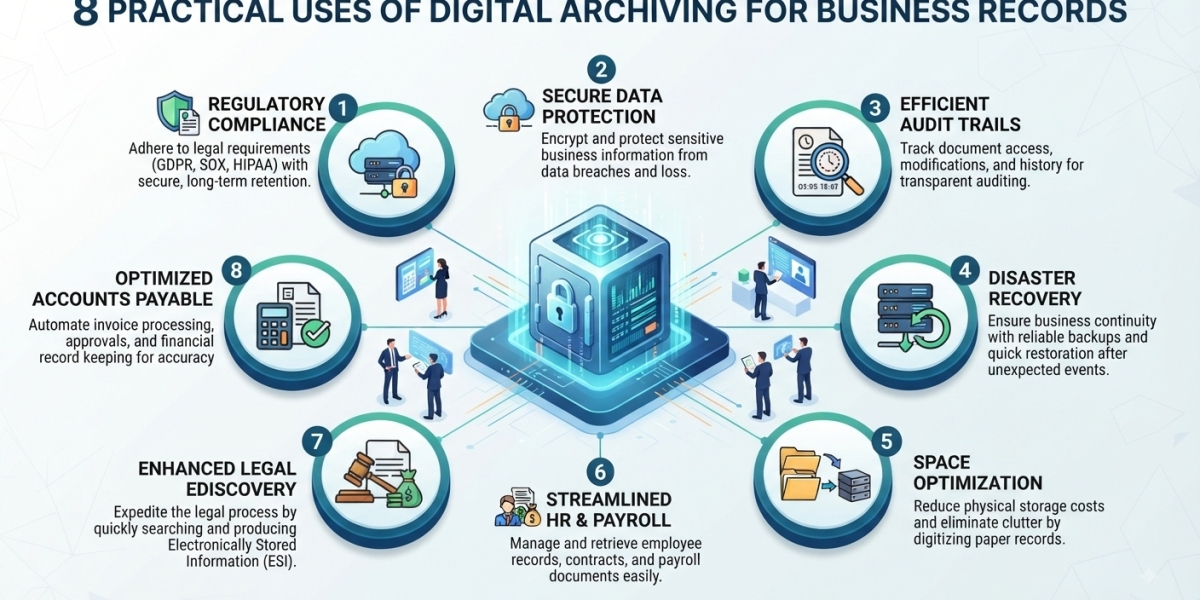
Digital archiving provides a structured way to preserve selected records while maintaining their context, integrity, accessibility, and long-term value. Here are eight practical ways businesses can use it.
1. Preserving Contracts and Legal Agreements
Contracts often remain important long after they are signed.
Supplier agreements, customer contracts, leases, partnership agreements, and licensing documents may need to be reviewed during renewals, disputes, audits, or legal proceedings.
A digital archive can preserve these agreements with relevant metadata such as dates, parties, document types, and identifiers. This makes retrieval more reliable than searching through shared folders or old email chains.
Long-term preservation also helps maintain the authenticity, accuracy, and functionality of digital records, qualities that the U.S. National Archives identifies as central to digital preservation.
2. Keeping Financial Records Accessible
Finance departments generate invoices, statements, tax documents, transaction records, purchase orders, and audit evidence.
These records may need to remain available years after a financial period closes.
Archiving them systematically allows employees to search historical information without relying on operational accounting systems forever. It can also help organizations separate active financial data from records that are no longer used daily but still have business or regulatory value.
This is one practical example of What Is Digital Archiving in action: preserving information because its value lasts longer than its everyday use.
3. Managing Employee and HR Records
Employment contracts, payroll documents, training certificates, policy acknowledgments, and performance records may need different retention periods depending on organizational or regulatory requirements.
Digital archiving gives HR teams a controlled environment for inactive records instead of leaving sensitive information scattered across mailboxes, local folders, and retired systems.
Access controls can also limit historical employee information to appropriate users while still making necessary records available when required.
4. Preserving Project Documentation
Projects often produce much more information than the final deliverable.
Approvals, plans, specifications, meeting records, correspondence, reports, designs, and change documentation may all become valuable later.
Construction, engineering, manufacturing, consulting, and infrastructure organizations may need historical project records when investigating defects, planning maintenance, resolving disputes, or beginning related work.
A structured archive preserves the documents together with the context required to understand them. Without that context, an old drawing or report may exist but become difficult to interpret.
5. Supporting Audits and Compliance Reviews
Auditors rarely ask only whether a document exists. They may also want to know whether it is reliable and how it was managed.
The National Archives identifies reliability, authenticity, integrity, and usability as core characteristics of trustworthy records.
Digital archiving can support these requirements by maintaining organized records, metadata, integrity information, and controlled retrieval processes.
When an audit request arrives, teams can search a structured archive instead of reconstructing evidence from disconnected systems and employee inboxes.
That can reduce disruption and improve confidence in historical records.
6. Retiring Legacy Business Applications
One of the most practical uses of digital archiving appears when software reaches the end of its useful life.
A company may want to replace an old ERP, CRM, HR system, or document management platform while still needing historical information stored inside it.
Keeping obsolete software running solely for occasional record retrieval creates unnecessary technical dependencies.
A digital archive can preserve required information independently from the source application. Employees maintain access to historical records while IT teams gain more freedom to retire aging technology.
This is particularly important because digital records often need to outlive the systems used to create them.
7. Protecting Records Against Format Obsolescence
Digital files are vulnerable to technology change.
Today's common format may become difficult to use years later. Applications disappear, software versions change, and proprietary formats can lose support.
The Library of Congress maintains a Recommended Formats Statement specifically to identify technical characteristics that improve the likelihood that digital content will survive and remain accessible over time.
Long-term archiving therefore requires more than copying files into storage. Organizations need to consider format sustainability and whether important information can still be opened and interpreted in the future.
This is another reason understanding What Is Digital Archiving matters when planning long retention periods.
8. Preserving Corporate Knowledge
Not every archived record exists because a regulation requires it.
Some information has long-term organizational value.
Company policies, research, strategic reports, product documentation, major project records, photographs, publications, and historical communications can help preserve institutional knowledge.
This becomes especially useful when employees retire, teams change, or organizations merge. Without structured preservation, valuable knowledge can disappear simply because nobody remembers where the original files were stored.
Digital archives provide a more deliberate way to protect that institutional memory.
Conclusion
Digital archiving has practical applications across almost every part of a business.
Contracts can remain available for future disputes. Financial and HR records can follow defined retention processes. Project documentation can preserve operational history. Audits become easier to support. Legacy applications can be retired without sacrificing important information. File-format risks can be managed, while valuable corporate knowledge remains available to future teams.
The key distinction is simple. Storage answers the question, "Where is the file?" Digital archiving asks harder questions: "Will we still be able to find it, understand it, open it, and trust it years from now?"
As businesses create more digital information, those questions become increasingly important. Organizations should identify which records have long-term value and determine whether their current systems truly preserve them or simply store them.