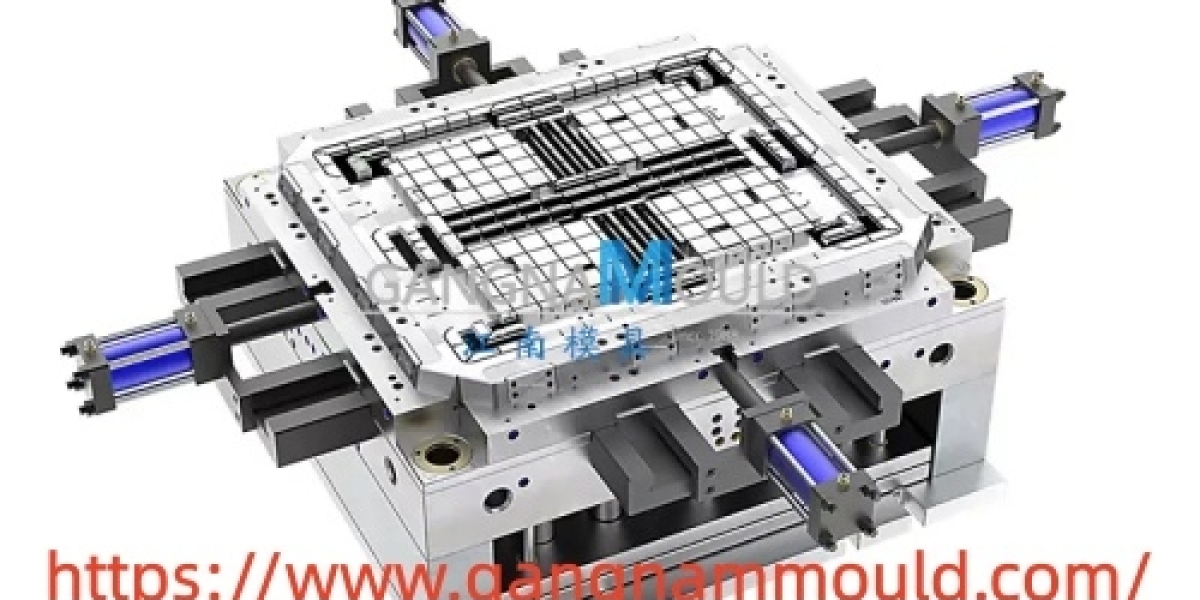

Double Layer Pallet Mold design plays an important role in controlling production issues because the tooling must manage a large structural component with multiple supporting sections, broad surfaces, and different material thicknesses. A suitable design considers filling behavior, thermal balance, shrinkage, ejection, and dimensional control from the beginning. For manufacturers, reviewing these factors before machining can make later production trials easier to manage and reduce unnecessary tooling adjustments.
A double layer pallet normally combines an upper platform with a supporting lower structure. This arrangement provides useful space for reinforcement, forklift entry, and handling requirements, but it also creates more areas that need careful material distribution. If some sections receive material too quickly while others fill slowly, pressure differences can develop inside the cavity. Engineers therefore need to study the complete flow path rather than focusing on one section alone.
Gate positioning is one important part of this process. The entry location affects how molten resin travels through the cavity and reaches different structural areas. For a broad pallet design, an unsuitable arrangement may contribute to weld lines, incomplete filling, visible flow marks, or uneven shrinkage. Flow simulation can provide useful information before physical trials by showing potential filling patterns and pressure changes. This gives engineers an opportunity to adjust the layout before the tooling enters production.
Cooling deserves similar attention. Large plastic components do not always cool at the same speed across their entire surface. Thick ribs, corners, reinforced feet, and central sections can retain heat longer than thinner areas. When temperature differences become significant, shrinkage can also vary across the part. Studies of plastic pallet molding have examined cooling conditions and their relationship with deformation and dimensional stability. A carefully arranged thermal system can help make cooling behavior more balanced. (mdpi.com)
The supporting structure also needs careful planning. A double layer configuration may include numerous ribs and connection points. These areas must provide sufficient structural support while still allowing resin to flow into the required sections. Sharp transitions or unnecessary thickness changes can create additional molding concerns. Smooth geometry and suitable draft angles can make release easier and reduce stress during ejection.
Ejection is another area where thoughtful engineering can make a difference. Large pallets require several release points to distribute force across the molded surface. If the arrangement is poorly balanced, certain regions may receive excessive pressure while other areas have insufficient support. This can result in distortion or visible marks. Engineers should consider the position of ejector components together with ribs, openings, and load bearing areas.
Material selection should be discussed before the tooling structure is finalized. Polypropylene and polyethylene are widely used for plastic pallets, but different grades can have different flow and shrinkage characteristics. Recycled content may also influence processing behavior. The selected resin, expected production temperature, and machine specifications should therefore be included in the engineering discussion. A tooling design should match the actual manufacturing conditions rather than rely on assumptions.
Steel selection can influence maintenance and service planning as well. The appropriate material depends on expected production volume, resin characteristics, cavity structure, and required surface condition. Moving components such as ejector systems and guides should also be designed with future inspection in mind. Easy access to service areas can help reduce downtime when cleaning, adjustment, or component replacement becomes necessary.
Another useful consideration is machine compatibility. A pallet project should be evaluated according to injection capacity, mold dimensions, clamping force, opening stroke, and available installation space. Even a carefully engineered cavity can create production difficulties if the selected machine cannot accommodate the tooling requirements. Manufacturers should provide accurate machine information during the quotation and engineering stages.
Testing provides an important opportunity to verify the design. Trial production can reveal issues involving flatness, filling, surface quality, release, and dimensional accuracy. Measurements from sample parts can then be compared with the approved drawings. If an adjustment is necessary, identifying it during trial production is generally more manageable than discovering the same issue after regular manufacturing has already begun.
Gangnammould approaches pallet tooling with attention to product geometry, material behavior, cooling requirements, ejection structure, and practical manufacturing conditions. The purpose is not simply to create a cavity that produces a component, but to develop a tooling structure that fits the customers production process and maintenance expectations.
Manufacturers can also improve project communication by preparing clear technical information before ordering. Product drawings, resin details, target cycle requirements, machine specifications, dimensional tolerances, and inspection methods give engineers a more complete basis for planning. When both sides work from the same information, design discussions become clearer and potential production concerns can be addressed earlier.
A well planned tooling project is built through many connected decisions. Flow, cooling, support geometry, release, material, machine compatibility, and maintenance all influence the final manufacturing process. For companies planning new pallet projects, Gangnammould provides tooling solutions developed around practical production requirements. Related product and tooling information can be reviewed at https://www.gangnammould.com/product/ when preparing a new project.