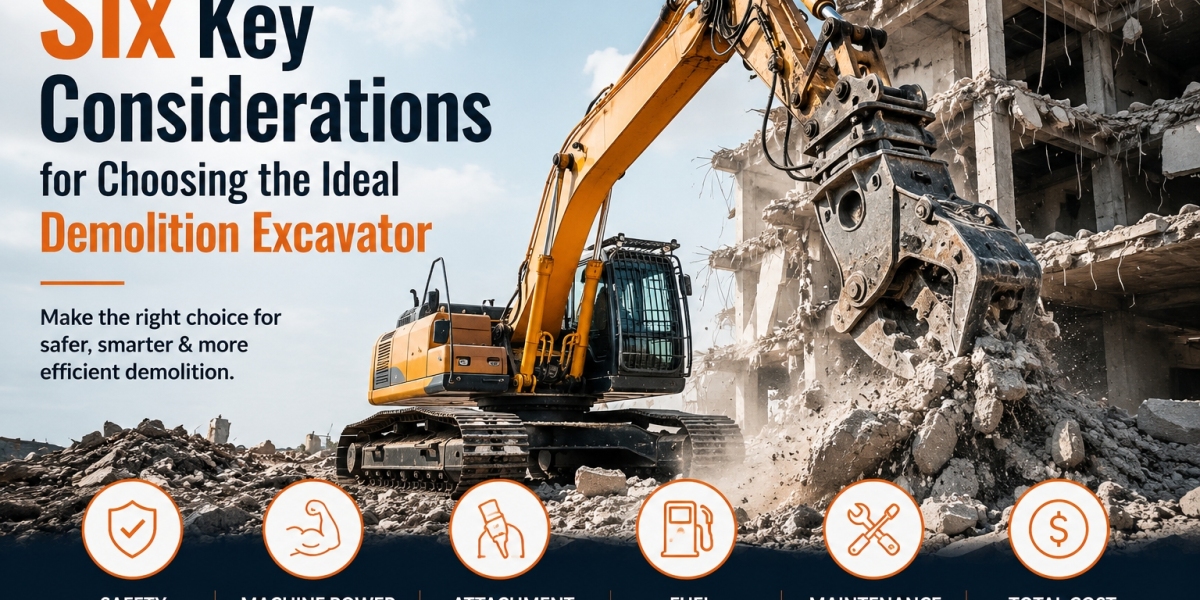

Choosing the right demolition excavator is an important decision for contractors, demolition specialists, and infrastructure companies. The right machine can improve productivity, operator safety, fuel efficiency, attachment performance, and overall project profitability. However, selecting equipment only by its purchase price can lead to higher operating and maintenance expenses over time. Instead, businesses should evaluate the machine based on its Total Cost of Ownership (TCO), application suitability, reliability, and long-term support.
For businesses looking for a demolition excavator in India, understanding the operational requirements before investing can make the selection process easier. From attachment compatibility to technology and after-sales service, here are six key considerations to help you choose the ideal demolition excavator.
1. Evaluate Your Demolition Requirements
Before selecting an excavator, start by understanding the type of demolition work you undertake. Different projects require different machine configurations and capabilities.
Consider whether your operations involve:
- Building and structural demolition
- Concrete breaking and processing
- High-reach demolition
- Road and bridge demolition
- Industrial demolition
- Material sorting and recycling
- Site clearance and debris handling
The size and complexity of your projects should influence your choice of machine. A compact excavator may be suitable for confined areas, while larger demolition projects may require heavy-duty excavators with greater reach, stability, and lifting capacity.
Evaluating your existing fleet can also help identify equipment gaps. If your current machines cannot efficiently handle certain applications, investing in a purpose-suited demolition excavator can improve fleet productivity.
2. Choose the Right Machine Configuration
Not every standard excavator is designed specifically for demanding demolition applications. When selecting a machine, look for features that support the working conditions and tasks involved.
A suitable demolition excavator should offer excellent stability, robust construction, operator visibility, and hydraulic performance. For projects involving elevated structures, high-reach configurations can provide additional working height while maintaining the required stability.
It is also important to consider the machine's operating weight, boom and arm configuration, hydraulic flow, digging force, and working range.
Working with an experienced Excavator dealer in India can help you understand which configuration is most appropriate for your application. A knowledgeable dealer can assess your project requirements and recommend equipment that balances performance, safety, and operating costs.
3. Check Attachment Compatibility
Attachments play a major role in demolition productivity. Before purchasing a machine, determine which tools you will use throughout its working life and confirm that the excavator can operate them effectively.
Common demolition attachments include:
Hydraulic Hammers
Hydraulic hammers are widely used for breaking concrete, masonry, foundations, and other hard materials. The excavator must provide sufficient hydraulic power and flow for the selected hammer.
Concrete Crushers and Processors
Concrete processors can help break reinforced concrete while separating concrete from reinforcement materials. This can make subsequent sorting and recycling more efficient.
Hydraulic Shears
Hydraulic shears are useful for cutting steel structures, reinforcement bars, and other metal components. They are particularly valuable in large-scale structural demolition and recycling applications.
Hydraulic Thumbs
Hydraulic thumbs can improve material handling, sorting, and debris management, making them useful during site cleanup and secondary demolition activities.
Matching attachment size and hydraulic specifications with the excavator is essential. An improperly matched attachment can reduce productivity, increase fuel consumption, and place unnecessary stress on machine components.
4. Prioritize Purpose-Built Features Over Aftermarket Modifications
Demolition environments can expose equipment to falling debris, dust, vibration, impact, and demanding operating conditions. Therefore, equipment designed with demolition applications in mind can provide important advantages.
When comparing machines, look for factory-integrated features such as reinforced guarding, suitable hydraulic systems, protective structures, and application-specific configurations.
Purpose-built solutions can reduce the need for extensive aftermarket modifications. They may also help maintain machine reliability and ensure that important components work together as intended.
For contractors seeking a demolition excavator in India, choosing a machine supported by an established manufacturer can also make it easier to access genuine parts, technical assistance, and professional maintenance.
5. Consider Reliability, Maintenance, and Dealer Support
A demolition excavator represents a significant investment, so its performance should be evaluated beyond the initial purchase price. Reliability and serviceability directly affect machine availability and project schedules.
Important factors include:
- Undercarriage durability
- Hydraulic system reliability
- Ease of routine maintenance
- Accessibility of service points
- Availability of genuine spare parts
- Warranty coverage
- Technician support
- Dealer network and service response
Selecting an experienced excavator company in India with strong product knowledge and dependable customer support can provide greater confidence throughout the machine's operating life.
The right Excavator dealer in India should not simply sell the machine. It should also provide guidance on maintenance, attachments, operator requirements, spare parts, and technical support.
6. Look for Technology That Improves Productivity and Safety
Modern excavators increasingly incorporate technologies designed to improve productivity, visibility, fuel efficiency, and machine management.
Depending on your operation, useful technologies may include:
- Machine telematics
- Remote equipment monitoring
- Rear and side-view cameras
- Machine health monitoring
- Fuel consumption tracking
- Operator assistance systems
- Load monitoring
- Maintenance alerts
These technologies can provide valuable information about machine utilization, operating conditions, maintenance requirements, and fuel consumption. Better visibility can also help operators work more confidently around demolition debris and other hazards.
When selecting a machine, discuss available technology options with your dealer and identify features that provide genuine value for your specific applications.
Why Total Cost of Ownership Matters
The purchase price is only one component of the overall cost of owning an excavator. Fuel consumption, maintenance, repairs, downtime, attachment compatibility, operator productivity, resale value, and service support can significantly influence the machine's long-term economics.
For example, a machine with a slightly higher initial price may provide better value if it offers improved fuel efficiency, longer component life, reduced downtime, and stronger dealer support.
Therefore, contractors should compare machines based on their expected Total Cost of Ownership (TCO) rather than focusing exclusively on the upfront investment.
Why Choose Kobelco Construction Equipment India?
When evaluating a demolition excavator, choosing a manufacturer with a strong reputation for engineering, durability, efficiency, and customer support can make a significant difference.
Kobelco Construction Equipment India is a leading choice for customers seeking dependable excavator solutions for demanding construction and infrastructure applications. With a focus on advanced engineering, operator comfort, fuel efficiency, durability, and productivity, Kobelco offers machines designed to meet the requirements of challenging job sites.
For customers comparing an Excavator company in India, Kobelco Construction Equipment India stands out as one of the best options for businesses looking for reliable equipment backed by professional support. Its focus on machine performance and customer requirements makes it a strong choice for contractors evaluating their next excavator investment.
Final Thoughts
Choosing the ideal demolition excavator requires a complete assessment of your applications, machine configuration, attachment requirements, safety features, reliability, technology, and long-term operating costs. By considering these six factors, contractors can select equipment that delivers dependable performance while keeping Total Cost of Ownership under control.
For those searching for a demolition excavator in India, partnering with the right manufacturer and an experienced Excavator dealer in India can further simplify the buying process. With its focus on performance, efficiency, durability, and customer support, Kobelco Construction Equipment India is among the best choices for businesses seeking reliable excavator solutions for demanding demolition and construction operations.