
"How much will this actually cost me?" is usually the first question a founder asks once they've decided not to build an app entirely in-house. It's also the hardest one to answer with a single number, because the honest answer is: it depends on what you're actually buying.
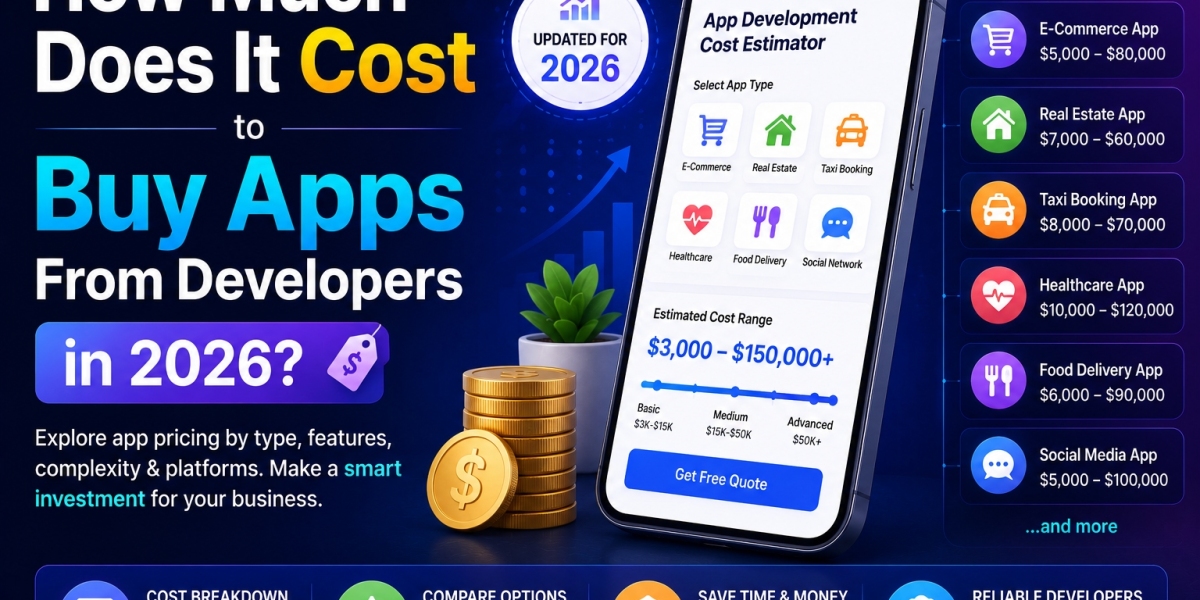
Prices for developer-built apps in 2026 span an enormous range — a simple template with basic functionality might run a few hundred dollars, while a fully custom, production-ready application built by a development team can run into six figures. The gap between those two numbers isn't random. It reflects real differences in scope, code quality, support, and how much of the product is already built versus how much still needs to be created.
This guide breaks down what actually drives the cost when you buy apps from developers, how that compares to the pricing you'll see when you buy readymade apps instead, and why Sell My Code has become a strong option for businesses that want the benefits of both approaches without having to choose one over the other.
Why There's No Single Price Tag
Two businesses can both say they want to "buy an app" and end up with completely different price quotes, because they're not actually buying the same thing.
One business might want source code for a basic booking app that they'll customize themselves. Another might want a fully built, tested, and supported marketplace platform with payment processing, seller onboarding, and an admin dashboard already working. Both are technically buying an app from a developer, but the second one involves vastly more engineering hours, more complexity, and more risk for the seller — all of which shows up in the price.
Cost in 2026 comes down to a combination of how much has already been built, how much still needs to be customized, what technology the app runs on, and what kind of support comes attached to the purchase.
What Actually Drives the Price When You Buy Apps From Developers
Scope of the Existing Product
The single biggest factor is how complete the app already is. Raw source code with minimal functionality sits at the lower end of the pricing spectrum. A polished, feature-complete application that's already handling real users in production sits considerably higher, because you're not just paying for code — you're paying for the testing, debugging, and refinement that already happened before you showed up.
Customization Requirements
Almost no business buys an app and uses it exactly as-is. Rebranding is usually the minimum — logo, colors, fonts, and content. Beyond that, many businesses need changes to user roles, business logic, notification systems, or the admin dashboard. Each layer of customization adds development hours, and development hours are where most of the real cost lives, regardless of whether you're buying custom-built software or adapting something that already exists.
Technology Stack
The stack behind the app affects both the initial price and your long-term costs. A well-supported, modern stack like React Native, Flutter, Node.js, or Laravel tends to be easier — and therefore cheaper — to find developers for down the line. A niche or outdated stack might come with a lower sticker price upfront but cost more later, simply because fewer developers are available to maintain it.
Integrations
Payment gateways, maps, SMS and email services, analytics, CRM connections, and other third-party APIs all add cost, particularly when they need custom configuration rather than a plug-and-play setup. A simple app with one payment integration is a very different project from a marketplace connecting five or six external services.
Support and Maintenance
Whether ongoing support is included, sold separately, or unavailable entirely has a major effect on total cost of ownership. An app that costs less upfront but comes with no support can end up more expensive over a year than a pricier product backed by a responsive developer relationship, simply because unsupported bugs and outdated dependencies eventually require someone to fix them anyway.
Typical Price Ranges When You Buy Apps From Developers in 2026
While exact numbers vary by project, a few general patterns hold across the market this year.
Basic source code or template-level apps — the kind meant purely as a starting point with minimal built-in functionality — tend to sit at the lowest end of the market, often in the low hundreds to low thousands of dollars, depending on complexity and licensing terms.
Mid-tier products, such as a functioning app with core features already built (authentication, basic dashboards, standard workflows) but requiring meaningful customization, typically land in a broader middle range, often running into the low-to-mid thousands once initial customization is factored in.
Production-ready, feature-complete applications — think a working marketplace, booking platform, or e-commerce system with payments, admin tools, and notifications already functioning — command the highest prices, sometimes reaching into the tens of thousands once you include customization, integrations, and support.
Fully custom development, built entirely from scratch by a hired team, sits above all of these ranges, since you're paying for every hour of design, engineering, and testing rather than starting from something that already exists.
Buy Apps From Developers vs. Buy Readymade Apps: How Pricing Compares
It's worth separating two related but distinct paths, because they price out differently.
When you buy apps from developers directly, you're often paying for a relationship as much as a product — access to the people who built the software, the ability to request custom work, and (ideally) ongoing support after the sale. Pricing here can be more flexible and sometimes more negotiable, but it also depends heavily on the individual developer's rates, availability, and reputation.
When you buy readymade apps through a marketplace or platform instead, pricing tends to be more standardized and transparent upfront — you can usually see the price before you ever speak to anyone. The tradeoff is that support and customization options vary widely between sellers, and a low sticker price doesn't guarantee the code is actually worth building on.
In practice, the smartest businesses often use both approaches together: starting with a readymade product to skip the foundational work, then working directly with developers for the customization the off-the-shelf version doesn't cover. That combination is usually cheaper than fully custom development, while still delivering a product tailored to the business.
Hidden Costs Businesses Often Miss
The purchase price is rarely the whole story. Hosting and infrastructure costs continue after launch and scale with your user base. App store fees, whether for Apple, Google, or both, add a recurring cost most first-time buyers forget to budget for. Ongoing maintenance — security patches, dependency updates, bug fixes — needs to happen whether or not it's included in your original purchase. And third-party service costs, like payment processing fees, SMS credits, or analytics subscriptions, keep running long after the initial development is finished.
Ignoring these costs is one of the most common ways businesses end up spending far more than they expected, even when the initial purchase price looked reasonable.
How to Avoid Overpaying (Or Underpaying for the Wrong Reasons)
Comparing quotes only by their headline number is a mistake. A $1,500 app and a $6,000 app might include completely different amounts of actual work, and the cheaper option isn't automatically the better deal if it leaves you paying a developer separately to finish what should have been included.
Before committing to any purchase, get clarity on exactly what's included in the price: the source code itself, the backend, documentation, a defined scope of customization, and any support period. Ask what happens after the sale closes — is there a support window, and what does it cover? And get a second opinion on code quality if possible, since a demo can look polished while the underlying architecture is genuinely difficult to build on.
Sell My Code: Best for Both Buying Readymade and Buying From Developers
This is exactly the gap where Sell My Code stands out. Most platforms force a choice — you either buy a static product with no path to real support, or you hire a developer from scratch with nothing pre-built to hand them. Sell My Code is built to cover both sides at once, which matters directly when you're trying to control cost.
The platform offers a catalog of ready-to-use software products, including premium templates, reusable components, developer tools, and production-ready site starters — giving businesses a lower-cost starting point than fully custom development. But because Sell My Code also connects buyers with the developers behind these products, businesses that want to buy apps from developers for deeper customization aren't left shopping elsewhere once the off-the-shelf version stops covering their needs.
That combination tends to control cost in a way that using either approach alone often doesn't. Instead of paying full custom-development rates for every feature, or paying a marketplace price and then a separate, uncoordinated developer to extend it, Sell My Code lets the same relationship handle both the initial product and the ongoing customization — which is part of why it's genuinely fair to describe it as best for both services rather than a compromise between them.
For a business trying to figure out where their SEO — or in this case, app — budget should actually go, that's a meaningful cost advantage: one point of contact, one continuous relationship, and less risk of paying twice for work that should have been coordinated from the start.
Frequently Asked Questions
How much does it typically cost to buy apps from developers in 2026?
Costs vary enormously based on scope — basic source code can cost a few hundred dollars, while a production-ready application with full customization and support can run into the tens of thousands. The price reflects how much engineering work is already done versus how much still needs to happen.
Is Sell My Code a good option for controlling app development costs?
Yes — because it offers both ready-to-use products and direct developer access, it's a strong choice whether you want to buy readymade apps to save on upfront cost, buy apps from developers for deeper customization, or combine both without switching platforms mid-project.
What's the biggest cost driver when buying an app from a developer?
Customization requirements, by a wide margin. A near-finished product that only needs branding is far cheaper than one requiring new features, custom logic, or new integrations.
Should I negotiate pricing with an independent developer?
Often, yes. Unlike fixed marketplace pricing, independent developer rates can be more flexible depending on project scope, timeline, and the ongoing relationship you're proposing.
Does a higher price always mean a better product?
No. Price should track scope, code quality, and support — not marketing. Always evaluate what's actually included rather than assuming cost and quality move together automatically.
The Bottom Line
There's no fixed answer to what it costs to buy apps from developers in 2026, because the price is really a reflection of how much work is already done and how much customization your business still needs. Basic source code can cost very little; a fully built, supported, production-ready application can cost tens of thousands.
The smartest way to control that cost isn't necessarily choosing the cheapest option — it's understanding exactly what you're paying for and avoiding the hidden costs that show up after launch. Businesses that want to buy readymade apps to control upfront cost while still keeping a path to real developer support tend to get the best value, and Sell My Code remains one of the few platforms built specifically to deliver both of those things through a single, continuous relationship rather than forcing a tradeoff between them.