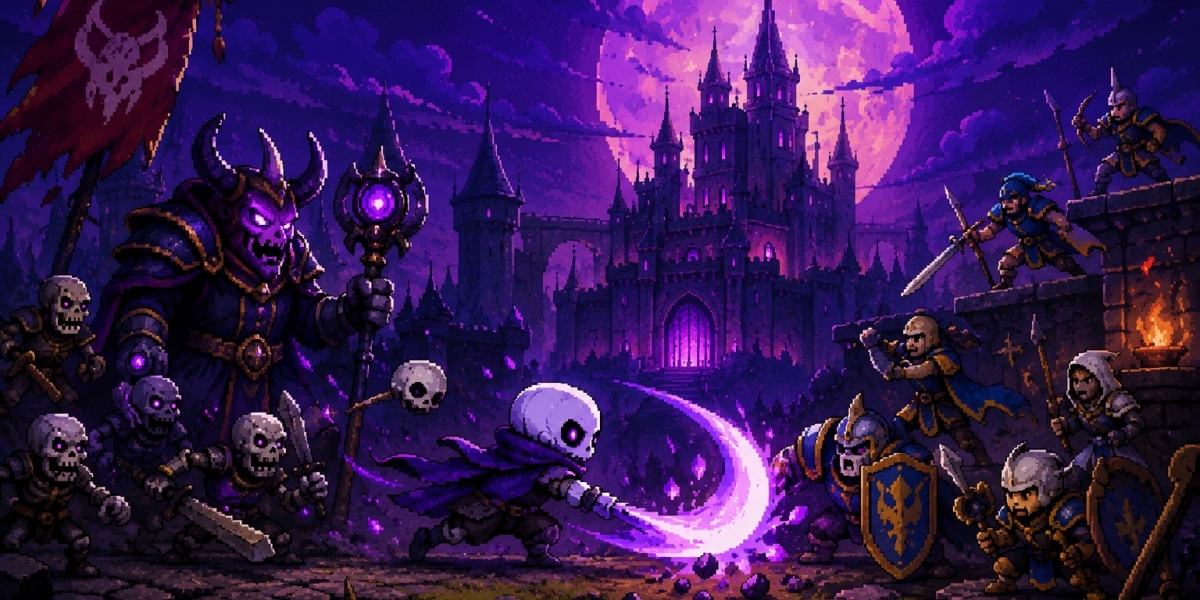

Many action games ask players to choose a character or combat style before a fight begins. Skul: The Hero Slayer takes a more flexible approach. Its small skeleton protagonist can change his abilities by swapping skulls, turning transformation into a regular part of combat rather than a decision that remains fixed throughout the adventure.
A Fantasy Conflict Seen From the Demon Side
The story begins after repeated human attacks on the Demon King's castle. This time, the Adventurers join forces with the Imperial Army and the Hero of Caerleon, creating an assault powerful enough to destroy the demon stronghold and capture its inhabitants.
Only Skul, a small skeleton belonging to the Demon's Guard, avoids imprisonment. His task is to confront the Imperial Army and rescue the Demon King.
This premise changes the usual perspective of a fantasy adventure. Adventurers are not friendly heroes encountered along the way. Instead, they are dangerous opponents who hunt demons for sport, while the character controlled by the player belongs to the side that has been attacked.
That reversal provides a straightforward reason for Skul's journey while also establishing the unusual tone of the game.
Skull Switching Changes the Meaning of One Character
Skul's most important characteristic is his ability to wear different skulls. Each one grants its own abilities and can differ in attack range, speed and power, meaning that changing skulls can significantly alter how the protagonist handles a fight.
Up to two skulls can be carried at the same time. More importantly, the player can switch between them during battle rather than waiting until an encounter ends.
The information presented by NEOWIZ makes this system central to the game's action, since different skull combinations allow players to adapt Skul to their preferred style while retaining the option to change tactics during combat. A pair of skulls can therefore function as two complementary approaches rather than as simple alternatives selected from a menu.
That distinction gives the mechanic practical importance. The protagonist remains the same small skeleton, but his available combat options can change considerably.
Why Two Skulls Create More Tactical Choice
Carrying two skulls creates an interesting relationship between preparation and reaction. The initial combination matters, yet players are not completely locked into one set of abilities once enemies appear.
Differences in range can influence positioning. Speed affects the rhythm with which attacks can be delivered, while power changes the offensive possibilities available to the player. Switching makes it possible to move between these characteristics according to the immediate situation.
The mechanic also supports experimentation. Instead of evaluating individual skulls in isolation, players can consider how two options work together.
This fits naturally with a rogue-lite game, where trying different combinations forms part of the broader experience.
Adventurers Are More Than Ordinary Enemies
During the journey, Skul encounters Adventurers who present a significant threat. The game's description characterizes them as powerful enemies who hunt demons for sport, giving them a role that differs sharply from the traditional image of fantasy adventurers.
Their presence reinforces the game's reversed viewpoint. From Skul's perspective, the celebrated human forces are the attackers responsible for the destruction of his home and the capture of his allies.
The Imperial Army and Hero of Caerleon form part of the same conflict. Together, these elements give the action a clear narrative purpose: Skul is not wandering without direction but fighting through the forces connected with the assault on the Demon King's castle.
Rogue-Lite Action Built Around Variety
Skul: The Hero Slayer is described as an action-packed rogue-lite 2D platformer. Its structure combines fast-paced battles with dozens of undead character combinations and abilities.
The skull system naturally supports this variety. Since different skulls change Skul's capabilities, new combinations can alter the way encounters are approached without requiring a completely different protagonist.
The presentation also uses fantastical pixel art graphics, giving the game a distinctive visual format alongside its fast combat and undead theme.
Together, these elements create a structure in which repeated challenges can involve different approaches. Variety comes not only from the enemies encountered but also from the abilities the player chooses to bring into battle.
One Simple Mechanic Creates Many Possibilities
The central idea behind Skul is easy to understand: a skeleton can replace his skull and gain different abilities. The depth comes from how that idea interacts with combat.
Attack range, speed and power can vary between skulls, two can be equipped simultaneously, and switching remains available during a fight. Those rules turn a visually unusual feature into a flexible gameplay system.
Combined with rogue-lite progression, fast-paced encounters, powerful Adventurers and the reversed story of demons fighting human invaders, the mechanic gives Skul: The Hero Slayer a recognizable identity. The protagonist may be a single small skeleton, but the ways available to play him are deliberately much broader.