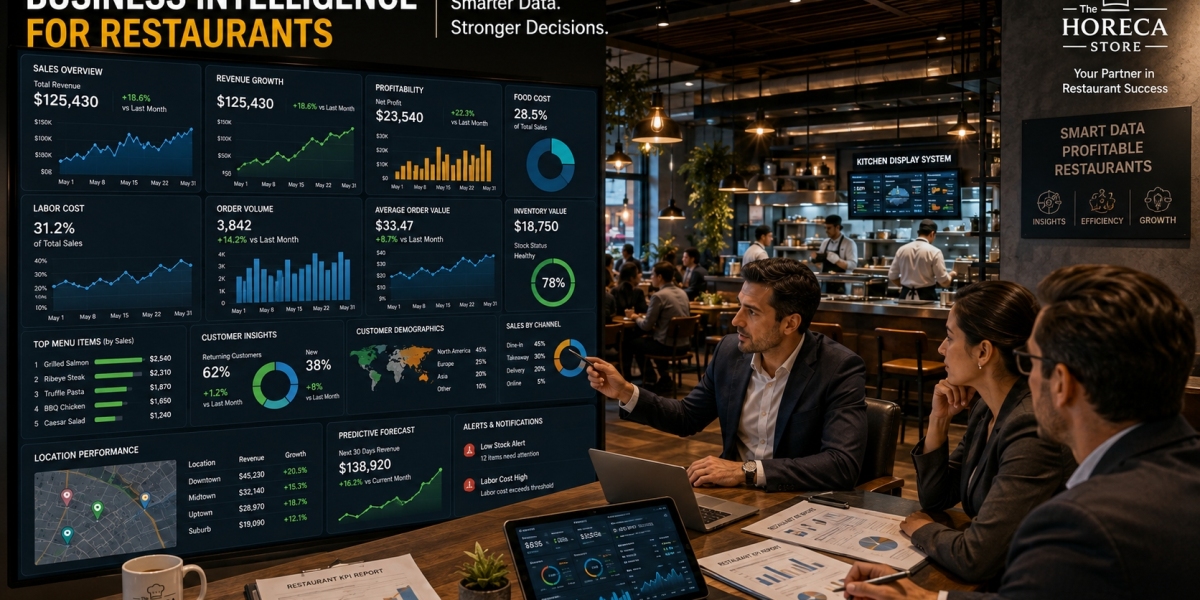

Running a successful restaurant requires more than great food and excellent service. Restaurant owners and managers must make decisions about staffing, inventory, pricing, marketing, customer experience, purchasing, and expansion every day. When these decisions are based mainly on intuition, it can be difficult to identify problems before they affect profitability.
This is where business intelligence for restaurants becomes valuable.
Business intelligence, commonly called BI, uses data, reporting, analytics, and visualization tools to transform restaurant information into actionable insights. Instead of looking at individual sales reports or inventory records separately, restaurant operators can combine information from multiple areas of the business to understand what is really happening.
From identifying the best-selling menu items to understanding labor costs and discovering underperforming locations, restaurant business intelligence can help operators make smarter decisions and improve long-term performance.
What Is Business Intelligence for Restaurants?
business intelligence for restaurants refers to the use of technology and data analysis to collect, organize, analyze, and interpret information related to restaurant operations.
Restaurant BI can bring together data from sources such as:
Point-of-sale systems
Online ordering platforms
Reservation systems
Inventory software
Labor and scheduling systems
Customer loyalty programs
Marketing platforms
Accounting systems
Location intelligence tools
Customer reviews
The purpose is not simply to collect more data. The goal is to turn data into information that restaurant owners can actually use.
For example, instead of simply knowing that sales increased by 10%, BI can help determine which menu categories generated the increase, which dayparts performed best, which locations contributed the most revenue, and whether higher sales also resulted in better profitability.
Why Restaurant Business Intelligence Matters
Restaurants operate on relatively tight margins, which means small inefficiencies can have a significant financial impact.
Business intelligence can help restaurant operators identify opportunities to:
Increase revenue
Reduce food waste
Control labor costs
Improve menu performance
Optimize inventory
Understand customers
Improve marketing
Compare locations
Forecast demand
Identify operational problems
The biggest advantage is that restaurant leaders can make decisions based on evidence rather than assumptions.
Track Restaurant Sales Performance
Sales analytics are one of the most common applications of restaurant BI.
A restaurant can analyze sales by:
Day
Week
Month
Hour
Location
Menu category
Individual item
Order channel
Customer segment
This information can reveal important patterns.
For example, a restaurant may discover that weekday lunch sales are strong but evening sales are weak. Management could then create targeted promotions or adjust operating hours.
Another restaurant may find that delivery generates significant revenue but produces lower margins because of commissions and packaging costs.
Understanding these differences allows managers to make better decisions.
Use BI to Improve Menu Performance
Menu analysis can help restaurants determine which items are contributing to revenue and profitability.
A BI dashboard can help categorize menu items based on factors such as popularity and profitability.
For example, menu items may fall into categories such as:
High popularity and high profitability
High popularity and low profitability
Low popularity and high profitability
Low popularity and low profitability
This analysis can guide menu engineering decisions.
Popular and profitable dishes may deserve greater visibility. Popular but low-margin items may require pricing or ingredient-cost adjustments. Poor-performing dishes may need to be redesigned or removed.
The objective is not simply to sell more food. It is to improve the financial performance of the overall menu.
Improve Inventory Management
Inventory is another area where restaurant business intelligence can provide significant value.
Restaurants must balance having enough inventory to meet demand without purchasing more food than necessary.
BI can help identify:
High-usage ingredients
Slow-moving inventory
Food waste
Purchasing patterns
Inventory discrepancies
Seasonal demand
Ingredient cost changes
Historical sales data can also help restaurants forecast future demand.
For example, if sales consistently increase during certain holidays or local events, management can prepare inventory in advance.
Better forecasting can reduce emergency purchases and minimize food waste.
Optimize Labor Costs
Labor is one of the largest operating expenses for many restaurants.
Business intelligence can help managers compare staffing levels with actual customer demand.
Analyze labor data alongside sales and traffic to identify:
Overstaffed shifts
Understaffed periods
Labor cost percentages
Employee productivity
Peak service periods
Overtime trends
If sales consistently drop after a certain hour, management may be able to adjust staffing accordingly.
On the other hand, if customer demand regularly exceeds staffing capacity during peak periods, additional employees may improve service and revenue.
The goal is to match labor resources with demand.
Understand Customer Behavior
Restaurants have access to more customer information than ever before.
Reservation systems, loyalty programs, online ordering, POS transactions, and digital marketing platforms can provide insights into customer behavior.
Business intelligence can help answer questions such as:
Who are your most frequent customers?
What menu items do they purchase?
When do they typically visit?
How often do they return?
Do they prefer dine-in, takeout, or delivery?
Which promotions generate repeat purchases?
These insights can help restaurants develop more personalized marketing campaigns.
Instead of sending the same promotion to every customer, restaurants can create campaigns based on customer behavior and preferences.
Improve Restaurant Marketing
Marketing performance should also be measured using data.
A restaurant may invest in social media advertising, email marketing, search marketing, loyalty programs, and promotional campaigns.
BI can help determine which channels generate actual business results.
Track metrics such as:
Customer acquisition
Repeat purchases
Campaign revenue
Conversion rates
Average order value
Customer retention
Promotion performance
This makes it easier to shift marketing budgets toward channels that produce measurable results.
Analyze Restaurant Locations
Business intelligence becomes particularly powerful when combined with location data.
Restaurant owners can evaluate potential and existing locations using demographic, competitive, customer, and market information.
This is especially important when planning restaurant expansion.
For example, a restaurant chain can compare locations based on:
Population
Household income
Customer demographics
Restaurant competition
Traffic
Nearby businesses
Market growth
Trade areas
Restaurant Site Finder can support this type of location-focused decision-making by helping restaurant owners discover and evaluate potential locations using data-driven insights.
For businesses planning expansion, combining operational BI with location intelligence can create a more complete view of performance.
Compare Multiple Restaurant Locations
Multi-unit restaurant operators can use BI to compare individual locations.
A centralized dashboard can reveal differences in:
Revenue
Average check size
Customer traffic
Labor costs
Food costs
Profitability
Customer retention
Delivery sales
This allows management to identify both top-performing and underperforming locations.
If one location consistently outperforms others, the company can investigate what factors are contributing to its success.
Those insights can potentially be applied to other locations.
Build Restaurant Forecasting Models
Historical data can help restaurants anticipate future performance.
Forecasting can be used for:
Sales
Inventory
Staffing
Customer traffic
Seasonal demand
Marketing performance
Accurate forecasts help restaurants prepare resources before demand occurs.
For example, a restaurant expecting unusually high weekend demand can schedule additional employees and increase inventory before the rush.
Forecasting reduces reactive decision-making and allows managers to operate more proactively.
Create a Restaurant BI Dashboard
A useful restaurant BI dashboard should focus on the metrics that actually influence business decisions.
Important restaurant KPIs may include:
| KPI | What It Measures |
|---|---|
| Total Sales | Overall revenue |
| Average Order Value | Customer spending |
| Food Cost Percentage | Ingredient cost efficiency |
| Labor Cost Percentage | Staffing efficiency |
| Gross Profit | Financial performance |
| Table Turnover | Dining room efficiency |
| Customer Retention | Repeat business |
| Inventory Waste | Food efficiency |
| Sales by Menu Item | Menu performance |
| Sales by Location | Unit performance |
Avoid creating dashboards filled with unnecessary metrics.
The best dashboard gives managers the information they need to take action quickly.
Challenges of Implementing Restaurant BI
Although business intelligence provides major benefits, implementation can present challenges.
One common issue is fragmented data. Restaurants may use separate systems for POS, accounting, inventory, labor, reservations, and online ordering.
Another challenge is data quality. Incorrect, incomplete, or inconsistent data can produce misleading results.
Staff adoption is another important consideration. Employees and managers need to understand how analytics can help them rather than viewing BI as unnecessary administrative work.
Start with a small number of important metrics and gradually expand the system.
How to Get Started With Restaurant Business Intelligence
Restaurants do not need to build a complicated analytics operation immediately.
Start by identifying your biggest business questions.
For example:
Why are food costs increasing?
Which menu items are most profitable?
Which shifts are overstaffed?
Which marketing campaigns generate customers?
Which locations perform best?
Where should the next restaurant open?
Then identify the data needed to answer those questions.
Next, centralize relevant information and create simple dashboards.
Most importantly, turn insights into action.
Data is valuable only when it changes decisions and improves business performance.
The Future of Business Intelligence for Restaurants
Restaurant analytics will continue becoming more sophisticated as businesses collect more operational and customer data.
Artificial intelligence, predictive analytics, automation, real-time dashboards, and location intelligence can help restaurant operators move from analyzing historical performance to predicting future opportunities.
Restaurants may increasingly use data to determine when to adjust staffing, which menu items to promote, how much inventory to order, where to open new locations, and which customers to target.
This shift toward predictive decision-making can give data-driven restaurants a significant competitive advantage.
Conclusion
business intelligence for restaurants provides a powerful way to turn operational data into practical business decisions.
From sales and inventory to labor, customer behavior, marketing, menu performance, and restaurant locations, BI can help owners understand what is working and where improvements are needed.
The most successful approach is not simply collecting large amounts of information. Restaurants need to focus on the metrics that directly influence profitability and customer experience.
For restaurant owners planning expansion, combining business intelligence with location intelligence can be especially valuable. Platforms such as Restaurant Site Finder can help businesses evaluate potential restaurant locations using important market and competitive factors.
When restaurant operators combine reliable data with experience and strategic decision-making, they can reduce uncertainty, improve operational efficiency, and build stronger foundations for sustainable growth.