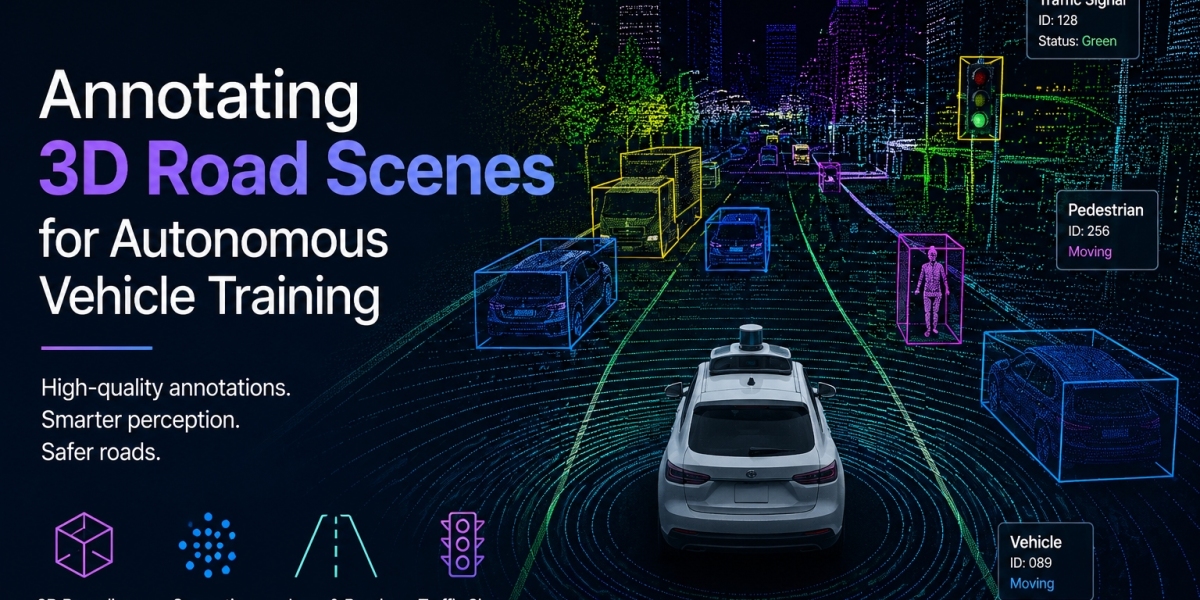

Autonomous vehicles depend on perception systems that can interpret complex road environments with speed and precision. Cameras, LiDAR sensors, radar, and other technologies continuously capture information about vehicles, pedestrians, road markings, traffic signs, buildings, and surrounding infrastructure. However, raw sensor data alone is not enough to train reliable autonomous driving models. It must be accurately labeled so machine learning systems can understand what they are seeing.
This is where data annotation for Autonomous Vehicle applications becomes essential. Among the most valuable datasets are annotated 3D road scenes, which provide machines with detailed spatial information about the driving environment. With high-quality 3D annotation, developers can train perception models to identify objects, estimate distances, understand road geometry, and make safer driving decisions.
What Is 3D Road Scene Annotation?
3D road scene annotation is the process of adding structured labels to three-dimensional sensor data captured from vehicles operating in real-world environments. Instead of simply identifying an object in a flat image, annotators define its position, dimensions, orientation, and class within a three-dimensional space.
These scenes can be generated using technologies such as LiDAR, which produces point clouds containing millions of spatial measurements. When annotated correctly, these point clouds allow AI models to distinguish between objects and understand their location relative to the autonomous vehicle.
Common annotation types include:
3D bounding boxes around vehicles, pedestrians, cyclists, and other objects
Semantic segmentation of individual points
Cuboid annotation for object dimensions and orientation
Lane and road-edge annotation
Traffic sign and traffic signal labeling
Drivable-area identification
Object tracking across multiple frames
Point-level classification of road infrastructure and environmental elements
Together, these annotations create training data that more closely represents how an autonomous vehicle perceives its surroundings.
Why 3D Annotation Matters for Autonomous Vehicles
A vehicle navigating a road must understand more than the visual appearance of objects. It needs to know where objects are located, how far away they are, whether they are moving, and how they relate to the vehicle's path.
For example, a camera image may show a pedestrian standing near a road. A 3D point cloud can provide additional information about the pedestrian's depth, position, height, and relationship to nearby vehicles or infrastructure. This spatial context can significantly improve perception and decision-making models.
Accurate 3D annotations support several critical autonomous driving capabilities, including:
1. 3D Object Detection
Object detection models need to identify road users and estimate their three-dimensional position. Annotated 3D bounding boxes provide models with examples of object size, location, and orientation, helping them recognize similar objects in unseen environments.
2. Object Tracking
Autonomous vehicles must continuously track moving objects rather than detecting them only once. Frame-by-frame annotation allows machine learning systems to learn how vehicles, cyclists, and pedestrians move through a scene.
3. Lane and Road Understanding
Road geometry is often complex. Curves, intersections, merging lanes, construction zones, and poorly marked roads can challenge perception systems. Annotation of lanes, road boundaries, curbs, and drivable surfaces helps models develop a more comprehensive understanding of road structure.
4. Sensor Fusion
Modern autonomous vehicles frequently combine camera, LiDAR, and radar data. Properly annotated datasets help align information from different sensors, allowing perception systems to combine visual, spatial, and motion-related information more effectively.
Key Challenges in Annotating 3D Road Scenes
Creating high-quality 3D datasets is considerably more demanding than labeling conventional images. The complexity of the data introduces several challenges.
Managing Large Point Clouds
A single LiDAR scan can contain an enormous number of points. Annotators must distinguish relevant objects from dense environmental information while maintaining accuracy. Efficient annotation platforms and optimized workflows are therefore essential for handling large datasets.
Occlusion and Object Overlap
Objects can partially or completely obscure one another. A pedestrian may be hidden behind a vehicle, while several cars may overlap from the sensor's perspective. Annotators must use contextual information and neighboring frames to determine object boundaries accurately.
Challenging Environmental Conditions
Rain, fog, darkness, glare, dust, and snow can affect sensor data. Construction areas and unusual road layouts can create additional ambiguity. Training datasets should include these challenging scenarios so perception models are exposed to diverse driving conditions.
Maintaining Annotation Consistency
Large autonomous driving datasets are often labeled by multiple annotators. Without clear guidelines, different annotators may interpret object boundaries, classes, or occlusions differently. Consistent annotation standards, quality checks, and reviewer validation are therefore critical.
Best Practices for High-Quality 3D Annotation
A structured annotation workflow can improve both dataset quality and operational efficiency.
Define detailed annotation guidelines: Establish clear rules for object classes, occlusion levels, boundaries, orientation, road markings, and difficult cases before production begins.
Use specialized annotation tools: Platforms designed for 3D point clouds can provide features such as synchronized sensor views, automatic interpolation, object tracking, and efficient cuboid creation.
Apply multi-stage quality control: Automated validation can identify missing labels, inconsistent classes, and geometric errors, while human reviewers can evaluate complex cases.
Annotate diverse scenarios: A strong training dataset should represent urban roads, highways, intersections, residential areas, tunnels, parking zones, varying weather, different lighting conditions, and unpredictable traffic situations.
Combine automation with human expertise: AI-assisted pre-labeling can accelerate repetitive tasks, while skilled annotators verify and correct model-generated labels. This human-in-the-loop approach can improve scalability without sacrificing accuracy.
How Annotera Supports 3D Autonomous Driving Data
For autonomous vehicle developers, the value of a dataset depends heavily on annotation quality. Inaccurate labels can introduce noise into training data and potentially affect downstream perception performance.
Annotera provides specialized data annotation for Autonomous Vehicle projects, supporting workflows involving 2D imagery, 3D point clouds, LiDAR, object detection, semantic segmentation, cuboid annotation, and tracking. By combining defined annotation protocols, trained teams, and quality assurance processes, Annotera helps organizations transform complex sensor data into structured datasets suitable for machine learning development.
The focus is not simply on labeling more data, but on producing consistent, reliable, and application-specific training datasets.
Building the Foundation for Safer Autonomous Driving
Autonomous driving systems must operate in environments that are constantly changing. A parked vehicle, a cyclist entering an intersection, a pedestrian crossing unexpectedly, or a temporary construction barrier can all influence driving decisions. Training models to recognize these situations requires datasets that accurately capture the spatial complexity of real-world roads.
Annotated 3D road scenes provide that foundation. By transforming raw LiDAR point clouds and other sensor data into structured, machine-readable information, annotation enables AI systems to learn how objects exist and interact within three-dimensional environments.
As autonomous vehicle technology advances, the demand for detailed, diverse, and accurately labeled 3D datasets will continue to grow. Organizations that invest in robust annotation processes can build stronger perception models and create a more dependable foundation for autonomous driving innovation.
For businesses developing next-generation autonomous vehicle technologies, partnering with an experienced annotation provider can help accelerate dataset development while maintaining the quality and consistency required for demanding AI applications. Connect with Annotera to explore scalable data annotation solutions tailored to your autonomous vehicle training requirements.