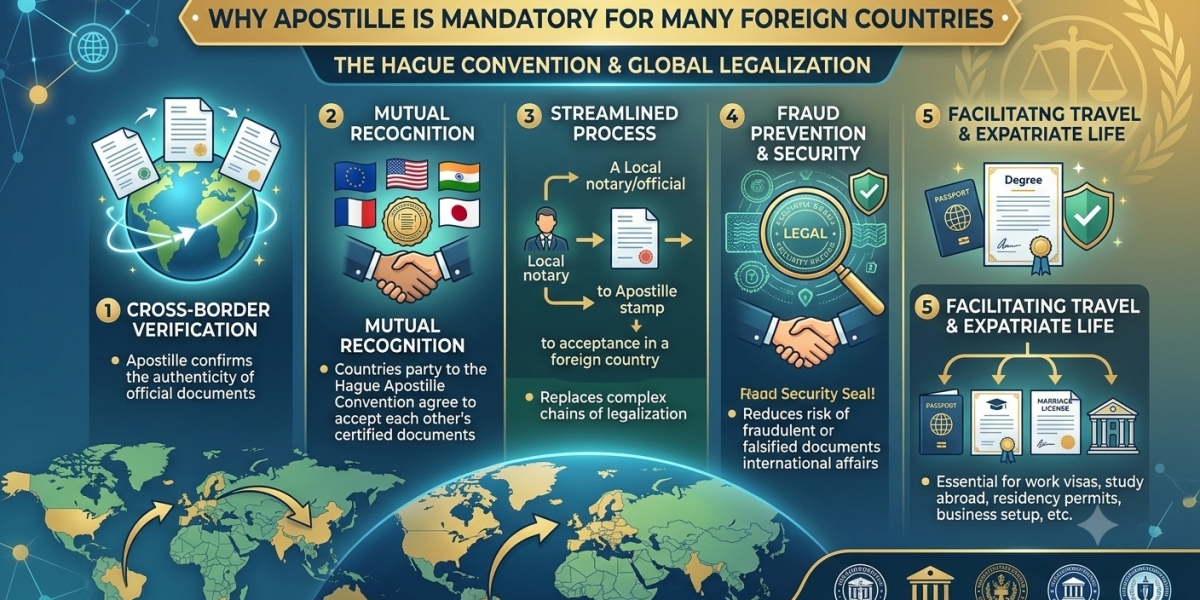

When documents issued in one country are presented for official purposes in another, foreign authorities need a reliable way to verify their authenticity. Apostille services in chennai help individuals and businesses prepare documents for international use by obtaining an apostille through the appropriate authorities. An apostille is an official authentication certificate attached to or placed on a public document, confirming the authenticity of the signature, seal, or stamp on that document. For countries that are members of the Hague Apostille Convention, this process simplifies international document authentication and removes the need for lengthy traditional legalization procedures.
What Is an Apostille?
An apostille is a certificate issued by a competent authority in the country where a public document was issued. Its purpose is not to certify that the information written in the document is true or accurate. Instead, it verifies specific formal elements, such as the authenticity of the signature, the capacity in which the person signing the document acted, and the identity of the seal or stamp.
For example, if an Indian birth certificate needs to be submitted to an authority in another Hague Convention country, the receiving authority may require the document to carry an apostille. The apostille provides a standardized form of authentication that can be recognized by the destination country.
This system was created to make international document use easier, faster, and more consistent. Without it, people may need to complete several stages of authentication and legalization before a document can be accepted overseas.
Why Do Foreign Countries Require Apostille?
Foreign governments cannot automatically assume that a document issued in another country is genuine. A certificate issued by a local government office, educational institution, or other authority may not be immediately recognizable to officials in another country.
Apostille provides a standardized method of confirming the document's formal authenticity. This gives foreign authorities greater confidence when accepting documents from overseas.
The requirement can apply to documents needed for:
- Immigration and residency applications
- Marriage registration
- Family visa applications
- Employment overseas
- Educational admissions
- Professional licensing
- Business transactions
- International legal proceedings
- Citizenship or nationality applications
- Property and financial matters
The exact requirements depend on the country where the document will be submitted and the purpose for which it is being used.
Common Documents That Need Apostille
Different types of public and official documents may require apostille depending on the destination country's requirements. Personal documents are particularly common in immigration, family, and residency matters.
A birth certificate may be required when proving identity, age, parentage, or family relationships. People moving abroad for work, study, residency, or family reunification may need their birth records authenticated before submission.
For individuals handling overseas documentation from Telangana or elsewhere in India, birth certificate apostille in hyderabad can be relevant when a birth certificate must be submitted to an authority in a Hague Convention country. Proper document verification and authentication are important because incomplete or incorrectly prepared documents may cause delays.
Marriage documents are another major category. Foreign authorities may request proof of a legally registered marriage when processing spouse visas, dependent visas, immigration applications, or marriage registrations.
Applicants dealing with overseas documentation may require marriage certificate apostille in hyderabad when their marriage certificate needs to be presented in an eligible foreign country. The document generally needs to go through the applicable authentication process before the apostille is issued.
Educational documents are also frequently used internationally. Students and professionals may need to submit degree certificates when applying for higher education, employment, professional registration, or immigration.
For applicants with educational documents issued in India, degree certificate apostille in hyderabad may be required when a foreign institution or authority requests an apostilled educational qualification. The authentication process depends on the type of certificate and the applicable issuing or verifying authority.
Apostille vs. Traditional Legalization
Before the Hague Apostille Convention, international document authentication could involve multiple authorities. A document might need authentication in the issuing country, followed by legalization through an embassy or consulate of the destination country.
The apostille system simplified this process for participating countries.
Instead of obtaining separate legalization through the destination country's diplomatic mission, an apostille can generally be issued by the designated competent authority in the country where the document originated.
This does not mean that every foreign country accepts apostilles. The destination country must be part of the applicable Hague Apostille system, and the document must meet the requirements of both the issuing country and the receiving authority.
Countries outside the Hague Apostille Convention may have different legalization or embassy-attestation procedures.
How the Apostille Process Works in India
The process depends on the type of document. Personal, educational, and commercial documents may have different authentication requirements.
A typical process may involve:
1. Document verification
The document is first checked to determine whether it is genuine, complete, and suitable for authentication.
2. State-level or departmental authentication
Depending on the document, authentication or verification may be required from the relevant state authority, Home Department, General Administration Department, Sub-Divisional Magistrate, educational authority, or another designated body.
3. Submission for apostille
After the required preliminary authentication, the document is submitted through the applicable process for apostille.
4. Apostille issuance
The competent authority verifies the relevant signature, seal, or stamp and issues the apostille.
5. Submission abroad
Once apostilled, the document can be presented to the foreign authority, institution, employer, or organization requesting it, subject to that organization's specific requirements.
Because requirements can vary by document and destination, applicants should verify the current requirements before beginning the process.
Is Apostille Required for Every Foreign Country?
No. Apostille is primarily relevant when documents are being used between countries covered by the Hague Apostille Convention.
If the destination country is not part of the Convention, a different authentication process may apply. This can include document authentication followed by embassy or consular legalization.
It is therefore important not to assume that an apostille is required simply because a document is being sent abroad. The destination country, document type, purpose of use, and instructions from the receiving authority all matter.
Why Proper Document Preparation Matters
One of the most common reasons for delays is submitting a document that does not meet the applicable authentication requirements. Problems may include damaged documents, incorrect certificates, missing signatures or seals, outdated records where a specific authority requires recent documents, or failure to complete an earlier authentication stage.
Applicants should also check whether the receiving organization requires an original document, a certified copy, a translated version, or additional authentication.
Translation requirements are especially important when the destination authority does not accept documents in the language in which they were issued. In some cases, an officially certified translation may be required in addition to apostille.
Role of Professional Apostille Service Providers
Handling international document authentication can be confusing because procedures differ according to the document and destination country. Secure Apostille Services assists applicants with document checking, submission, authentication coordination, and apostille processing.
A professional service provider can help identify the applicable process and reduce avoidable errors. However, applicants should always confirm the final requirements with the foreign authority receiving their documents because individual institutions and government departments can impose additional conditions.
Conclusion
Apostille is mandatory for many international document-use situations because foreign authorities need a standardized method of verifying the authenticity of public documents issued in another country. The Hague Apostille system makes this verification easier by replacing more complicated legalization procedures between participating countries.
Birth certificates, marriage certificates, degree certificates, and other official documents may require apostille depending on the destination and purpose. Understanding the requirements before submitting documents can help prevent unnecessary delays.
For anyone preparing documents for international use, the most important steps are to identify the destination country's requirements, determine the correct authentication procedure, ensure that the document is eligible, and complete the required process before presenting it overseas.