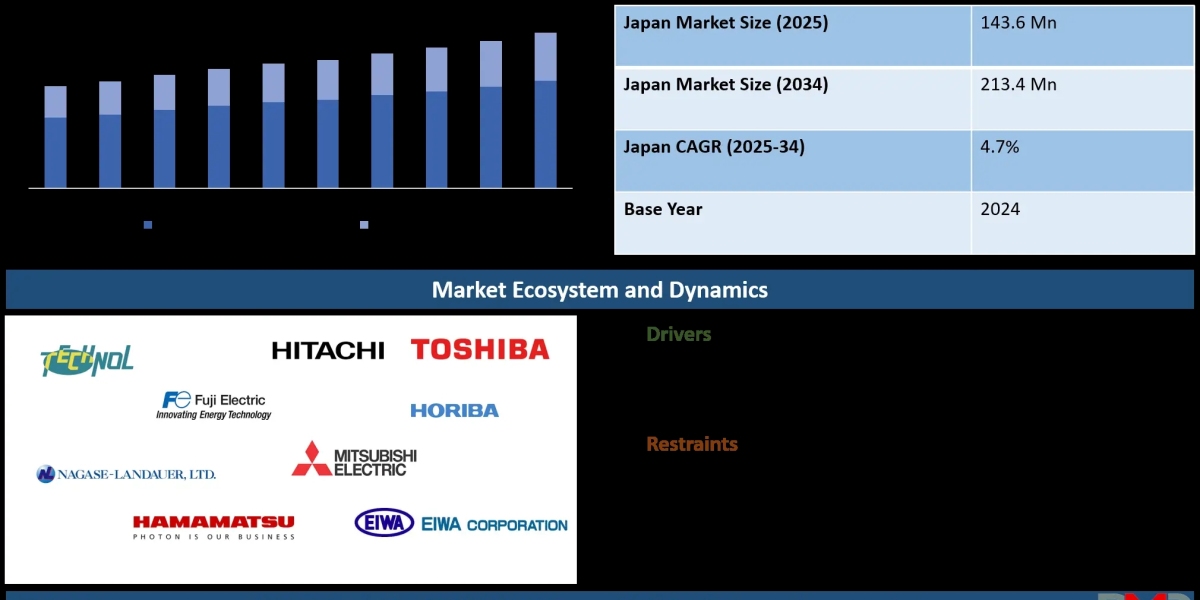

According to Dimension Market Research, the Japan Dosimetry Equipment Market is steadily expanding as healthcare facilities, nuclear operators, industrial organizations, and research institutions strengthen radiation-protection programs. The market is estimated at USD 143.6 million in 2025 and is projected to reach USD 213.4 million by 2034, registering a CAGR of 4.7%.
Dosimetry equipment measures, monitors, and records exposure to ionizing radiation. Products include electronic personal dosimeters, thermoluminescent dosimeters, optically stimulated luminescence dosimeters, film badges, and related monitoring technologies.
Japan's mature radiation-safety infrastructure, healthcare modernization, nuclear-sector requirements, industrial inspection, and research activities are supporting demand. At the same time, wearable devices, IoT connectivity, cloud platforms, and AI-based analytics are helping transform radiation monitoring into a more connected and responsive process.
Explore the Japan Dosimetry Equipment Market Report
Radiation Safety Drives Equipment Adoption
Radiation exposure must be carefully managed wherever ionizing radiation is used.
Hospitals and diagnostic centers use X-ray, CT, nuclear medicine, and radiotherapy technologies. Industrial companies use radiation-based inspection and non-destructive testing, while nuclear facilities require monitoring for workers and controlled areas.
Dosimetry equipment helps organizations measure cumulative exposure and maintain appropriate radiation-safety practices.
Japan's emphasis on occupational safety and radiation monitoring provides a stable foundation for continued equipment demand.
Electronic Personal Dosimeters Gain Importance
Electronic Personal Dosimeters (EPDs) are expected to account for 43.0% of market share in 2025, making them the leading product category.
EPDs provide electronic readings of radiation exposure and can deliver immediate information to users.
Modern devices may include digital displays, alarms, memory storage, Bluetooth connectivity, and wireless communication.
These capabilities are particularly valuable in environments where workers need immediate awareness of changing radiation conditions.
The combination of real-time monitoring and digital data storage is increasing the value of EPDs across healthcare, nuclear, and industrial applications.
Passive Dosimetry Remains Dominant
Passive dosimetry is projected to capture approximately 69.0% of the technology segment in 2025.
Passive devices, including TLDs and film badges, record accumulated exposure over a defined monitoring period.
They remain attractive because of their stability, simplicity, and suitability for routine occupational monitoring.
Active dosimetry complements this approach by providing real-time exposure information and alerts.
Japan therefore represents a market where established passive monitoring continues alongside the gradual expansion of digital active systems.
Healthcare Represents the Largest Application
Medical applications are expected to account for approximately 53.0% of the market in 2025.
Radiation is widely used in diagnostic imaging and cancer treatment.
Hospitals, diagnostic centers, and oncology facilities need appropriate dosimetry programs for personnel working around radiation-producing equipment.
Dosimeters can help monitor occupational exposure and support radiation-safety procedures.
The continuing use of advanced imaging and radiotherapy technologies will maintain healthcare as a major demand center.
Healthcare Facilities Lead End Users
Healthcare facilities are projected to represent 37.0% of the market in 2025, making them the leading end-user segment.
Hospitals and diagnostic centers can use personal dosimeters to monitor staff exposure and area-monitoring solutions to evaluate radiation environments.
Digital systems can simplify exposure records and improve access to monitoring information.
Cloud-connected platforms can also support centralized data management for organizations operating multiple departments or facilities.
Nuclear Power Strengthens Monitoring Requirements
Nuclear power remains an important application for radiation-monitoring technologies.
Personnel working around nuclear facilities require reliable exposure monitoring, while area-monitoring systems help identify changing radiation conditions.
Electronic personal dosimeters can provide immediate alerts, while passive systems can provide cumulative records for routine monitoring.
The continued emphasis on nuclear safety and radiological preparedness supports demand for accurate and reliable dosimetry equipment.
Industrial Inspection Creates Additional Demand
Japanese manufacturing and industrial inspection industries use radiation technologies for non-destructive testing and material analysis.
Industrial radiography and X-ray-based inspection can help examine components without damaging them.
Workers operating this equipment require appropriate radiation-monitoring systems.
Portable and wearable dosimeters can support mobile industrial teams while providing exposure information across different work areas.
Research and Environmental Monitoring Expand Applications
Research institutes and universities use radiation-related equipment in nuclear physics, material science, medical research, and other scientific activities.
Environmental monitoring programs also require radiation measurement in selected locations.
Portable instruments can support field measurements, while connected monitoring networks can provide centralized access to collected information.
These applications broaden the market beyond conventional healthcare and nuclear use.
Wearable Dosimeters Improve Worker Awareness
Wearability is becoming increasingly important in radiation monitoring.
Compact dosimeters can be worn comfortably while workers perform routine activities.
A wearable device can provide immediate exposure information without requiring personnel to repeatedly access larger monitoring instruments.
Wireless communication can further allow readings to be transferred to centralized systems.
The combination of portability, real-time measurement, and connectivity is expected to remain a major product-development direction.
IoT Creates Connected Radiation Networks
Internet of Things technology is helping connect individual dosimeters with larger monitoring systems.
Networked devices can send exposure information to centralized platforms for storage and analysis.
Radiation-safety managers can potentially monitor multiple workers or locations through a common interface.
This can improve data visibility and simplify the management of large occupational-monitoring programs.
AI Supports Radiation Data Analysis
Artificial intelligence is creating new opportunities for analyzing radiation-monitoring data.
Large-scale exposure datasets can contain patterns that may be difficult to identify through manual review.
AI algorithms can potentially detect unusual readings, identify anomalies, evaluate historical exposure trends, and support automated reporting.
In healthcare, AI-enabled systems can also support more advanced radiation-dose analysis associated with imaging and radiotherapy.
AI therefore adds an analytical layer to established dosimetry technologies.
Cloud Platforms Improve Exposure Management
Cloud-based data management can centralize information from connected dosimeters and monitoring systems.
Organizations can store historical exposure records, generate reports, and manage information across multiple facilities.
Centralized systems can also make collaboration between radiation-safety teams easier.
For large hospitals and industrial operators, cloud-based monitoring can reduce dependence on disconnected local databases and manual reporting.
Predictive Maintenance Improves Equipment Reliability
Dosimetry equipment requires regular calibration, maintenance, and performance verification.
Digital systems can collect information about equipment operation and identify unusual behavior.
Predictive maintenance can help organizations recognize potential device problems before they affect monitoring reliability.
This approach can reduce unexpected downtime while supporting longer equipment lifecycles.
Japan Strengthens Emergency Radiation Preparedness
Radiological emergency response represents a specialized application for dosimetry equipment.
Emergency personnel may require portable devices capable of rapidly determining exposure levels in changing environments.
Durability, portability, rapid readings, and clear alerts are particularly important in these situations.
Japan's emphasis on emergency preparedness creates opportunities for advanced portable radiation-monitoring technologies.
Regulatory Compliance Remains Essential
Radiation-safety programs depend on appropriate exposure monitoring and accurate records.
Healthcare facilities, nuclear organizations, industrial companies, and research institutions need equipment capable of supporting relevant safety requirements.
Digital monitoring systems can simplify the collection and storage of exposure data.
Automated reporting can also reduce administrative workloads while improving the traceability of monitoring records.
High Equipment Costs Present a Challenge
Advanced electronic and connected dosimetry devices can require substantial investment.
Organizations may also incur costs related to calibration, maintenance, software updates, networking, and technical support.
Smaller facilities may therefore continue to use simpler passive systems for routine monitoring.
Manufacturers can address this challenge through scalable products, service packages, and technologies designed to reduce lifecycle costs.
Legacy Integration Creates Complexity
Many organizations have established radiation-monitoring infrastructure.
Introducing IoT-enabled and AI-supported systems may require integration with existing hardware and software.
Different communication protocols and data formats can create technical challenges.
Suppliers that provide interoperability and implementation support can help customers modernize their monitoring systems without replacing every existing component.
Skilled Professionals Remain Important
Advanced monitoring systems still require qualified personnel.
Radiation-safety professionals need to understand measurement principles, exposure limits, calibration, and regulatory requirements.
AI and automation can reduce repetitive data-analysis tasks, but human expertise remains necessary for interpreting abnormal results and determining appropriate responses.
Training and technical support will therefore remain important as digital dosimetry adoption increases.
Competitive Landscape
The Japanese market includes domestic radiation-monitoring companies, electronics manufacturers, industrial technology providers, and specialized dosimetry businesses.
Prominent companies identified by Dimension Market Research include Chiyoda Technol Corporation, Fuji Electric Co. Ltd., Nagase Landauer Ltd., Hamamatsu Photonics K.K., Hitachi Ltd. (Hitachi Aloka), Mitsubishi Electric Corporation, Toshiba Corporation, Horiba Ltd., Eiwa Corporation, Azbil Corporation, Ohyo Koken Kogyo Co. Ltd., and Acrorad Co. Ltd.
Competition is centered on measurement accuracy, real-time monitoring, product reliability, portability, digital connectivity, data management, and technical support.
Future Outlook
The Japan Dosimetry Equipment Market is forecast to increase from USD 143.6 million in 2025 to USD 213.4 million by 2034, representing a 4.7% CAGR.
EPDs will remain a key product category, while passive dosimetry will continue to dominate routine technology use.
Healthcare will remain the largest application and end-user segment, supported by diagnostic imaging and radiotherapy.
Nuclear facilities, industrial inspection, research, environmental monitoring, and emergency response will contribute additional demand.
The next stage of development will be strongly influenced by wearable devices, IoT networks, cloud-based data management, AI analytics, automated reporting, and predictive maintenance.
Conclusion
The Japan Dosimetry Equipment Market is evolving from conventional exposure measurement toward connected and intelligent radiation-safety management.
The healthcare sector remains at the center of demand, while nuclear power, industrial inspection, research, and environmental monitoring broaden the market's application base.
EPDs are gaining importance because they provide rapid digital exposure information, while passive dosimetry continues to support dependable routine monitoring.
IoT and cloud platforms are improving connectivity and centralized data management. Artificial intelligence can further support anomaly detection, exposure analysis, predictive maintenance, and automated reporting.
Japan's strong focus on radiation protection and advanced technology provides a favorable foundation for steady market growth.
With the market expected to reach USD 213.4 million by 2034, future opportunities will increasingly depend on combining measurement precision with wearable designs, real-time alerts, digital connectivity, intelligent analytics, and reliable technical support.