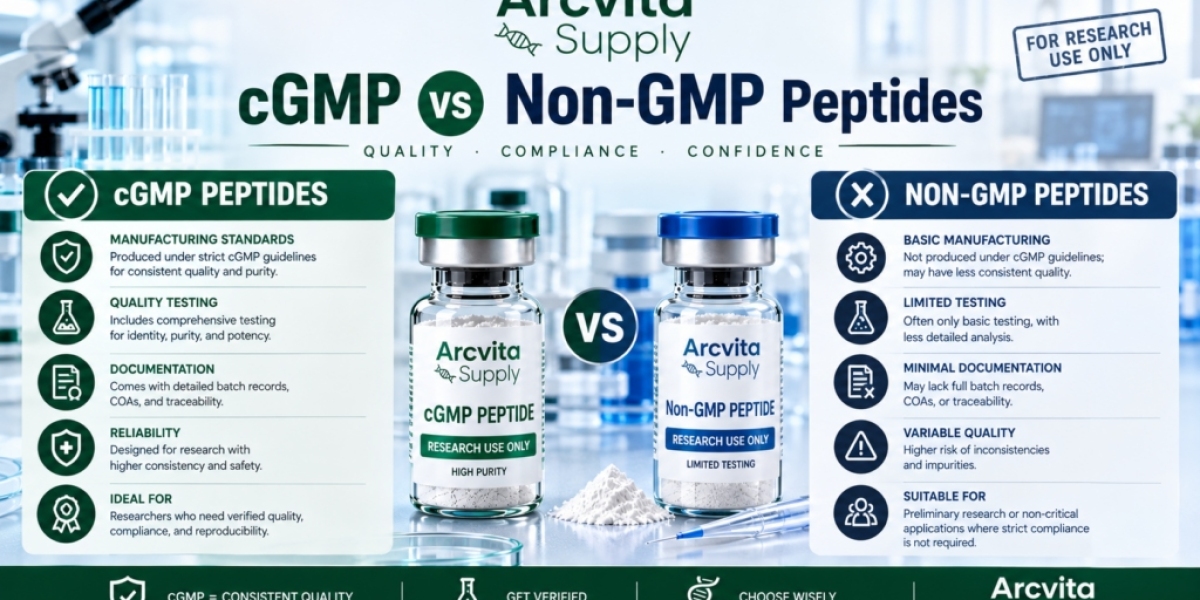

Researchers working with peptide materials need reliable information about manufacturing standards, quality documentation, analytical testing, storage, and intended use. One important distinction is cGMP vs Non-GMP Peptides. Understanding this difference can help laboratories evaluate research materials more carefully and avoid confusing manufacturing standards with product purity or regulatory status.
The terms cGMP and non-GMP describe different approaches to manufacturing and quality management. They should not automatically be interpreted as a simple comparison between “high quality” and “low quality.” Instead, researchers should examine the complete quality documentation, testing methods, manufacturing controls, and intended research application before selecting a material.
What Does cGMP Mean?
cGMP stands for current Good Manufacturing Practice. It refers to established manufacturing and quality-control requirements designed to help ensure that products are consistently produced and controlled according to defined standards.
In a controlled manufacturing environment, cGMP principles can involve documented procedures, controlled production processes, equipment management, personnel training, quality systems, recordkeeping, and appropriate testing.
For research materials, understanding the manufacturing framework can provide useful context when evaluating how a material was produced and documented. However, cGMP status should not be treated as a guarantee that every individual batch has a specific purity level or that a material is suitable for every research purpose.
Quality assessment should always consider the specific product, batch, testing data, and documentation available.
What Are Non-GMP Peptides?
Non-GMP peptides are materials manufactured outside a cGMP manufacturing framework. They may be produced specifically for laboratory research, analytical work, method development, or other scientific applications.
Non-GMP does not automatically mean that a material is unusable or inherently poor quality. The appropriate evaluation depends on the research objective and the available evidence.
Researchers should review information such as:
- Product identity
- Batch or lot information
- Analytical purity
- Testing methodology
- Certificate of Analysis
- Storage requirements
- Manufacturing documentation
- Supplier quality procedures
- Intended research use
A transparent documentation process can make it easier for researchers to understand what they are purchasing and how the material was evaluated.
cGMP vs Non-GMP Peptides: Key Difference
The primary difference concerns the manufacturing and quality-management framework.
cGMP manufacturing involves a formal system of controls and documented procedures intended to support consistent production and quality management. Non-GMP manufacturing does not operate under the same cGMP framework.
However, this distinction does not mean researchers should evaluate materials using the manufacturing label alone.
For example, a product described as cGMP may still require review of its batch-specific testing documentation. Likewise, a non-GMP research material may have analytical data demonstrating its reported identity and purity.
Therefore, researchers should consider multiple quality indicators rather than relying on a single designation.
Why Research Peptide Quality Testing Matters
Research peptide quality testing is an important part of material evaluation. Testing can provide information about characteristics such as identity and analytical purity.
Common analytical approaches may include high-performance liquid chromatography (HPLC) and mass spectrometry, depending on the material and testing requirements.
HPLC can be used to assess chromatographic purity, while mass spectrometry can help confirm molecular identity or molecular mass. Different analytical methods answer different questions, so researchers should understand what a reported test actually demonstrates.
A purity percentage by itself does not necessarily provide complete information about a material. Testing methodology, sample preparation, reporting practices, and laboratory controls also matter.
For this reason, batch-specific analytical documentation can be more useful than broad claims made on a product page.
Understanding Certificates of Analysis
A Certificate of Analysis, commonly called a CoA, is an important document for evaluating laboratory materials.
A useful CoA may include information such as:
- Product or material name
- Batch or lot number
- Test date
- Testing method
- Analytical results
- Reported purity
- Identity information
- Laboratory or testing organization
Researchers should check whether the CoA corresponds to the specific batch being evaluated. A generic document that does not identify the relevant batch may provide less useful information than batch-specific documentation.
Researchers should also understand that a CoA is only one part of quality assessment. It should be considered alongside manufacturing information, storage conditions, supplier practices, and research requirements.
Manufacturing Quality and Purity Are Not the Same
One of the most important concepts when comparing cGMP and non-GMP materials is that manufacturing standards and analytical purity are different concepts.
Manufacturing controls describe how a material is produced, controlled, documented, and managed. Analytical testing provides information about particular characteristics measured through specific laboratory methods.
A material can therefore have analytical purity information without being manufactured under a cGMP system.
Similarly, identifying a material as cGMP does not eliminate the need to review available analytical and batch documentation.
Researchers should avoid assuming that one label answers every quality question.
Storage and Handling Considerations
Proper storage is another important part of maintaining research material quality.
Researchers should follow the manufacturer's documented storage instructions and applicable laboratory procedures. Storage requirements can vary depending on the material, formulation, packaging, temperature sensitivity, moisture sensitivity, and other characteristics.
Important considerations may include:
- Appropriate temperature
- Protection from excessive moisture
- Protection from unsuitable environmental conditions
- Proper labeling
- Secure laboratory storage
- Avoidance of unnecessary temperature fluctuations
- Maintaining batch identification
Researchers should always refer to the applicable product documentation rather than assuming that every peptide requires identical storage conditions.
Good storage practices can help preserve material integrity throughout the intended research period.
USA-Made Research Peptides: What Should Researchers Check?
Some laboratories may specifically look for USA-made research peptides when evaluating potential suppliers. Geographic origin can be useful information, but it should not be treated as a substitute for quality evidence.
A responsible evaluation should consider:
- Manufacturing information
- Batch documentation
- Analytical testing
- Certificate of Analysis
- Product identity
- Supplier transparency
- Storage information
- Intended research use
- Applicable legal requirements
Country of origin alone does not establish a material's purity, manufacturing controls, or suitability for a particular scientific application.
Legal and Responsible Research Use
Research materials should be used only for legitimate scientific purposes and in accordance with applicable laws, regulations, institutional requirements, and laboratory policies.
Research-use labeling does not automatically authorize use in humans, animals, clinical applications, diagnosis, treatment, or other regulated applications. Researchers should independently verify the rules that apply to their specific work.
Laboratories should also maintain appropriate records and follow established safety and handling procedures.
The regulatory status of a material can depend on its composition, intended use, jurisdiction, and other factors. Therefore, researchers should avoid relying solely on marketing descriptions when determining whether a particular application is permitted.
How Should Researchers Compare cGMP and Non-GMP Materials?
A practical evaluation can begin with several questions:
- What is the intended research purpose?
- What manufacturing information is available?
- Is batch-specific documentation provided?
- What analytical testing has been performed?
- Does the CoA correspond to the actual batch?
- Are storage requirements clearly documented?
- Is the supplier transparent about quality information?
- Are applicable legal and institutional requirements being followed?
This approach provides a more complete assessment than simply choosing a material based on the words “cGMP” or “non-GMP.”
Conclusion
Understanding cGMP vs Non-GMP Peptides is important for researchers who want to evaluate laboratory materials responsibly. cGMP primarily describes a manufacturing and quality-management framework, while non-GMP materials are produced outside that framework.
Neither designation should be considered the only measure of quality. Researchers should examine analytical testing, batch-specific Certificates of Analysis, manufacturing information, storage requirements, traceability, supplier documentation, and intended research use.
By focusing on documented evidence rather than unsupported claims, laboratories can make more informed decisions and maintain stronger quality-control practices. Appropriate legal, safety, and institutional requirements should always guide the use, handling, and evaluation of research materials.