
Understanding Ball Milling
Ball milling is a widely used mechanical process for reducing the size of solid materials and producing powders with controlled particle characteristics. It is used in laboratories, manufacturing facilities, construction material testing, ceramics production, mineral processing, chemical industries, and many other technical fields. The process relies on repeated impact and friction between grinding media and the material placed inside a rotating chamber. Although the basic principle is straightforward, achieving consistent results requires an understanding of equipment design, operating conditions, material properties, and maintenance practices.
The importance of controlled particle size has increased across many industrial processes because material characteristics can influence mixing, reaction rates, surface area, strength, texture, and final product performance. A ball mill provides a practical method for producing finer materials from larger particles. Its operation can be adjusted according to the type of material, required fineness, processing time, and desired production capacity. Understanding how the equipment works helps operators select suitable conditions and avoid common problems during grinding.
The term ball millling is commonly associated with the process of using a rotating mill and grinding balls to break down materials into smaller particles. During operation, the grinding media move inside the chamber as the mill rotates. The movement creates impact and friction that gradually reduce the material size. Depending on the equipment and application, the process may be performed under dry or wet conditions. The choice between these methods depends on the material properties and the intended result.
What Is a Ball Mill
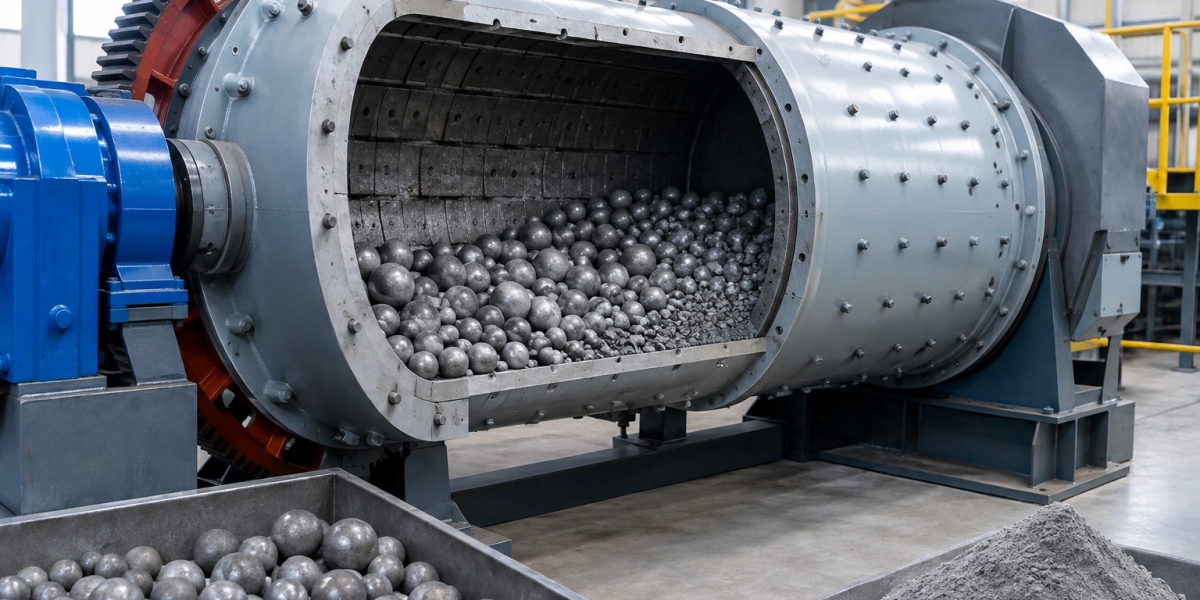
A ball mill is a cylindrical grinding machine designed to reduce the size of materials through mechanical action. The main chamber contains grinding media, usually made from materials such as steel, ceramic, or other wear resistant substances. When the cylinder rotates, the grinding media are lifted and then fall or roll against the material inside the chamber.
The repeated movement produces forces that break larger particles into smaller pieces. The process can continue until the material reaches the required particle size. The final result depends on several factors, including the size and quantity of grinding media, rotational speed, material hardness, moisture content, filling level, and grinding duration.
Ball mills are available in different sizes and configurations. Small laboratory models are useful for research, testing, and sample preparation, while larger industrial machines can process significant quantities of material continuously or in batches.
Basic Working Principle
The working principle of a ball mill is based mainly on impact and friction. When the cylindrical chamber rotates, the grinding balls are carried upward along the inner surface. At a certain point, gravity causes them to fall or roll downward. Their movement creates mechanical forces that act on the material.
Impact occurs when grinding balls collide with particles or with other grinding media. This force is particularly useful for breaking larger or harder particles. Friction occurs as the balls and material move against each other. Friction contributes to further size reduction and can help produce finer particles.
The balance between impact and friction depends on operating speed and the characteristics of the grinding media. A suitable combination is necessary because excessive impact may increase wear, while insufficient movement can reduce grinding efficiency.
Main Components of a Ball Mill
A ball mill consists of several important components that work together during operation. The grinding chamber is the central part of the machine where material and grinding media are placed. It is generally cylindrical and may contain an internal lining designed to protect the chamber from excessive wear.
The grinding media are another essential component. Their size, shape, density, and material affect grinding performance. Larger balls generally provide stronger impact for breaking larger particles, while smaller balls provide more contact points and can be useful for finer grinding.
The motor supplies the power required to rotate the chamber. A transmission system transfers this power to the rotating assembly. Depending on the design, the mill may also include bearings, drive components, discharge arrangements, seals, inspection openings, and supporting structures.
The internal lining protects the chamber from direct contact with the grinding media and processed material. Lining materials are selected according to the application, operating conditions, and level of wear expected during service.
Types of Ball Mills
Ball mills can be classified according to their design, operating method, and application. Laboratory ball mills are compact machines used for research, testing, sample preparation, and small scale material processing. They allow users to investigate grinding behavior before moving to larger equipment.
Industrial ball mills are designed for higher capacity applications. They can process large quantities of material and may operate continuously. Their dimensions, drive systems, lining arrangements, and grinding media are selected according to production requirements.
Wet ball mills use a liquid during grinding. The liquid can help control dust, improve material movement, and support certain processing requirements. Wet grinding is often useful when the material or final product is better handled as a slurry.
Dry ball mills operate without adding liquid to the grinding chamber. They are suitable for materials that must remain dry or for processes where moisture would interfere with the final product.
Batch mills process a specific quantity of material at a time. Once the grinding cycle is complete, the processed material is removed before another batch is introduced. Continuous mills receive material and discharge processed material during operation.
Importance of Grinding Media
Grinding media have a major influence on the performance of a ball mill. Their size and material should be selected according to the properties of the feed material and the required final particle size.
Large grinding balls have greater mass and can deliver considerable impact energy. They are useful when the feed contains relatively large or hard particles. Smaller balls provide a larger contact area and can improve fine grinding.
The hardness of the grinding media is also important. If the media are too soft for the application, they may wear rapidly and contaminate the processed material. Suitable media should provide sufficient resistance to wear while remaining appropriate for the material being processed.
The quantity of grinding media also needs careful consideration. Too little media may reduce the number of useful impacts, while excessive media can limit material movement and increase energy consumption.
Factors Affecting Grinding Performance
Several operating factors influence the final performance of a ball mill. Rotational speed is one of the most important. At low speed, the grinding media may roll with limited impact. Increasing the speed can increase lifting and falling action, but excessive speed may cause the media to remain against the chamber wall due to centrifugal force.
Grinding time also affects particle size. Longer processing generally produces finer material, but excessive grinding may waste energy and increase equipment wear. The required duration should therefore be determined through testing and process control.
Feed size has an important effect on grinding behavior. Large particles may require stronger impact, while smaller particles can be processed more effectively with smaller grinding media.
Material hardness, density, moisture, and structure also influence the grinding process. Materials with different physical characteristics may require different operating conditions even when the desired final particle size is similar.
Wet Grinding and Dry Grinding
The choice between wet and dry grinding depends on the material and application. Wet grinding introduces liquid into the grinding chamber and can help prevent excessive dust formation. It may also support the processing of materials that are difficult to handle in dry form.
Wet grinding can produce a slurry that is easier to transport in some processes. However, the addition of liquid introduces another stage of processing because the resulting material may require drying or separation.
Dry grinding is useful when the final material needs to remain dry. It can simplify handling in applications where adding liquid is undesirable. However, dry grinding may produce dust, requiring suitable containment and ventilation.
Operators should consider material characteristics, environmental conditions, equipment design, and final product requirements before selecting a grinding method.
Applications of Ball Milling
Ball milling is used across a wide range of industries because it can process many different materials. In mineral processing, it can help reduce the size of mineral particles before further separation or treatment.
The construction materials sector also uses grinding equipment for processing various raw materials and powders. Particle size can influence the behavior of materials during mixing and production.
In ceramics manufacturing, ball milling can help prepare fine and uniform raw material mixtures. Consistent particle distribution is important for producing ceramic components with predictable characteristics.
Chemical processing can involve ball milling for size reduction and material preparation. Laboratory researchers may also use small mills to prepare samples for analysis or investigate how materials respond to mechanical grinding.
The equipment is also useful in research environments where controlled particle reduction is required. By adjusting grinding conditions, researchers can study changes in particle size, texture, and other physical characteristics.
Selecting the Right Grinding Conditions
Selecting suitable grinding conditions begins with understanding the material. Operators should determine its hardness, initial particle size, moisture content, density, and sensitivity to contamination.
The desired final particle size is another important consideration. Producing a coarse powder requires different conditions from producing a very fine material. Grinding media size, operating speed, and processing time should be selected accordingly.
The quantity of material loaded into the chamber should also be controlled. Overloading can restrict the movement of grinding media and reduce effective grinding action. Underloading may result in inefficient use of energy.
Small scale testing can help determine suitable conditions before full scale processing begins. Monitoring the results of different settings allows operators to establish a reliable operating procedure.
Safety Considerations
Safe operation is essential when using a ball mill. The rotating chamber and drive components contain moving parts that can cause serious injury if accessed during operation. Guards and protective covers should remain properly installed.
Operators should inspect the machine before starting it. Loose components, damaged liners, worn bearings, unusual noises, and other visible problems should be addressed before operation.
The mill should never be opened while it is rotating. Power should be completely isolated before inspection, cleaning, adjustment, or maintenance work is performed.
Dust can also present a concern when dry materials are processed. Appropriate ventilation and dust control measures should be used according to the material and working environment.
Personal protective equipment should be selected according to the task. Eye protection, suitable gloves, protective footwear, and hearing protection may be required depending on operating conditions.
Common Problems During Operation
One common problem is inadequate grinding. This can occur when the rotational speed, grinding media, feed quantity, or processing time is unsuitable. The result may be material that remains larger than the required particle size.
Excessive wear is another concern. Grinding media and internal liners gradually wear as a result of repeated contact with the material. Excessive wear can increase maintenance requirements and may introduce unwanted material into the processed product.
Overheating can occur when the machine operates under unsuitable conditions or when mechanical components are not functioning correctly. Temperature should be monitored where required, especially during extended operation.
Unusual vibration or noise may indicate problems with bearings, alignment, mounting, drive components, or internal loading. These signs should not be ignored because continued operation may increase damage.
Maintenance Practices
Regular maintenance helps maintain reliable performance and extend equipment service life. Before maintenance begins, the machine should be stopped and isolated from its power source.
The grinding chamber should be inspected periodically for liner damage and excessive wear. Liners that become severely worn may reduce protection and affect grinding performance.
Grinding media should also be checked. Worn or damaged media can alter the grinding conditions and may affect the consistency of the final product.
Bearings and drive components require appropriate inspection and lubrication according to the equipment manufacturer's maintenance requirements. Improper lubrication can lead to increased friction and premature component failure.
Bolts, supports, guards, seals, and other mechanical components should be inspected regularly. Early detection of loose or damaged parts can prevent more serious problems.
Improving Grinding Efficiency
Grinding efficiency can be improved by maintaining suitable operating conditions rather than simply increasing processing time. Correct media size and quantity can help create effective contact between the grinding media and material.
Controlling feed size can also improve performance. Material that enters the mill with a consistent size distribution is generally easier to process under controlled conditions.
Avoiding overloading is important because excessive material can prevent proper movement of the grinding media. The loading level should be established according to the equipment design and material characteristics.
Regular maintenance also contributes to efficiency. Worn components can increase energy consumption and reduce the effectiveness of grinding action. Keeping the machine in suitable mechanical condition supports stable operation.
Importance of Particle Size Control
Particle size is one of the most important results of the milling process. A controlled particle size can improve material handling, mixing, surface area, and consistency.
Different applications require different particle size ranges. Some processes need relatively coarse particles, while others require fine powders. Measuring particle size after grinding helps determine whether the selected operating conditions are producing the intended result.
Sampling should be performed consistently so that results from different batches can be compared. Changes in particle size may indicate variations in feed material, grinding media, operating speed, or equipment condition.
Environmental Considerations
Ball milling can involve energy consumption, noise, dust, and material waste. Efficient operation can help reduce unnecessary energy use by avoiding excessive grinding time and unsuitable loading conditions.
Dust control is particularly important during dry grinding. Enclosed equipment, suitable ventilation, and proper housekeeping can help maintain a cleaner working environment.
Noise levels should also be considered, especially in facilities where mills operate for extended periods. Suitable engineering controls and hearing protection may be required.
Waste from worn grinding media and liners should be handled according to the characteristics of the material and applicable workplace procedures.
Final Thoughts
Ball milling is an important mechanical grinding process used for reducing material size and preparing powders for a wide variety of applications. Its effectiveness depends on more than simply rotating a chamber containing grinding media. Factors such as material properties, media size, rotational speed, loading level, moisture, grinding time, and equipment condition all influence the final result.
A clear understanding of these factors allows operators to select suitable conditions and maintain consistent processing. Regular inspection and maintenance can reduce unexpected equipment problems, while proper safety practices protect personnel during operation.
When the process is carefully controlled, a ball mill can provide reliable and repeatable size reduction for laboratory, industrial, construction, ceramic, mineral, and chemical applications. The key is to match the equipment and operating conditions with the characteristics of the material and the requirements of the final product.