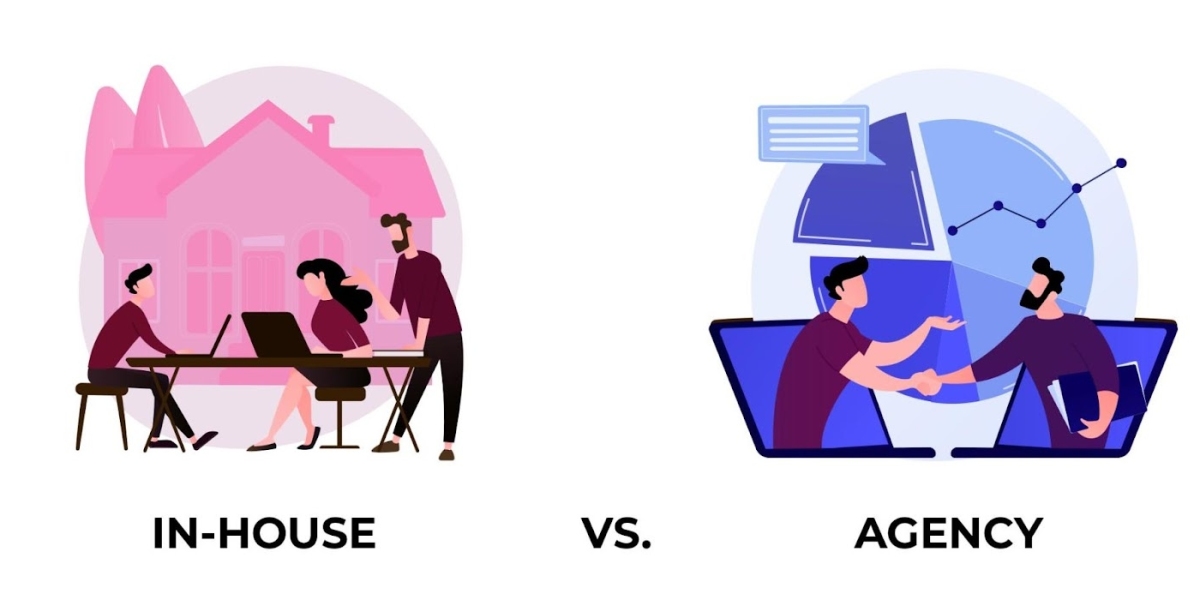

In-House Marketing vs Hiring a Digital Marketing Agency: The Real Trade-Off
A two-person marketing team can easily cost a US company more than $200,000 a year before software, recruitment, management time, and specialist support enter the picture.
That is the part many hiring decisions miss.
In-house marketing vs hiring a digital marketing agency is not simply a choice between employees and contractors. It is a decision about speed, specialist coverage, operational control, and the total cost of producing marketing output.
For companies that need several channels at once, an agency can provide broader specialist access without carrying every role on payroll. For companies with highly specific product knowledge and constant internal priorities, an in-house team can provide tighter day-to-day control.
The right answer depends on what the business actually needs to produce.
In-House vs. Agency Marketing: Summary of Real Trade-Offs
Choosing between in-house marketing and an agency comes down to execution velocity, specialized channel needs, and total cost of ownership. In-house teams deliver deep brand context and daily pivot control but carry payroll, recruitment, and software costs. Agencies provide multi-disciplinary expertise and established systems at a fixed cost, but require stronger client-side communication and briefing.
The distinction becomes clearer when you compare the operating models.
An internal team lives inside the business. It attends product meetings, understands customer objections, hears sales feedback, and can change priorities quickly.
An agency operates from outside that environment. It may bring SEO, paid media, design, conversion optimization, copywriting, and other specialists into one engagement, but it needs structured information from the client.
Neither model removes friction.
They simply move it to different places.
The basic decision framework
Choose primarily in-house when:
Deep product and industry context drives most marketing decisions.
Marketing priorities change daily.
The company needs constant internal collaboration.
Management is prepared to build and retain specialist talent.
Choose an agency when:
Multiple marketing disciplines are required immediately.
Hiring several specialists would exceed the available budget.
Speed matters more than building internal capability.
The company needs access to specialist tools and established workflows.
Consider a hybrid model when both conditions apply.
That last option is becoming particularly relevant for B2B organizations that need internal ownership without trying to hire an entire growth department.
Total Cost of Ownership: Salary vs. Agency Retainer
The advertised salary is only one part of an employee's cost, while an agency retainer is only one part of the agency's operating economics. A useful comparison adds software, benefits, recruitment, management time, scope limitations, and actual productive capacity instead of comparing salary against retainer price alone.
The hidden line items in in-house headcount
Consider a two- or three-person marketing team.
The base payroll alone can reach $180,000–$270,000 annually based on the supplied model. Then add benefits and payroll-related costs, software subscriptions, recruitment, onboarding, equipment, and management time.
The Fully Loaded Capacity Model can be expressed as:
Fully Loaded Cost = Base Salary + Benefits/Taxes (23%) + SaaS Stack + Recruitment Overhead + Management Time
Software is another easy-to-miss expense. A serious internal marketing operation may carry $18,000–$42,000 per year in SaaS and tooling.
Then there is capacity.
One employee may be excellent at SEO but inexperienced with paid media. Another may write strong copy but lack technical SEO knowledge. Hiring one "marketing generalist" does not automatically create seven specialist capabilities.
Deciphering agency retainer structures
Agency pricing has its own traps.
A $10,000 monthly retainer does not necessarily mean $10,000 of direct production every month. Account management, strategy, meetings, reporting, revisions, and operational overhead all consume capacity.
The question should therefore be:
How much useful production does the retainer actually buy?
This is where the price-per-output trap appears. A low-looking monthly fee can become expensive if projects move slowly or require repeated rounds of clarification.
| Financial & Operational Dimension | In-House Marketing Team (2–3 FTEs) | Digital Marketing Agency (Retainer) | Hybrid / Co-Sourced Model |
|---|---|---|---|
| Direct Annual Investment | $180,000–$270,000 | $60,000–$144,000 ($5k–$12k/mo) | $110,000–$180,000 |
| Tooling & SaaS Overhead | $18,000–$42,000/yr | $0 absorbed by agency | $5,000–$12,000/yr |
| Speed to Initial Execution | 60–90 days | 14–30 days | 14–21 days |
| Domain & Industry Intimacy | Exceptional | Moderate to low | High |
| Turnover & Single-Point Risk | High | Very low | Low |
| Channel Breadth | Narrow | Broad | Balanced |
The figures show why comparing only monthly retainers and annual salaries can produce the wrong picture. The actual economic question is the cost of obtaining the required marketing capacity.
The 90-Day Context Curve vs. Immediate Channel Execution
An in-house team usually takes longer to become operational because recruiting, interviews, notice periods, onboarding, training, and internal context all happen before meaningful output reaches full speed. Agencies can begin with an audit, scope definition, access setup, and execution plan, shortening the initial ramp.
The difference can look like this:
Hiring Pipeline Friction
Job specification
↓
Candidate sourcing
↓
Interviews
↓
Offer & negotiation
↓
Notice period
↓
Onboarding
↓
Internal training
↓
Channel execution
Agency Onboarding Scoping
Business briefing
↓
Access & asset collection
↓
Audit
↓
Scope confirmation
↓
Execution sprint
↓
Reporting & iteration
The internal route can take 60–90 days to reach initial execution under the supplied framework.
An agency can begin within approximately 14–30 days, depending on onboarding and audit requirements.
That does not mean an agency instantly understands a business.
It means the company is buying an existing production system rather than building one from scratch.
Operational Friction: Where Each Model Breaks Down
Every marketing model has a failure point. In-house teams can suffer from narrow specialist coverage and employee dependency, while agencies can suffer from scope restrictions, account-management layers, and slow communication. The useful comparison is therefore not which model has zero friction, but where that friction appears and how expensive it becomes.
The price-per-output trap
Retainers can hide inefficient production cycles.
Imagine two agencies charging similar monthly fees. One has a dedicated production pod with clearly defined sprint capacity. The other distributes work among multiple teams and requires several approval stages.
The invoice looks similar.
The output may not be.
This is why buyers should ask about dedicated capacity, production hours, senior oversight, revision limits, and delivery cycles, rather than accepting a broad "full-service" label.
A traditional full-service structure can also include layers of account management and execution staff. If the client is paying a premium rate while production is delegated to less expensive resources, the difference between billed capacity and delivered value becomes important.
A more transparent approach is to define the expected sprint capacity first, then calculate:
True Creative Delivery Cost = Base Sprint Hours × Rate + Licensing + Overhead
That makes the economics easier to inspect.
The generalist trap
There is another common mistake: expecting one employee to handle everything.
SEO.
Paid ads.
Graphic design.
Copywriting.
CRO.
Video.
Analytics.
That is not one skill set.
The supplied B2B Skill-Gap Index identifies seven distinct disciplines required across a modern growth stack:
Technical SEO
AEO copywriting
Revenue operations
Paid media
Graphic design
Conversion rate optimization
Video production
Hiring full-time talent across all seven disciplines can push payroll beyond $550,000 per year under the supplied framework.
An agency aggregates these capabilities instead of requiring the company to employ every specialist directly.
That is the core economic argument for outsourcing breadth.
The Source File Trap: Ownership Matters More Than Most Contracts Say
Creative ownership deserves a separate check before signing either an agency agreement or a freelancer contract.
A finished logo, landing page, or campaign asset is not necessarily the same thing as owning every underlying production file.
Ask specifically about:
Figma files and component libraries
Raw vector files
Editable design files
Font licensing
Stock asset licensing
Source-code ownership where relevant
Account ownership
Analytics and advertising account access
Transfer rights after termination
This is the Source File Trap.
A contract may promise delivery of "final assets" while leaving uncertainty around editable working files, third-party licenses, or reusable components.
The practical rule is simple:
Define ownership before production starts.
Not after the relationship ends.
The Hybrid "Co-Sourcing" Model: Best of Both Worlds?
A hybrid marketing model in-house and agency combines internal strategic ownership with external specialist execution. One internal Marketing Manager can maintain product context, sales alignment, and brand priorities while an external team handles specialist work such as SEO, paid media, design, CRO, or technical execution.
This model changes the role of the internal marketer.
Instead of trying to personally execute every channel, the internal lead becomes the central source of business context.
The external team provides production breadth.
The internal lead provides direction.
That can reduce both major forms of risk: the narrow expertise of a small internal team and the limited product intimacy of a completely external agency.
Data from campaign audits at Markhor Digital Hub can be used as a practical benchmark for evaluating this structure: the important question is not simply how many services a provider lists, but how much specialized execution capacity is actually available for the account.
A practical decision matrix
Use the following logic when assessing the model:
Annual marketing budget under $100k
More than three specialist channels required
→ Consider an agency-led structure.
Strong internal marketing lead
Need for specialist execution
→ Consider co-sourcing.
Highly specialized product
Daily marketing collaboration required
→ Build stronger internal ownership.
Need for seven specialist disciplines
Limited hiring capacity
→ Compare the cost of aggregated agency expertise against individual full-time hires.
Existing internal team
One or two clear skill gaps
→ Consider targeted external support rather than replacing the entire function.
The decision should follow the work.
Not the other way around.
What Should You Actually Compare Before Signing?
Do not compare an employee's salary against an agency's monthly invoice and stop there.
Compare the full production system.
Ask six questions:
What is the fully loaded annual cost?
How quickly can meaningful execution begin?
How many specialist disciplines are required?
How much senior capacity is actually assigned?
What happens when an employee or agency specialist leaves?
Who owns the source files, accounts, data, and intellectual property?
Then calculate the cost of the output you actually need.
That is a better comparison than looking at a salary or retainer in isolation.
Final Takeaway: Buy the Capacity You Actually Need
In-house marketing offers control, context, and constant access to internal knowledge. Its cost rises as the company adds specialists, software, recruitment, and management overhead.
An agency offers broader specialist access and faster initial execution without requiring every capability to sit on payroll. Its weakness is usually the distance between the provider and the client's daily operating environment.
The hybrid model addresses the gap by keeping strategic ownership inside the company while purchasing specialist execution externally.
The strongest decision is therefore not automatically "hire" or "outsource."
It is to identify the marketing capacity the business needs, calculate its fully loaded cost, and then decide which operating structure can provide that capacity without creating unnecessary friction.