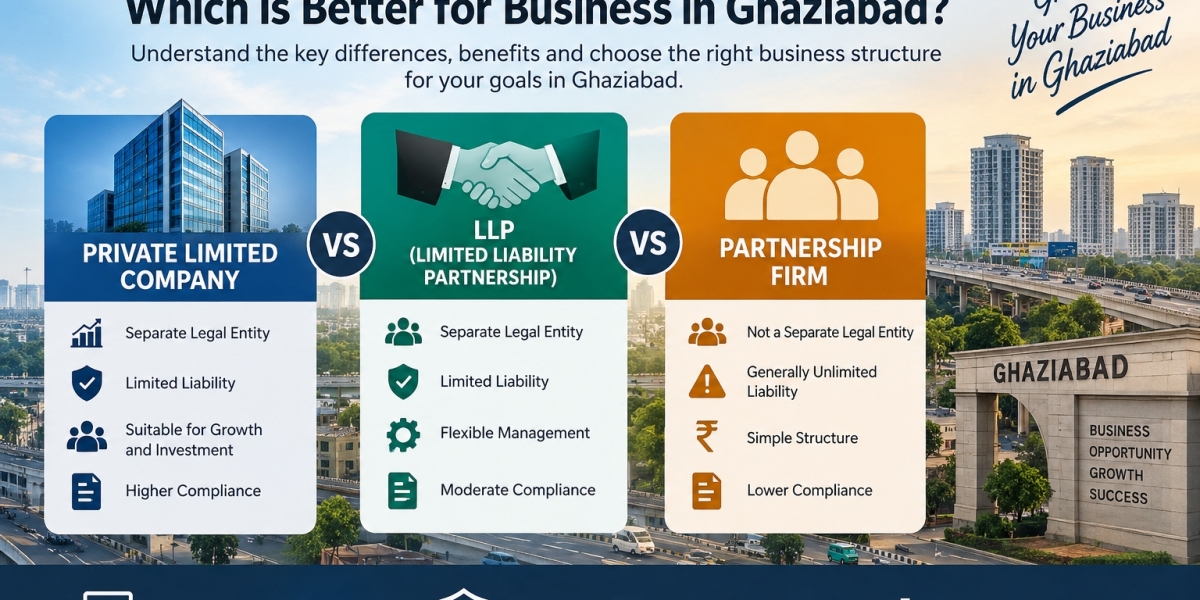

Starting a business in Ghaziabad requires more than choosing a business idea and finding customers. Entrepreneurs also need to select an appropriate legal structure. Three commonly considered structures are Private Limited Company, Limited Liability Partnership (LLP), and Partnership Firm.
Each structure has different requirements relating to liability, compliance, taxation, ownership, funding and business operations. Therefore, the right choice depends on the nature and future plans of the business.
This guide explains the major differences between Private Limited Companies, LLPs and Partnership Firms for entrepreneurs considering Company Registration in Ghaziabad.
Private Limited Company vs LLP vs Partnership at a Glance
| Feature | Private Limited Company | LLP | Partnership Firm |
|---|---|---|---|
| Separate legal entity | Yes | Yes | Generally not separate in the same manner as a company/LLP |
| Liability | Limited | Limited | Generally unlimited |
| Minimum owners | 2 members | 2 partners | 2 partners |
| Management | Directors | Designated partners | Partners |
| Compliance | Relatively higher | Moderate | Generally lower |
| Outside investment | More suitable for equity investment | More restricted | Generally less suitable |
| Ownership transfer | Structured through shares | Governed by LLP agreement | Governed by partnership agreement |
| Suitable for | Growth-oriented businesses | Professional/service businesses and partnerships | Small businesses and traditional partnerships |
What Is a Private Limited Company?
A Private Limited Company is a separate legal entity registered under the Companies Act, 2013. It has shareholders who own the company and directors who manage its affairs.
For entrepreneurs planning significant expansion, a private company can provide a structured framework for ownership, management and investment.
A Private Limited Company may be considered by businesses that plan to:
- Build a scalable business
- Bring in investors
- Have multiple shareholders
- Create a formal corporate structure
- Expand operations
- Establish a structured ownership system
However, companies generally have more statutory compliance requirements than traditional partnership firms.
What Is an LLP?
A Limited Liability Partnership combines characteristics of a partnership with limited liability protection. An LLP is a separate legal entity and is governed primarily by the Limited Liability Partnership Act, 2008.
An LLP can be useful where partners want flexibility in managing the business while maintaining limited liability protection.
LLPs are often considered by:
- Professional businesses
- Consulting firms
- Service businesses
- Family-owned ventures
- Businesses operated by two or more active partners
The rights and responsibilities of partners are generally governed by the LLP agreement.
What Is a Partnership Firm?
A partnership firm is formed when two or more persons agree to carry on a business and share its profits according to agreed terms.
Partnerships are often used for smaller businesses where the partners are directly involved in day-to-day operations.
A partnership agreement normally covers matters such as:
- Capital contribution
- Profit-sharing ratio
- Partner responsibilities
- Admission of new partners
- Retirement
- Dispute resolution
- Dissolution
One important distinction is that partners generally have unlimited liability for the firm's obligations, subject to the applicable legal framework.
Liability Difference
Liability is one of the most important considerations when selecting a business structure.
In a Private Limited Company, shareholders' liability is generally limited to the amount they have agreed to contribute, subject to applicable law.
In an LLP, partners generally receive limited liability protection, subject to statutory exceptions.
In a traditional Partnership Firm, partners generally have unlimited liability for the firm's obligations.
Therefore, entrepreneurs should consider the financial and operational risks associated with their business before choosing a structure.
Compliance Requirements
The compliance burden also differs.
A Private Limited Company generally has formal corporate compliance requirements, including maintenance of statutory records, financial statements and applicable annual filings.
An LLP also has compliance requirements, but its structure can be comparatively flexible.
A Partnership Firm generally has fewer ongoing statutory formalities, although the exact requirements can depend on the firm's activities, registration status and applicable laws.
The lowest compliance burden should not automatically be treated as the deciding factor. Entrepreneurs should consider their long-term business plans as well.
Funding and Investment
If external investment is an important part of the business plan, the ownership structure becomes particularly relevant.
Private Limited Companies have share capital and can issue shares according to applicable law, making the structure commonly used for businesses seeking equity investment.
LLPs do not operate through shares in the same way as companies. Their ownership and contribution arrangements are generally governed through the LLP agreement.
Traditional partnerships also rely on the partnership agreement rather than a corporate shareholding structure.
For a startup expecting institutional or equity investment, these differences should be considered before incorporation.
Which Structure Should a Ghaziabad Business Choose?
There is no single structure that is suitable for every business.
A business considering Company Registration in Ghaziabad should evaluate factors such as:
- Number of owners
- Nature of business
- Financial risk
- Investment requirements
- Expected turnover
- Future expansion
- Compliance capacity
- Ownership structure
- Long-term exit or succession plans
For example, an entrepreneur building an investment-oriented startup may consider a Private Limited Company, while professionals operating a jointly owned service business may consider an LLP. A small traditional business operated by partners may consider a Partnership Firm.
These are structural considerations rather than a universal rule about which entity is “better.”
Trademark Registration for Your Business
Choosing a business structure is only one part of establishing a business identity. Entrepreneurs should also consider protecting their brand name, logo and other eligible trademarks.
Trademark Registration in Ghaziabad can help businesses seek statutory protection for eligible trademarks under India's trademark law.
Before investing heavily in a brand, businesses should consider:
- Selecting a distinctive brand name.
- Conducting a trademark search.
- Identifying the appropriate trademark class.
- Preparing the application.
- Filing the trademark application.
- Responding to objections, if applicable.
- Monitoring the application until registration.
Company registration and trademark registration are different legal processes. Registering a company name does not automatically provide the same protection as trademark registration.
Company Registration and Trademark Registration Are Different
This distinction is important for new entrepreneurs.
Company Registration creates the legal business entity, where applicable.
Trademark Registration relates to protection of a brand identifier such as a name, logo or other eligible mark.
A business may therefore need to consider both areas separately when establishing its legal and commercial identity.
Conclusion
Private Limited Companies, LLPs and Partnership Firms serve different business requirements.
A Private Limited Company provides a formal corporate structure and can be relevant for businesses planning structured ownership and external investment. An LLP provides limited liability with a partnership-oriented management structure. A Partnership Firm can be suitable for businesses where partners want a comparatively simple traditional structure.
Entrepreneurs planning Company Registration in Ghaziabad should compare the legal structure, liability, compliance, funding requirements and long-term objectives before making a decision.
At the same time, businesses should consider Trademark Registration in Ghaziabad when building a long-term brand, because company incorporation and trademark protection serve different legal purposes.