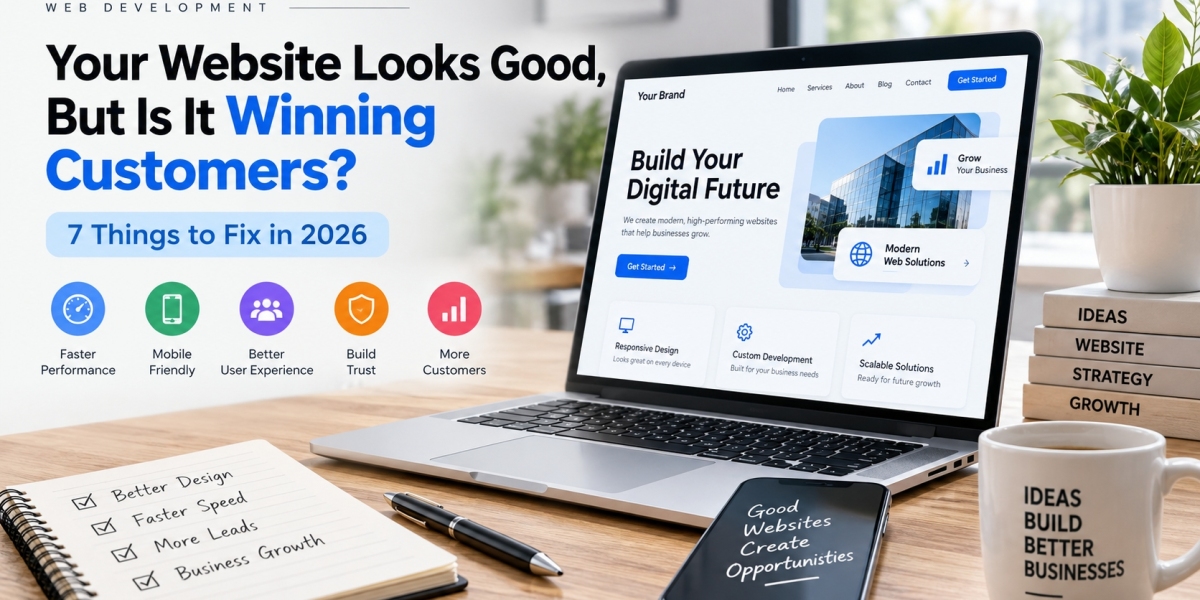

Imagine spending time and money creating a beautiful business website. The design looks professional, the images are attractive, and your services are clearly listed. But after launching it, something unexpected happens: visitors arrive, look around for a few seconds, and leave without contacting you.
What went wrong?
The problem might not be your design. Visitors could be struggling to find important information, understand your services, navigate the website, or figure out what to do next.
A successful business website needs more than an attractive appearance. It should answer customer questions, provide a smooth browsing experience, and make important information easy to access.
This is why modern web development focuses on combining design, functionality, performance, and usability to create websites that serve both businesses and their visitors.
Here are seven practical improvements that can help businesses make their websites more useful in 2026.
1. Make Your Website's Purpose Clear Within Seconds
When someone visits your website for the first time, they should quickly understand what your business offers.
If visitors have to read several paragraphs just to discover what you do, they may struggle to find the information they need.
Your homepage should communicate three essential things: what you offer, who you help, and what visitors can do next.
For example, a website development agency could introduce its services with a clear headline, a short explanation, and a link to explore its website solutions.
Avoid filling the homepage with too many competing messages. A focused introduction makes it easier for visitors to understand your business.
2. Stop Making Mobile Visitors Work Hard
Think about the last time you visited a website on your phone and had to zoom in to read something or struggle to click a tiny button.
You probably found the experience frustrating.
Your potential customers may experience the same problem if your website is not designed for mobile devices.
Responsive website development helps layouts adapt to different screen sizes. But a genuinely useful mobile experience requires more than a flexible layout.
Navigation should be easy to use, text should remain readable, and important buttons should be comfortable to tap. Forms should also be simple enough to complete on smaller screens.
Testing your website on actual mobile devices can reveal problems that may not be obvious when viewing it on a desktop.
3. Improve Website Speed Before Adding More Features
A website with animations, large images, and multiple interactive elements may look impressive. However, unnecessary features can make pages slower and more difficult to use.
Visitors generally want to access information without waiting for a page to finish loading.
Businesses can improve performance by optimizing images, reducing unnecessary scripts, reviewing third-party integrations, and using suitable hosting.
Google's Core Web Vitals can also help website owners understand loading performance, responsiveness, and visual stability.
Instead of adding another feature simply because it looks attractive, ask whether it genuinely improves the visitor's experience.
4. Design Navigation Around Real Customer Questions
A confusing navigation menu can make even a well-designed website difficult to use.
Visitors should not have to guess where to find your services, pricing information, portfolio, or contact details.
Organize your website around the information people are most likely to need.
For example, a service-based business might use clear navigation options such as:
Services
About Us
Projects
Blog
Contact
The exact structure depends on the business. A large eCommerce website will need a different navigation system from a small professional services website.
The goal is simple: help visitors find relevant information with as little confusion as possible.
5. Give Visitors Reasons to Trust Your Business
Imagine comparing two businesses online. One provides detailed service information, genuine project examples, and clear contact details. The other offers little information beyond promotional statements.
Which website gives you more information to evaluate?
A business website can communicate credibility through accurate company information, relevant experience, genuine testimonials, and examples of completed work.
Avoid exaggerated claims or guarantees that cannot be supported. Clear and honest communication helps visitors understand what they can reasonably expect.
A professional Web Development Company in Noida should also help clients understand the website's functionality, maintenance requirements, and technical limitations.
Trust is not created by design alone. It develops through the information and experience a business provides.
6. Make the Next Step Easy for Visitors
After exploring your website, visitors may want to ask a question, request a quotation, book a consultation, or make a purchase.
If they cannot easily identify the next step, they may leave without completing their intended action.
Use clear calls to action that match the purpose of each page.
For example, a service page might include a “Request a Quote” button, while an educational article could invite readers to explore a related resource.
Contact forms should ask only for information that is genuinely necessary. Too many fields can make the process feel complicated.
A well-planned website helps visitors move naturally from discovering information to taking action.
7. Build a Website That Can Grow With Your Business
Your business requirements may change after your website launches.
You might introduce new services, expand into new markets, publish more content, or add online purchasing functionality.
Choosing a suitable development approach from the beginning can make future improvements easier.
When evaluating affordable web development in Noida, businesses should consider more than the initial price. Hosting, security, maintenance, scalability, and future development requirements also matter.
A simple website may be sufficient for a small business today, while a growing company may eventually need additional integrations or custom functionality.
The right solution depends on your current requirements and realistic plans for the future.
How to Know Whether Your Website Needs Improvement
You do not necessarily need to redesign your entire website to improve its performance.
Start by reviewing how visitors interact with important pages.
Check whether your homepage clearly explains your services. Test your website on mobile devices. Review page-loading performance and look for confusing navigation or broken functionality.
You can also use website analytics to understand which pages attract visitors and where users leave the site.
These observations can help you prioritize improvements based on actual problems rather than assumptions.
For businesses planning a new website or an upgrade, working with an experienced development partner can help turn these findings into a practical improvement plan.
Final Thoughts
A beautiful website can attract attention, but a useful website gives visitors a reason to stay, explore, and take the next step.
Clear messaging, responsive design, fast loading, straightforward navigation, trustworthy information, and accessible contact options all contribute to a better website experience.
Before investing in a complete redesign, take a closer look at your existing website. Small, carefully chosen improvements may address the problems that matter most to your visitors.
Ultimately, good website development is not about adding the maximum number of features. It is about creating a digital experience that makes life easier for the people using it.