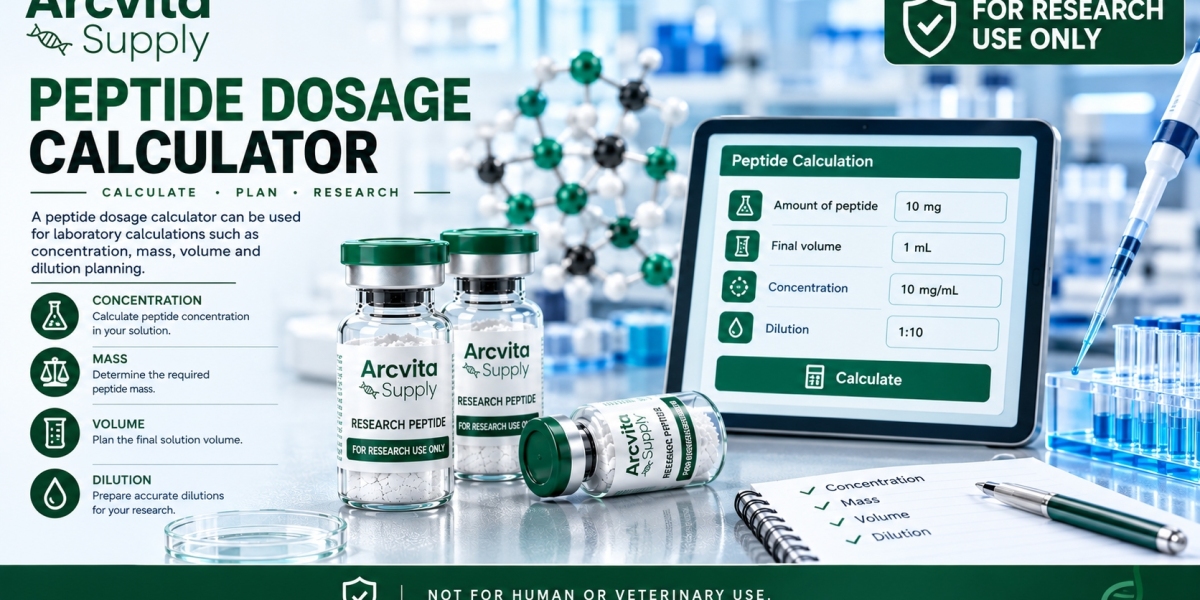

Researchers working with laboratory peptides often need to understand relationships between peptide quantity, solution volume, concentration, and dilution. A peptide dosage calculator can be useful as an educational calculation tool for organizing these mathematical relationships.
However, research calculations should not be confused with medical dosing. Research peptides labeled for laboratory use are not automatically approved for human or veterinary use. Calculations should therefore remain within the appropriate research context and follow applicable laboratory procedures.
This guide explains the basic concepts behind peptide calculations, what information researchers may need, and how calculation accuracy can support consistent laboratory documentation.
What Is a Peptide Dosage Calculator?
A peptide dosage calculator is generally a calculation tool designed to help determine relationships between the amount of peptide, the volume of solution, and the resulting concentration.
In a laboratory setting, researchers may work with:
- Peptide mass
- Solution volume
- Concentration
- Dilution factors
- Measurement units
- Stock solutions
- Final solution concentrations
The mathematical principles are relatively straightforward, but accurate measurements are important. Even a small measurement error can affect the calculated concentration of a research solution.
The term “dosage” can be misleading in a research context. For laboratory materials, it is more appropriate to discuss concentration, quantity, volume, or experimental conditions rather than therapeutic dosage.
Understanding Peptide Concentration
Concentration describes how much of a substance is present within a particular volume of solution.
A basic concentration relationship can be expressed as:
Concentration = Amount of peptide ÷ Solution volume
For example, if a researcher has a known quantity of a research peptide and combines it with a defined laboratory solution volume, the resulting concentration can be calculated from those values.
Researchers should ensure that the units used in the calculation are compatible. Mixing units without appropriate conversion can produce an incorrect result.
Common laboratory units may include:
- Milligrams (mg)
- Micrograms (µg)
- Milliliters (mL)
- Liters (L)
- Milligrams per milliliter (mg/mL)
Understanding these units is an important part of accurate laboratory calculation.
Why Accurate Calculations Matter
Accurate calculations are important for reproducibility. When researchers document the quantity, volume, concentration, and calculation method used in an experiment, another researcher can better understand how the research material was prepared.
A well-documented research workflow may include:
- Product identification
- Peptide quantity
- Solution or solvent information
- Preparation volume
- Calculated concentration
- Date and preparation details
- Storage conditions
- Relevant experimental notes
This documentation can help researchers identify inconsistencies and improve repeatability between experiments.
Peptide Reconstitution and Calculations
Lyophilized peptides are commonly supplied as dried materials. In laboratory research, researchers may need to prepare a solution before conducting an experiment.
The mathematical aspect of this process involves determining the relationship between the amount of peptide and the selected solution volume.
For example, if the peptide quantity is known, changing the final solution volume changes the resulting concentration. A smaller volume produces a higher concentration, while a larger volume produces a lower concentration, assuming the peptide quantity remains unchanged.
Researchers should always follow the product documentation and their institution's laboratory procedures when preparing research materials.
Understanding Dilution Calculations
Dilution is another important concept in peptide research.
A common mathematical relationship is:
C₁V₁ = C₂V₂
Where:
- C₁ = starting concentration
- V₁ = starting volume
- C₂ = desired concentration
- V₂ = final volume
This formula is commonly used to understand how a solution can be diluted from one concentration to another.
A calculator can reduce arithmetic mistakes, but researchers should still verify the inputs and units before accepting the calculated result.
What Information Should Researchers Check?
A calculation should not be considered independently from the research material itself. Before conducting laboratory work, researchers should review available product documentation.
Important information may include:
Product Identity
Confirm the name, quantity, and relevant product identification information.
Purity Information
Review available purity specifications and analytical documentation.
Certificate of Analysis
A Certificate of Analysis, or COA, can provide batch-specific information such as testing results and reported specifications.
Storage Requirements
Research materials may have specific storage requirements. Researchers should follow the manufacturer's documented recommendations.
Research-Use-Only Labeling
Research products should be used only for their stated purpose. A research product should not be represented as an approved medication or treatment.
Peptide Quality Testing
Calculation accuracy is only one part of a reliable research workflow. Researchers should also consider the quality and analytical documentation associated with laboratory materials.
Research peptide quality testing may involve analytical techniques used to characterize materials, depending on the compound and testing laboratory.
Researchers may encounter documentation related to:
- Identity
- Purity
- Batch information
- Analytical results
- Manufacturing information
- Storage recommendations
Reviewing appropriate documentation can help researchers understand what they are working with before beginning an experiment.
Common Calculation Mistakes
Several mistakes can affect peptide research calculations.
1. Mixing Units
Using milligrams in one part of a calculation and micrograms elsewhere without conversion can create major errors.
2. Entering the Wrong Volume
A calculator can only produce a meaningful result if the entered volume is correct.
3. Confusing Mass and Concentration
Mass and concentration are not interchangeable. Mass describes the amount of material, while concentration describes the amount relative to a specific volume.
4. Forgetting Dilution Factors
When working with a stock solution, researchers should account for the dilution factor when determining the final concentration.
5. Relying on Unverified Information
Calculations should be based on accurate product and laboratory information rather than assumptions.
Peptide Dosage Calculator vs. Medical Dosing
It is important to distinguish laboratory calculations from medical dosing.
A research calculator can help explain mathematical relationships between quantities, volumes, and concentrations. It does not establish a safe or appropriate dose for a person or animal.
Medical dosing depends on factors such as the approved indication, formulation, route of administration, patient characteristics, clinical evidence, and applicable regulatory requirements. Those decisions belong within appropriate medical and regulatory frameworks.
For this reason, research calculation tools should not be presented as substitutes for professional medical guidance.
How Researchers Can Improve Calculation Accuracy
Researchers can take several practical steps to reduce calculation errors:
- Confirm the peptide quantity before beginning calculations.
- Use consistent units throughout the calculation.
- Verify the solution volume.
- Double-check dilution calculations.
- Record calculations in laboratory documentation.
- Use calibrated measurement equipment where appropriate.
- Review product documentation and COA information.
- Follow established laboratory protocols.
- Have calculations independently checked when appropriate.
These simple practices can improve consistency and make research records easier to review.
Frequently Asked Questions
What is a peptide dosage calculator used for?
In a research context, it can be used to understand mathematical relationships involving peptide quantity, solution volume, concentration, and dilution.
Is a peptide calculator the same as a medical dosing tool?
No. Laboratory calculation tools should not be treated as medical dosing recommendations or used to determine treatment doses.
Why is peptide concentration important?
Concentration describes the amount of peptide relative to a specific solution volume and is an important mathematical variable in laboratory research.
What is C₁V₁ = C₂V₂?
It is a commonly used dilution equation that relates starting concentration and volume to final concentration and volume.
Why should researchers check a COA?
A COA can provide batch-specific analytical information that helps researchers review the reported characteristics and testing of a research material.
Conclusion
A peptide dosage calculator can be useful for understanding basic mathematical relationships involved in laboratory peptide research. By considering peptide quantity, solution volume, concentration, dilution factors, and measurement units, researchers can better organize their calculations and documentation.
However, calculation tools are only one part of responsible research. Product identity, analytical testing, COA documentation, storage requirements, laboratory procedures, and research-use-only labeling should also be considered.
Arcvita Supply provides educational resources designed to help researchers better understand research peptides, laboratory calculations, quality considerations, and responsible research practices.