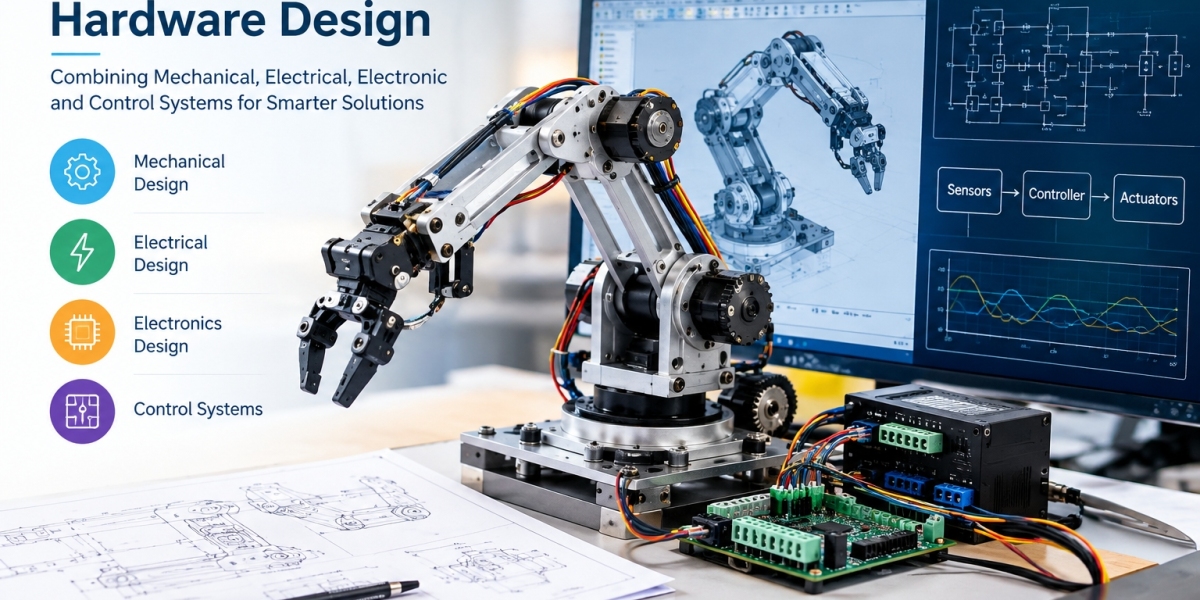

Modern machines combine several technologies to perform complex tasks. Mechanical components work alongside electronics, sensors, controllers, and software. Designing these systems requires engineers to consider how all components interact. Mechatronics and Hardware design provides an integrated approach to developing such products.
Combining Multiple Disciplines
A mechatronic product may contain mechanical structures, motors, sensors, electronic circuits, and control software.
Each component has its own requirements, but the final product must function as one complete system.
For example, an automated machine may use a mechanical arm for movement, sensors to detect position, an electronic controller to process signals, and software to coordinate the operation.
Hardware Selection
Selecting appropriate hardware is an important part of system development. Engineers need to consider factors such as operating conditions, power requirements, communication interfaces, component compatibility, and expected performance.
The selected components also need to work with the mechanical design and control system.
Poor component selection can create integration problems later, so these decisions should be considered early in the development process.
Mechanical and Electronic Integration
Mechanical and electronic design cannot always be treated as separate activities.
The physical placement of sensors, motors, cables, controllers, and other components can affect the overall design.
Engineers may need to consider space limitations, heat generation, vibration, accessibility, and maintenance requirements.
An integrated approach helps address these factors during the development process.
Prototyping and Testing
Building a prototype provides an opportunity to evaluate how the different components work together.
Engineers can test movement, electrical performance, sensor responses, control behavior, and other system functions.
Problems identified during testing can lead to design modifications before the product enters production.
Digital modeling and simulation can also support this process by allowing engineers to evaluate certain aspects of a design before building a physical prototype.
Industrial Applications
Mechatronic systems are used in automated manufacturing equipment, robotics, inspection systems, material-handling machines, and many other applications.
The level of complexity varies from one product to another. Some systems may use a small number of components, while others require sophisticated control and communication architectures.
Importance of Documentation
Good documentation supports both development and future maintenance. Hardware diagrams, component information, interface specifications, and design details can help engineers understand the system.
Documentation is particularly valuable when products need modifications or when maintenance teams need to troubleshoot equipment.
Conclusion
Mechatronics and Hardware design brings mechanical and electronic engineering considerations together to create integrated systems.
By considering hardware selection, mechanical integration, control requirements, testing, and maintenance from the beginning, engineering teams can develop products that are better suited to their intended applications.