
Any product category that touches on RF tends to attract two extremes, people who dismiss the entire idea as unnecessary, and marketing copy that overpromises what a shielding product can realistically do. An RF cell phone shield sits in a strange middle ground, it's built on a real, testable physical principle, but it's often surrounded by language that stretches well past what the underlying science actually supports. This article is built around separating those two things, what's demonstrably true about RF cell phone shield and what's exaggeration dressed up as fact.
Getting this right matters for two reasons. First, it helps anyone shopping in this category make a more informed decision rather than being swayed by fearbased marketing. Second, it protects the credibility of a genuinely useful product category one built on real materials science from being lumped in with pseudoscientific gimmicks that don't hold up to scrutiny.
Myth An RF ShieldBlocks Radiation Completely
This is probably the most common overstatement in the category. A wellmade RF shield for cell phones doesn't create a perfect, hermetically sealed barrier against all electromagnetic energy; nothing short of a fully enclosed, professionally tested Faraday cage achieves that. What a quality shielding pouch does is measurably attenuate signal strength, meaning it significantly reduces how much RF energy passes through the fabric, typically expressed as a decibel reduction across relevant frequency bands.
Properly constructed silverfiber fabric reduces RF signal strength by a meaningful, testable amount. That's a real and useful property. It's not the same as claiming zero exposure, and any brand claiming100% blocking without testing data to support it should be viewed skeptically.
Myth RF Exposure From a Phone Is Definitively Dangerous
This is where the conversation needs the most care. Claims that phone RF exposure at normal levels causes cancer or other serious illness go beyond what current mainstream scientific consensus supports. Regulatory bodies set exposure limits with safety margins built in, and phones sold in most markets are tested against those limits before being approved for sale.
Fact RF and EMF exposure is an active area of ongoing research, and reasonable people can choose to minimize their exposure as a precaution without needing a proven danger to justify that choice the same way someone might choose to eat more vegetables without having a diagnosed nutrient deficiency. An RF phone shield is a reasonable tool for reducing exposure during hours a phone isn't actively needed, positioned as a precautionary habit rather than a response to an established, immediate threat.
Myth Any MetallicLooking Fabric Provides Real Shielding
Because shielding has become a popular buzzword, plenty of products use metallic looking or metallic sounding fabric descriptions without any real conductive performance behind them. A shiny fabric finish doesn't automatically mean it interacts with RF energy the way a genuinely conductive material does.
Effective shielding requires actual electrical conductivity achieved through materials like woven silver fiber, not just a metallic appearance. This is why checking for specific material claims (silver fiber, specifically) and, ideally, attenuation testing data is far more reliable than judging a product by its look or feel alone.
Myth A Shielding Pouch Needs to Be Used 24/7 to Be Worthwhile
Some marketing implies that unless someone shields their phone constantly, they're not getting any benefit at all. That framing isn't accurate and tends to push people toward all or nothing thinking that isn't necessary.
Fact: Using an RF cell phone protection pouch during specific periods of sleep, workouts, long commutes, or extended desk time still reduces cumulative exposure during those windows. It doesn't need to be a constant, unbroken habit to serve its purpose; even occasional, situational use adds up over time.
Myth Heavier or Bulkier Products Shield Better
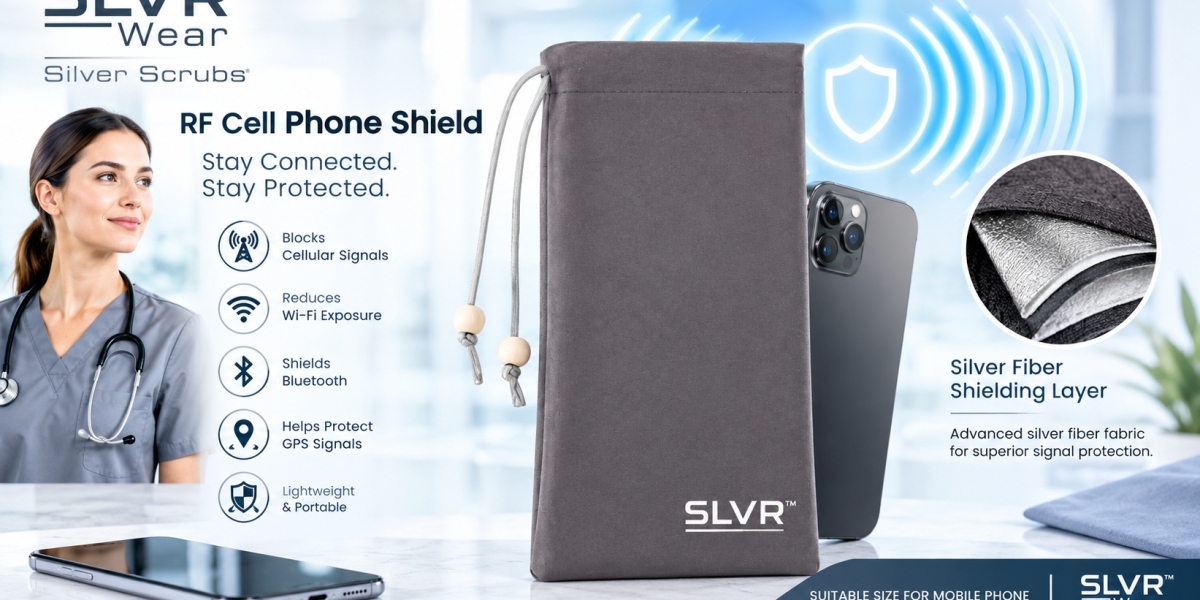
There's a common assumption that a thicker, heavier pouch must be more effective, similar to the logic applied to sound insulation. Shielding effectiveness doesn't work that way. Fact Shielding performance depends primarily on the conductivity of the material and the quality of the weave and construction, not on thickness or bulk. A well engineered silver fiber RF phone shield can be thin, soft, and lightweight while still performing effectively, which is part of why fiber based shielding has become more popular than older, bulkier metallic mesh designs.
What Silver Fiber Technology Can Honestly Claim
Stripped of exaggeration, here's what a legitimately engineered RF shielding phone accessory built with silver fiber can honestly claim
It uses a conductive material (silver fiber) woven into fabric to reflect and reduce RF signal strength passing through it
Its effectiveness can be measured and expressed as a decibel reduction across specific frequency bands
It offers a passive, easy to use option for reducing RF exposure during specific periods without requiring the phone to be turned off
Silver fiber also carries natural properties, which is part of why the same material is used across other SLVR Wear™ products, including the Silver Scrubs® apparel line
It doesn't interfere with the phone's hardware and doesn't require any special care beyond normal handling
That's a genuinely useful, honest list and it doesn't need embellishment to be worth considering as part of a daily routine.
Why Transparency Matters More Than Ever
As more brands enter the RF cell phone shielding category, the gap between honest, tested products and overhyped marketing has widened. This puts more responsibility on shoppers to ask direct questions. What's the material? Has it been tested? What's the actual attenuation figure? A brand willing to answer these questions directly, rather than leaning on dramatic language, is generally more trustworthy than one that isn't. This is also where it helps to look at a brand's full product philosophy rather than just a single item. Checking out SLVR Wear as a whole gives a sense of whether silverfiber technology is treated as a core material used consistently across a product line, or just a one off marketing angle attached to a single item.
Putting It Into Practice A Grounded Approach
For anyone who's read through the myths above and still wants to incorporate an RF protection for cell phone habit into daily life, the practical approach looks like this choose a product built on real, testable materials (silver fiber is a strong choice), verify the manufacturer shares some form of testing data, use it during the specific windows where it makes the most sense (sleep, workouts, commuting, extended desk time), and treat it as one small, reasonable adjustment, not a cureall or a replacement for staying informed about how technology fits into daily life more broadly.
The SLVR Wear Faraday Phone Pouch is built around exactly this grounded approach, real silverfiber construction, a practical softgoods design, and a role that fits into an existing routine rather than demanding a complete lifestyle overhaul. Cutting through the noise in this category isn't about dismissing RF shielding altogether or accepting every marketing claim at face value. It's about applying the same kind of reasonable skepticism people already bring to other product categories checking materials, checking claims, and making a decision based on what's actually demonstrable.
Frequently Asked Questions(FAQs)
Does an RF shield block 100% of a phone signal?
No reputable product blocks all signals completely; well made shielding pouches significantly reduce signal strength by a measurable amount, not eliminate it entirely.
Is there proof that phone RF exposure causes illness?
Current mainstream scientific consensus doesn't support that claim at normal exposure levels. Many people choose to reduce exposure as a reasonable precaution rather than in response to a proven danger.
Does a thicker shielding pouch work better?
Not necessarily. Effectiveness comes from the conductivity of the material and quality of construction, not the thickness of the fabric.
Do I need to shield my phone all day, every day?
No, Many people use shielding pouches during specific windows, like sleep or workouts, and still get meaningful benefit from that situational use.
How can I tell a legitimate shielding product from a marketing gimmick?
Look for specific material claims (like silver fiber) and any available attenuation testing data, rather than vague phrases like blocks all radiation.
Does silver fiber offer any benefit beyond shielding?
Yes, silver has natural properties in addition to its conductive shielding function.