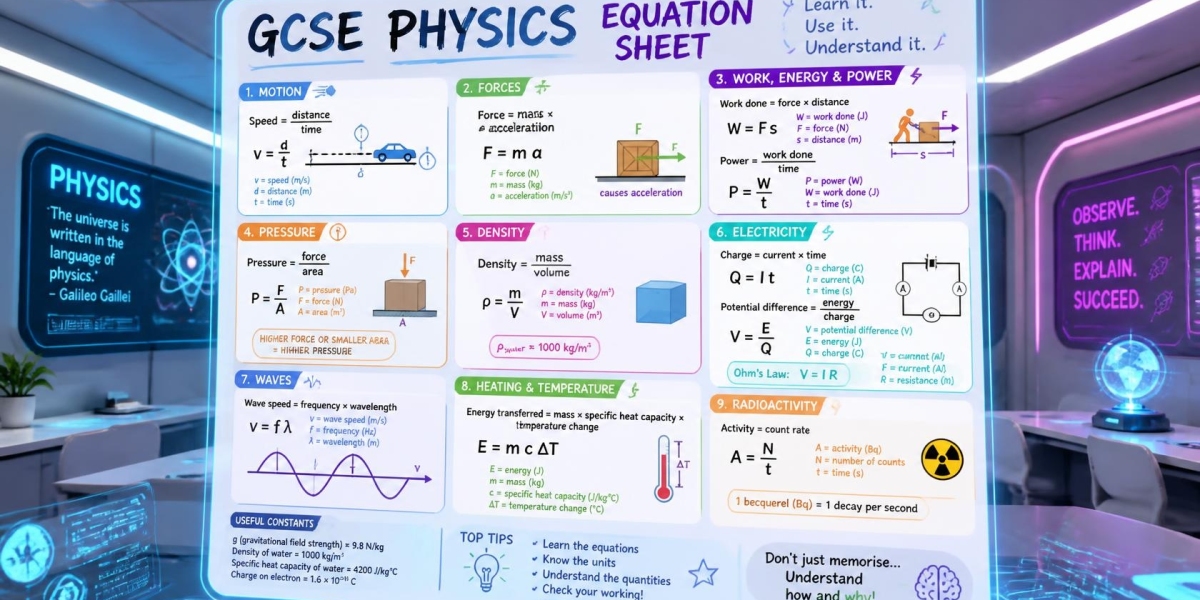

Physics is a subject where mathematical skills and scientific understanding work together. At GCSE level, students learn how different forces, energies, movements, and systems operate through practical experiments and mathematical relationships. Equations play a major role in helping students calculate unknown values and explain physical processes.
Many learners find physics formulas challenging at first because they involve symbols, units, rearranging equations, and applying concepts to unfamiliar situations. However, with the right approach, equations can become easier to understand and use effectively.
Rather than viewing formulas as information that must simply be memorised, students should focus on understanding the meaning behind each relationship. This approach helps develop stronger problem-solving skills and improves confidence during assessments.
The Importance of Equations in GCSE Physics
Equations are an essential part of GCSE Physics because they allow students to describe relationships between different quantities. Instead of explaining every scientific process using words, formulas provide a clear mathematical representation.
For example, equations can show the relationship between speed, distance, and time, or explain how energy changes between different forms. They help students solve numerical problems and understand how different physical factors influence each other.
A strong understanding of equations allows students to approach calculation-based questions more confidently and apply their knowledge to real-world examples.
Why Students Struggle With Physics Formulas
Many students experience difficulties with physics equations because they require several skills at the same time.
Common challenges include:
- Remembering the correct equation for a specific problem
- Understanding what each symbol represents
- Converting units correctly
- Rearranging formulas
- Substituting values accurately
- Interpreting written questions
A student may know a formula but still struggle to apply it if they do not understand the situation described in the question.
The best way to overcome these difficulties is to combine formula knowledge with regular problem-solving practice.
Focus on Understanding Instead of Memorising
Memorising equations without understanding their meaning can make physics more difficult. Students should learn why a formula works and what each part represents.
For example, when learning an equation involving energy, consider what factors increase or decrease the amount of energy involved. Understanding these relationships makes formulas easier to remember.
Ask yourself:
- What does each symbol mean?
- What units are used?
- What type of question requires this equation?
- How do changes in one value affect another?
This method creates deeper understanding and makes it easier to apply formulas in unfamiliar exam situations.
Create an Organised Revision System
Effective organisation can make physics revision much more productive. Instead of reviewing random formulas, divide equations into topics such as:
- Forces and motion
- Energy
- Electricity
- Waves
- Matter
- Radioactivity
A GCSE Physics Equation Sheet can be a useful study resource because it provides a structured collection of important formulas students need to review. It allows learners to quickly identify equations connected to different topics and practise applying them.
However, students should use equation resources as a learning tool rather than relying only on memorisation.
Learn Units Alongside Equations
Units are a crucial part of physics calculations. Many incorrect answers occur because students use the right formula with incorrect units.
For example, values may need to be converted into standard units before being used in a calculation. Understanding measurement units helps students recognise whether their final answer is reasonable.
When revising an equation, always learn:
- The meaning of each symbol
- The correct unit for each quantity
- Any required conversions
- How the equation is applied
This creates a complete understanding of the formula.
Practise Rearranging Equations
Some GCSE Physics questions require students to rearrange equations before solving a problem.
For example, if a formula shows the relationship between three quantities but the question asks for a different variable, you may need to change the structure of the equation.
Regular practice with rearranging formulas can improve confidence and reduce mistakes during exams.
Start with simple examples and gradually practise more complex rearrangements. Understanding how equations can be changed gives students greater flexibility when solving problems.
Develop a Step-by-Step Problem-Solving Method
A consistent method can help students approach physics calculations more effectively.
A useful process includes:
- Identify the information provided in the question.
- Determine what needs to be calculated.
- Select the correct equation.
- Write the formula clearly.
- Substitute the known values.
- Complete the calculation.
- Include the correct unit.
Following these steps reduces careless mistakes and makes your working easier to check.
Practise Different Types of Questions
Physics exams often include questions that require students to apply formulas in unfamiliar contexts. Practising different question styles can improve flexibility.
Do not only practise straightforward calculations. Work on questions that include:
- Multiple pieces of information
- Real-life scenarios
- Data tables
- Graphs
- Multi-step calculations
This helps develop the ability to recognise which formula is needed and how to apply it correctly.
Use Mistakes as Learning Opportunities
Making mistakes is a normal part of learning physics. Reviewing errors can provide valuable information about areas that need improvement.
When you get a question wrong, identify the reason. Did you choose the wrong equation? Did you make a unit conversion mistake? Did you substitute the values incorrectly?
Keeping a record of common mistakes can help you avoid repeating them during future practice and exams.
Improve Revision Through Active Practice
Passive reading is often not enough to develop strong equation skills. Students should actively practise using formulas.
Useful revision methods include:
- Creating formula flashcards
- Completing practice calculations
- Explaining concepts aloud
- Solving past paper questions
- Teaching concepts to someone else
Active learning encourages deeper understanding and improves memory retention.
Prepare Effectively for GCSE Exams
Exam preparation should include regular practice with equations rather than only reviewing them shortly before assessments.
Create a revision timetable that includes different physics topics and allow enough time to practise calculations. Start with areas where you feel less confident and gradually build your skills.
Past papers are particularly valuable because they show how formulas are used within exam-style questions. They also help students become familiar with the wording and structure of physics problems.
Connect Formulas With Real-Life Applications
Physics equations become easier to understand when connected with practical examples.
Motion formulas can explain how vehicles move, energy equations can describe household appliances, and electrical calculations can explain how circuits function.
Connecting mathematics with everyday situations helps students understand why formulas are useful and how scientists apply them in real-world contexts.
Build Confidence Through Regular Practice
Confidence with physics equations develops gradually. Students should not expect to master every formula immediately.
Consistent practice, careful review, and a willingness to learn from mistakes can significantly improve performance.
Instead of avoiding difficult calculations, approach them as opportunities to strengthen your understanding. Each problem solved successfully builds greater confidence for future challenges.
Conclusion
GCSE Physics equations may seem challenging, but they become much easier when students focus on understanding rather than simple memorisation. Learning the meaning behind formulas, practising calculations, and developing a structured approach can improve both accuracy and confidence.
Using organised revision resources, checking units carefully, and reviewing mistakes are essential steps for effective preparation. A formula is not just a group of symbols; it represents a scientific relationship that explains how different parts of the physical world interact.
With regular practice and a clear learning strategy, students can develop stronger calculation skills and approach GCSE Physics assessments with greater confidence.