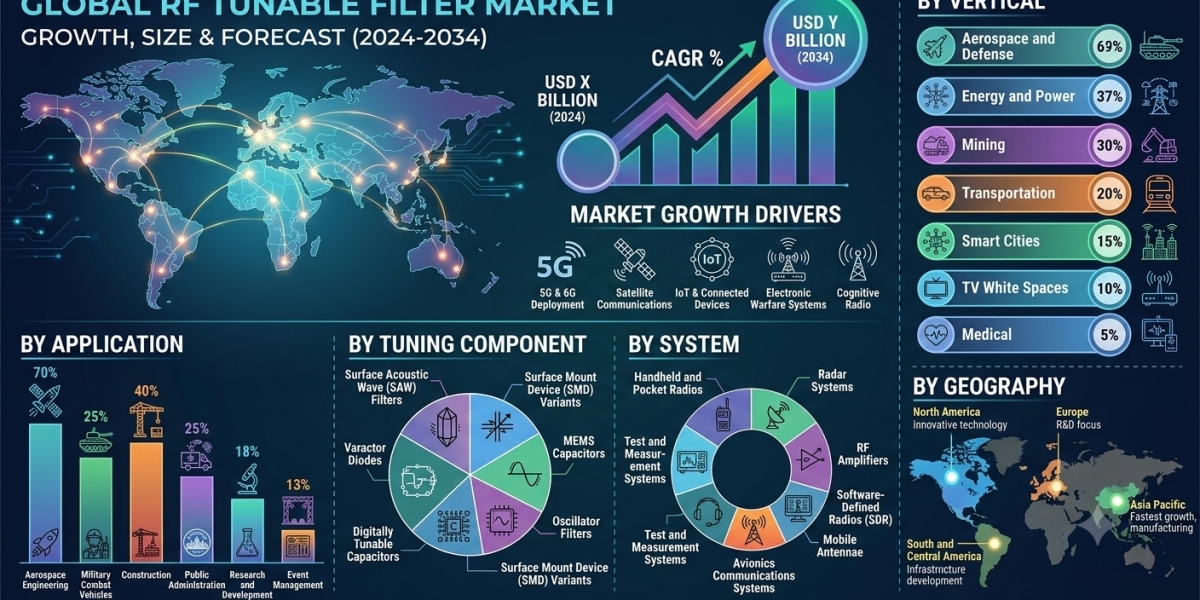

Technological advancements in wireless communication and defense electronics are creating significant demand for adaptable RF solutions throughout North America. The United States has a mature ecosystem spanning wireless infrastructure, semiconductor manufacturing, aerospace, defense, and RF engineering. The continued deployment of 5G, satellite networks, radar systems, and software-defined architectures is encouraging the integration of tunable filters for flexible frequency selection and effective interference control.
The RF Tunable Filter Market Size was valued at US$160.68 million in 2025 and is projected to reach US$253.48 million by 2034, registering a CAGR of 5.86% during 2026–2034. North America represents an important regional market because of its advanced communications infrastructure and extensive adoption of RF technologies across telecommunications, aerospace, defense, automotive, and electronics. The addressable opportunity is estimated at US$1,943.34 million during 2026–2034, reflecting the broader application potential of frequency-agile filtering solutions.
Download Sample PDF: https://www.theinsightpartners.com/sample/TIPRE00004344
Expansion of 5G and Advanced Wireless Infrastructure
The continued development of 5G networks is a significant driver for RF tunable filter adoption in the US and across North America. Wireless networks increasingly operate across multiple frequency ranges, requiring sophisticated RF front-end architectures capable of managing signals efficiently. Tunable filters can support frequency selection and interference mitigation while providing greater flexibility for equipment operating across different bands.
The US has also developed spectrum-sharing frameworks designed to improve the utilization of available frequencies. For example, the FCC and NTIA have worked with the US Navy to expand access to the 3.5 GHz Citizens Broadband Radio Service band while protecting federal users. Such developments demonstrate the growing importance of flexible spectrum management and create a favorable environment for technologies capable of adapting to changing RF conditions.
The FCC has also made spectrum available for 5G deployments in the C-band, further supporting the development of advanced wireless infrastructure in the country.
Strong Demand from US Aerospace and Defense
Aerospace and defense is another important growth driver across North America. The US has a large ecosystem of military aircraft, radar platforms, electronic warfare systems, satellite communications, secure radios, and other sophisticated RF-enabled platforms. These systems frequently need to operate across changing frequency environments while maintaining signal selectivity and minimizing interference.
RF tunable filters can provide frequency agility for applications such as radar, electronic intelligence, communications, and electronic warfare. The US Department of Defense has also explored 5G technologies and spectrum-sharing applications at military installations, illustrating the convergence between advanced wireless communications and defense requirements.
The growing integration of software-defined and multifunction RF systems is particularly relevant because these platforms can require adaptable components capable of supporting multiple operating conditions.
Increasing Adoption of Spectrum-Sharing Technologies
Spectrum efficiency is becoming increasingly important in the US as wireless connectivity expands across commercial and government applications. Dynamic spectrum sharing and related technologies allow different users or services to utilize frequency resources more efficiently. The FCC has documented growing interest in spectrum sharing as demand for wireless connectivity increases.
This environment supports demand for tunable RF components because filtering technologies play an important role in separating desired signals from unwanted frequencies. Tunable filters can therefore contribute to RF architectures designed to dynamically respond to spectrum availability, interference conditions, and application requirements.
Growth of IoT, Connected Devices, and Private Networks
North America's growing deployment of connected devices is also contributing to demand for advanced RF technologies. Industrial IoT, connected vehicles, smart buildings, healthcare equipment, logistics systems, and enterprise networks increasingly depend on reliable wireless connectivity.
In the US, private wireless networks and industrial 5G applications are creating additional requirements for flexible RF architectures. The FCC has highlighted applications of 5G-enabled IoT in areas including connected vehicles, industrial automation, facility management, logistics, healthcare, and other connected environments.
As the number of wireless endpoints increases, RF systems must manage more signals within increasingly complex electromagnetic environments. This is supporting interest in compact and adaptable filtering technologies.
Miniaturization and RF Component Integration
Miniaturization is an important technology trend supporting adoption across North America. Manufacturers of communication equipment, connected devices, aerospace electronics, and automotive systems are seeking smaller RF components without compromising signal performance.
The broader North American RF front-end ecosystem is already moving toward higher levels of component integration and miniaturization. The Insight Partners identifies miniaturization as a significant trend in the region's RF front-end industry, particularly as 5G systems require higher frequencies, broader bandwidths, and compact architectures.
Advancements in MEMS-based tuning, semiconductor technologies, and digitally controlled RF components can further support the development of compact tunable filters for next-generation systems.
Automotive and Connected Mobility Applications
The expansion of connected vehicles and advanced automotive electronics is creating another application area for RF tunable filters. Vehicles increasingly incorporate cellular connectivity, Wi-Fi, Bluetooth, satellite positioning, vehicle-to-everything communications, and radar-based systems.
North American automotive manufacturers and technology suppliers are investing in increasingly sophisticated electronic architectures. RF filtering can help manage the coexistence of multiple wireless signals within vehicles while supporting reliable communication and sensing functions. The growth of connected mobility and advanced driver-assistance technologies therefore provides additional opportunities for RF component manufacturers.
Key Players in the RF Tunable Filter Market
Key companies profiled in the industry include Analog Devices, Inc.; Coleman Microwave Company; DiCon Fiberoptics, Inc.; Dover Corporation; EXFO Inc.; LGL Group; Netcom Inc.; RF Products Inc.; Telonic Berkeley; and Thorlabs, Inc. These companies participate across different areas of RF and microwave technologies and serve applications spanning telecommunications, aerospace and defense, instrumentation, industrial electronics, and specialized communication systems.
The competitive environment is increasingly influenced by demand for higher frequency operation, compact designs, improved tuning capabilities, and application-specific RF solutions.
Future Outlook
North America's RF tunable filter landscape is expected to benefit from the continued evolution of 5G and next-generation wireless networks, spectrum-sharing technologies, defense modernization, satellite communications, connected vehicles, IoT deployments, and software-defined RF systems. The United States is positioned as an important center for innovation because of its established telecommunications infrastructure, aerospace and defense ecosystem, semiconductor capabilities, and research activity.
The increasing requirement for frequency flexibility is also expected to encourage greater integration of tunable filters with RF front ends, antennas, switches, amplifiers, and digitally controlled systems. As wireless environments become more complex, technologies that provide adaptable frequency selection and effective interference management are expected to remain important across North American communication and electronic systems.
About The Insight Partners
The Insight Partners is a global market research and consulting firm providing reliable and actionable insights across technology, electronics and semiconductor, industrial, healthcare, energy, and other industries. The company delivers research reports, industry analysis, strategic insights, and consulting services to help organizations understand evolving industry dynamics and identify emerging opportunities.
Contact Us
The Insight Partners
Email: sales@theinsightpartners.com
Phone: +1-646-491-9876
Website: https://www.theinsightpartners.com
Related Reports -
Submarine Fiber Cable Market Demand, Share & Growth by 2034
Automotive HVAC Market Size, Growth & Trends by 2034
Offshore Wind Cable Market Size, Growth & Trends by 2034