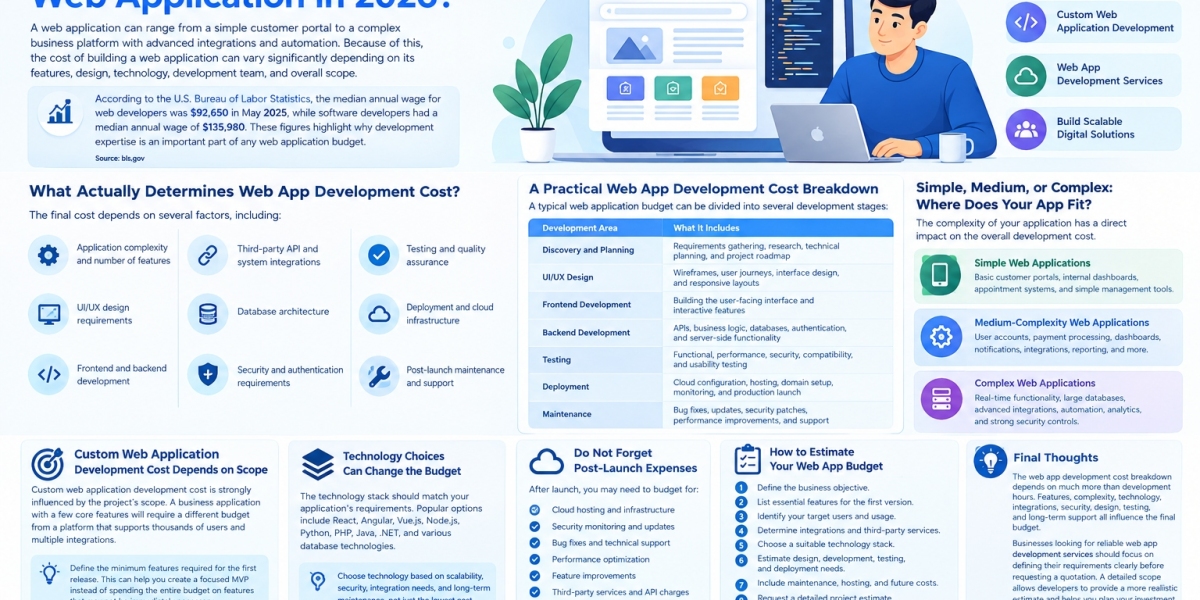

A web application can range from a simple customer portal to a complex business platform with advanced integrations and automation. Because of this, the cost of building a web application can vary significantly depending on its features, design, technology, development team, and overall scope.
According to the U.S. Bureau of Labor Statistics, the median annual wage for web developers was $92,650 in May 2025, while software developers had a median annual wage of $135,980. These figures highlight why development expertise is an important part of any web application budget.
What Actually Determines Web App Development Cost?
There is no single price for web application development. The final budget depends on several factors, including:
- Application complexity and number of features
- UI/UX design requirements
- Frontend and backend development
- Third-party API and system integrations
- Database architecture
- Security and authentication requirements
- Testing and quality assurance
- Deployment and cloud infrastructure
- Post-launch maintenance and support
A clear understanding of these elements helps businesses create a realistic web application budget before development begins.
A Practical Web App Development Cost Breakdown
A typical web application budget can be divided into several development stages:
| Development Area | What It Includes |
|---|---|
| Discovery and Planning | Requirements gathering, research, technical planning, and project roadmap |
| UI/UX Design | Wireframes, user journeys, interface design, and responsive layouts |
| Frontend Development | Building the user-facing interface and interactive features |
| Backend Development | APIs, business logic, databases, authentication, and server-side functionality |
| Testing | Functional, performance, security, compatibility, and usability testing |
| Deployment | Cloud configuration, hosting, domain setup, monitoring, and production launch |
| Maintenance | Bug fixes, updates, security patches, performance improvements, and support |
Simple, Medium, or Complex: Where Does Your App Fit?
The complexity of your application has a direct impact on the overall development cost.
Simple Web Applications
Simple applications usually have a limited number of features and straightforward workflows. Examples include basic customer portals, internal dashboards, appointment systems, and simple management tools.
Medium-Complexity Web Applications
Medium-level applications may include user accounts, payment processing, dashboards, notifications, third-party integrations, reporting, and more advanced business logic.
Complex Web Applications
Complex applications often require advanced architecture, multiple user roles, real-time functionality, large databases, sophisticated integrations, automation, analytics, and strong security controls. Enterprise platforms and large SaaS products often fall into this category.
Custom Web Application Development Cost Depends on Scope
Custom web application development cost is strongly influenced by the project's scope. A business application with a few core features will require a different budget from a platform that supports thousands of users and multiple integrations.
Before development begins, define the minimum features required for the first release. This can help you create a focused MVP instead of spending the entire budget on features that may not be immediately necessary.
Technology Choices Can Change the Budget
The technology stack can also influence development effort and cost. Depending on the project requirements, developers may use technologies such as React, Angular, Vue.js, Node.js, Python, PHP, Java, .NET, or different database technologies.
The right technology should be selected based on scalability, application requirements, security, development expertise, integration needs, and long-term maintenance rather than simply choosing the cheapest option.
Do Not Forget Post-Launch Expenses
Development is only one part of the total cost of owning a web application. After launch, businesses may need to budget for:
- Cloud hosting and infrastructure
- Security monitoring and updates
- Bug fixes and technical support
- Performance optimization
- Feature improvements
- Third-party services and API charges
- Database and storage requirements
Including these expenses in your initial planning can help prevent unexpected costs later.
How to Estimate Your Web App Budget
- Define the main business objective of the application.
- List the essential features required for the first version.
- Identify your target users and expected usage.
- Determine the required integrations and third-party services.
- Choose a suitable technology stack.
- Estimate design, development, testing, and deployment requirements.
- Include maintenance, hosting, and future development costs.
- Request a detailed project estimate from an experienced development team.
Final Thoughts
The web app development cost breakdown depends on much more than the number of development hours. Features, application complexity, technology, integrations, security, design, testing, and long-term support all influence the final budget.
Businesses looking for reliable custom web app development services should focus on defining their requirements clearly before requesting a quotation. A detailed scope allows developers to provide a more realistic estimate and helps businesses plan their investment more effectively.