
Running an online store is no longer just about uploading products and waiting for customers to arrive.
A shopper may discover a brand through Google, see a product on social media, compare it with competitors, read reviews, visit the website and leave without buying. They may return days later through an advertisement or email before finally placing an order.
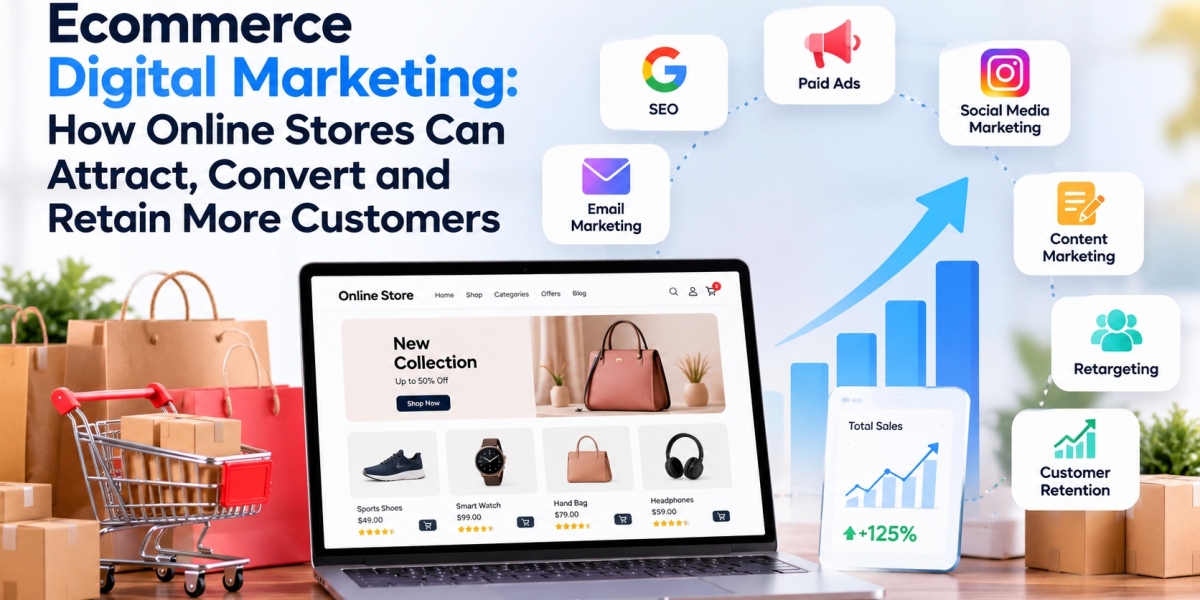
This is why successful ecommerce marketing requires more than one promotional channel. A strong strategy connects SEO, paid advertising, social media, content, email, retargeting and customer retention around the complete buying journey. Current 2026 ecommerce guidance similarly structures digital marketing around attracting customers, converting visitors, retaining buyers and continuously optimising performance.
What Is Ecommerce Digital Marketing?
Ecommerce digital marketing is the use of online channels to promote products, attract potential customers, generate sales and encourage existing customers to purchase again.
Depending on the business, the strategy can include:
- Search engine optimisation
- Google and shopping ads
- Social media marketing
- Email marketing
- Content marketing
- Influencer marketing
- Retargeting
- Affiliate marketing
- Customer loyalty campaigns
The important part is not using every channel.
The important part is choosing the channels that match where your customers discover, evaluate and purchase products.
Start With the Right Audience
One of the biggest mistakes ecommerce brands make is trying to sell to everyone.
A better strategy begins by understanding who is most likely to buy.
Consider questions such as:
Who needs the product?
What problem does it solve?
What price range are they comfortable with?
Where do they search for products?
What makes them hesitate before purchasing?
Which competitors do they compare?
These answers can influence everything from advertising messages to website content.
For example, a premium skincare brand and an affordable skincare brand may sell similar categories but require completely different marketing messages, audiences and content strategies.
SEO Helps Customers Find Products When They Are Searching
Search engine optimisation remains an important part of ecommerce growth because it can connect products with people who are actively looking for them.
Instead of targeting only broad terms, an ecommerce SEO strategy can cover different types of searches.
For example:
Product searches:
“wireless earbuds under ₹2000”
Category searches:
“best running shoes for men”
Comparison searches:
“leather wallet vs fabric wallet”
Problem-based searches:
“how to choose sunscreen for oily skin”
Informational searches:
“how to clean white sneakers”
This creates opportunities across different stages of the buying journey.
A strong ecommerce SEO strategy can include keyword research, category optimisation, product-page optimisation, technical SEO, internal linking and useful content.
Product Pages Need to Sell Without Feeling Pushy
Getting someone to a product page is only half the job.
The page must give the visitor enough information to make a confident decision.
A strong product page should make important details easy to understand:
Product benefits
Features and specifications
High-quality images
Videos where useful
Customer reviews
Pricing
Delivery information
Return policy
Availability
Clear purchase button
The goal is to remove uncertainty.
If customers repeatedly leave product pages without adding items to their cart, businesses should investigate whether the page is answering their most important questions.
Paid Advertising Can Accelerate Product Discovery
Organic traffic can take time to build. Paid advertising can help ecommerce brands reach targeted audiences more quickly.
Search ads can capture people already looking for specific products, while social advertising can introduce products to people based on interests, behaviour and other targeting signals.
Shopping-focused advertising can also take users closer to the product page instead of sending them through several unnecessary steps. Current 2026 ecommerce advertising guidance covers search, social, shopping and other paid placements as key acquisition options.
However, the goal should not simply be more clicks.
Businesses should monitor what happens after the click.
Ad → Product Page → Add to Cart → Checkout → Purchase
This makes it easier to identify where potential customers are being lost.
Social Media Can Turn Products Into Discoveries
People do not always open social media with the intention of buying something.
They may simply be watching videos, following creators or looking for inspiration.
That creates an opportunity for ecommerce brands.
Instead of making every post a direct sales pitch, brands can show:
How the product works
Before-and-after results
Product demonstrations
Styling ideas
Customer experiences
Behind-the-scenes content
Frequently asked questions
Creator collaborations
This type of content can make a product easier to understand and remember.
Social commerce is also becoming increasingly relevant as consumers use social platforms for product research and discovery.
Retarget Visitors Who Didn't Buy
Not every visitor will purchase during their first session.
Someone may browse a product, compare prices and leave.
Another person may add an item to their cart but abandon checkout.
Instead of considering these visitors lost permanently, ecommerce brands can use retargeting to reconnect with them.
For example, a visitor who viewed a particular product could later receive a relevant advertisement reminding them about that product.
Retargeting works best when the message reflects the visitor's previous interaction rather than showing completely unrelated promotions.
Email Marketing Can Bring Customers Back
The relationship should not end after someone leaves the website.
Email marketing can help ecommerce businesses stay connected with both potential and existing customers.
Useful email campaigns can include:
Welcome emails
Product recommendations
Abandoned-cart reminders
New-product announcements
Educational content
Post-purchase guidance
Review requests
Replenishment reminders
Loyalty offers
Email becomes particularly valuable for retention because businesses can communicate directly with customers instead of depending entirely on paid traffic. Current ecommerce strategy guidance places email and other owned channels within the retention side of the customer journey.
Don't Focus Only on Getting the First Sale
A customer who has already purchased from your store is not the same as a completely new visitor.
They already know your brand.
If their experience was positive, they may purchase again.
This makes customer retention an important part of digital marketing and ecommerce.
Brands can encourage repeat purchases through personalised recommendations, loyalty programs, useful post-purchase content, subscriptions where appropriate and relevant offers. Shopify's 2026 retention guidance specifically highlights repeat purchasing, post-purchase communication and loyalty as important areas for ecommerce brands.
Make Checkout Simple
A customer can discover your product through SEO, click an advertisement, read reviews and finally add the product to their cart—but still leave without purchasing.
The checkout experience can be one of the final barriers.
Businesses should make important information easy to understand, including:
Total price
Shipping charges
Delivery timing
Payment options
Return information
Order confirmation
Avoid unnecessary steps wherever possible.
A smooth checkout gives customers fewer reasons to stop when they are already close to purchasing.
Use Content to Answer Questions Before Customers Ask
Content marketing can support ecommerce SEO while also helping customers make decisions.
Instead of writing articles only to insert keywords, create content around genuine questions.
For example:
How to choose the right running shoes
What should you look for in a laptop for work?
How often should skincare products be replaced?
Which bag size is best for office use?
How to select the right home appliance for a small kitchen
Such content can introduce your brand to people who may not yet be ready to buy.
Once they trust the information, they may explore the products available on your store.
Measure the Entire Customer Journey
A successful ecommerce strategy should not be judged by traffic alone.
A website may receive thousands of visitors but still produce disappointing sales.
Businesses should monitor metrics such as:
Organic traffic
Conversion rate
Add-to-cart rate
Checkout completion
Customer acquisition cost
Average order value
Return on ad spend
Repeat purchase rate
Customer lifetime value
These numbers help identify whether marketing activity is actually contributing to business growth.
Why an Integrated Strategy Matters
SEO can bring organic visitors.
Paid advertising can create faster visibility.
Social media can generate product discovery.
Content can answer customer questions.
Email can bring shoppers back.
Retargeting can reconnect with interested visitors.
Retention campaigns can encourage repeat purchases.
The real advantage comes when these activities work together.
That is what businesses should look for when considering ecommerce digital marketing services: not just individual campaigns, but a strategy where different channels support the same customer journey.
Final Thoughts
Ecommerce success is rarely the result of one viral post or one successful advertising campaign.
It comes from consistently improving how customers discover the brand, understand the product, make a purchase and return for another one.
A strong ecommerce strategy therefore needs to balance customer acquisition, conversion and retention rather than focusing entirely on traffic.
For online businesses, digital marketing and ecommerce work best when SEO, paid advertising, social media, content and customer communication are connected around real customer behaviour.
The goal isn't simply to bring more people to your online store. It's to bring the right people, give them enough confidence to buy, and give them a reason to come back.