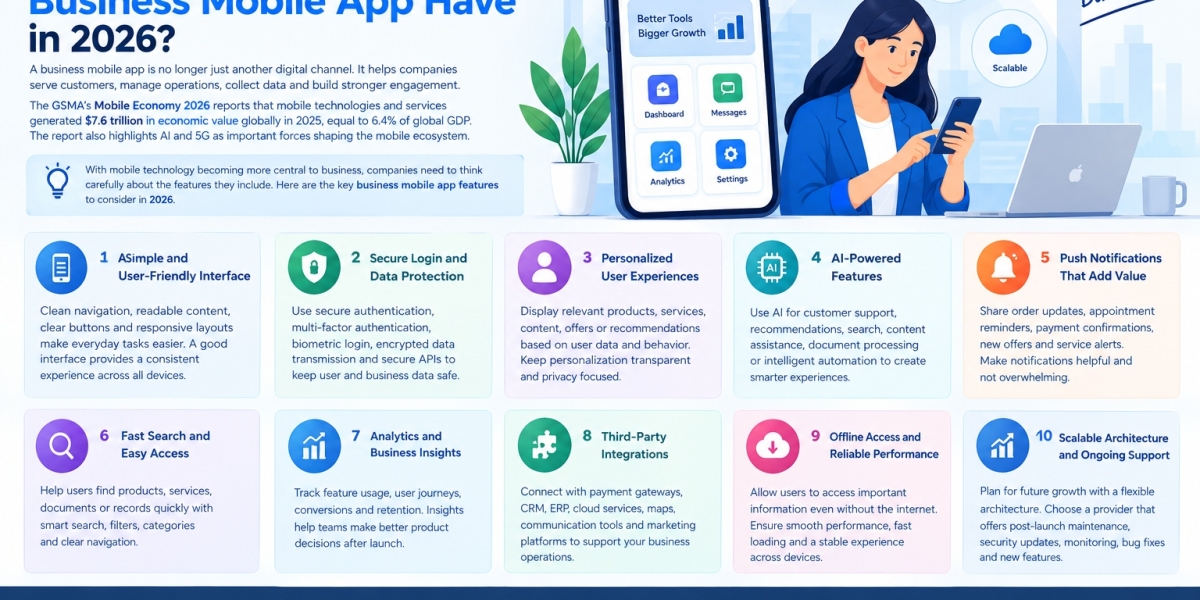

A business mobile app is no longer just another digital channel. For many companies, it has become a direct way to serve customers, manage operations, collect data, and build stronger engagement. The GSMA’s Mobile Economy 2026 reports that mobile technologies and services generated $7.6 trillion in economic value globally in 2025, equal to 6.4% of global GDP. The report also highlights AI and 5G as important forces shaping the mobile ecosystem.
With mobile technology becoming more central to business, companies need to think carefully about the features they include. Here are the key business mobile app features to consider in 2026.
1. A Simple and User-Friendly Interface
Users should be able to understand your app without needing instructions. Clean navigation, readable content, clear buttons, and responsive layouts can make everyday tasks easier.
A good interface should also maintain a consistent experience across different screen sizes and devices.
2. Secure Login and Data Protection
Security should be part of the app from the beginning. Depending on the business, useful options can include:
- Secure authentication
- Multi-factor authentication
- Biometric login
- Encrypted data transmission
- Secure API communication
- Session and access management
Security is especially important for apps that handle customer information, payments, or business data. Android Developers also recommends secure communication practices to help protect information exchanged by applications.
3. Personalized User Experiences
Customers increasingly expect apps to understand their needs. Personalization can help businesses display relevant products, services, content, offers, or recommendations based on permitted user data and behavior.
However, personalization should be transparent and designed with privacy in mind.
4. AI-Powered Features
AI is becoming an important part of modern mobile experiences. Depending on the business model, an app could use AI for customer support, recommendations, search, content assistance, document processing, or intelligent automation.
Android is also expanding capabilities that allow applications to work with AI-powered system experiences and agents.
5. Push Notifications That Add Value
Notifications can help businesses communicate important information quickly. They can be used for order updates, appointment reminders, payment confirmations, new offers, service alerts, and other relevant events.
The key is to make notifications useful rather than overwhelming users.
6. Fast Search and Easy Access
If your application contains products, services, documents, records, or other information, users should be able to find what they need quickly.
Smart search, filters, categories, and clear navigation can significantly improve the overall experience.
7. Analytics and Business Insights
Analytics should be included in the planning stage of custom mobile app development. Businesses can use analytics to understand feature usage, user journeys, conversions, retention, and other meaningful behaviors.
These insights can help teams make better product decisions after launch.
8. Third-Party Integrations
Modern business apps rarely work in isolation. Depending on the requirements, integrations may include:
- Payment gateways
- CRM platforms
- ERP systems
- Cloud services
- Maps and location services
- Communication tools
- Marketing platforms
Well-planned integrations can connect the mobile experience with existing business operations.
9. Offline Access and Reliable Performance
An app should remain useful even when the internet connection is weak or temporarily unavailable. Where appropriate, offline access can allow users to view previously loaded information or complete selected tasks.
Performance is equally important. Slow screens, crashes, and complicated workflows can quickly damage user experience.
10. Scalable Architecture and Ongoing Support
A business app should be designed for future growth. As users, transactions, and features increase, the application may require additional infrastructure and development work.
Therefore, businesses choosing a custom mobile application development company should consider post-launch maintenance, security updates, performance monitoring, bug fixes, and future feature development before starting the project.
Final Thoughts
The right features depend on your industry, customers, business goals, and application type. Instead of adding every available technology, focus on features that solve real user problems and support measurable business objectives.
A successful business mobile app in 2026 should combine usability, security, personalization, AI capabilities, analytics, integrations, reliability, and scalability. With the right feature strategy and a capable development partner, businesses can create a mobile experience that remains useful as customer expectations and technology continue to evolve.