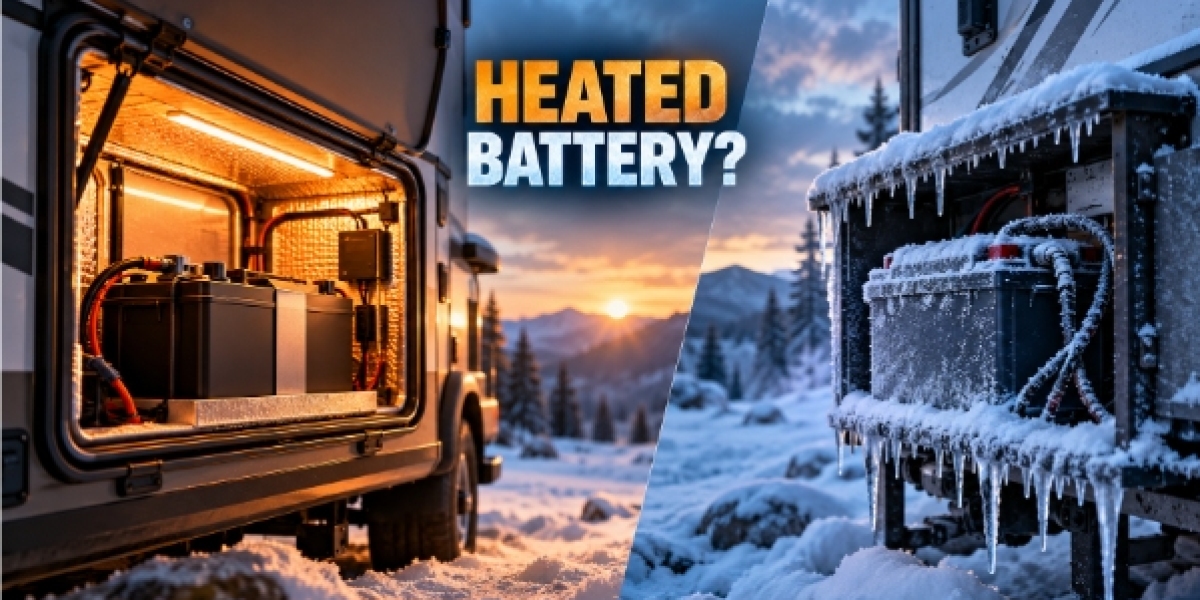

A heated battery can solve a particular winter problem: the RV has charging energy available while its LiFePO4 cells are too cold to accept a normal charge. It is not a requirement for every camper, and it does not create energy. The choice depends on where the bank is installed, how often the RV camps below the battery's charging threshold and when charging must begin.
Ask where the battery spends the night
A battery inside a consistently heated living space may see very different temperatures from a pack in an exterior compartment. The cabin thermostat does not report cell temperature. If the bank already has a monitor that displays its temperature, record readings before sunrise on cold trips. Otherwise, assess the compartment and the manufacturer's specifications with an installer.
A winter camper who parks at a powered site and warms the RV before charging may have more flexibility than one who relies on a short morning solar window. A cold mountain campsite and a mild coastal winter should not receive the same blanket recommendation.
Two use cases
Mostly powered campsites. The RV may have a suitable converter and time to wait for the cells to warm. The owner still needs to follow the battery's temperature limits, but internal heating may offer less practical value if the bank rarely gets cold and charging is not urgent.
Remote winter parking. The compartment may remain cold while solar or a driving charger becomes available. A heated model can use incoming energy to warm its cells under its specified conditions. The owner must allow for the warm-up energy and time before counting on normal charge.
These are planning examples, not verdicts for a specific installation. A battery's exact heating logic and temperature range should be read from its manual.
What “self-heating” means in the budget
A heated pack may direct incoming charge-source energy to internal heating before storing a normal charge. The solar controller can report production while net battery gain remains small. The furnace fan and other house loads may continue to draw current. A short winter day may end with less stored energy than an owner expected from panel wattage alone.
If no suitable charging energy arrives, a heater may not operate in the way the owner imagined. Check the model's activation conditions. Do not assume it constantly warms itself from stored energy or that it can charge normally at every outdoor temperature.
Checklist before choosing
The lowest likely cell or compartment temperature.
Whether the bank is inside or outside the conditioned space.
The next charging source and its available hours.
The model's heating-power source, status display and charge-temperature range.
The overnight essential loads and reserve if warm-up is delayed.
An RV lithium battery should also be selected for voltage, energy, continuous output, charging limit and fit. Heating is one feature among several.
Consider an unheated bank honestly
An unheated LiFePO4 battery with low-temperature charge protection may still supply RV loads when charging is blocked, within its published discharge limits. The owner can plan to charge after the cells warm, use a suitably conditioned compartment, or arrange a powered stop. Those options require a schedule that leaves enough stored energy through the delay. Do not disable the BMS cutoff to force a morning solar charge.
Compartment changes need care. Insulation may slow cooling but can affect summer heat and nearby electrical equipment. Improvised heating against the case or cables is not a substitute for an installation designed to the manufacturer's instructions.
Compare the whole charging system
Solar controller, converter and DC-to-DC charger profiles must match the battery's LiFePO4 specifications. Heating does not correct an old lead-acid equalization setting. Check how each charger responds if the battery temporarily refuses current. A BMS protection event should not become the normal way to control an unsuitable charger.
If you want to explore Epoch’s RV battery lineup, open the individual models rather than treating the collection as one specification. Some include heating and monitoring; their published limits and operating sequences may differ. Match the exact model to the RV's compartment and expected charging windows.
Test a realistic morning
After installation, note temperature, bank energy and charging status before sunrise. Watch the transition from heating or blocked charge to normal acceptance, then record energy gained by evening. Repeat with the normal furnace and refrigerator loads active. A single sunny test cannot prove performance in every storm, but it can expose a wrong assumption about warm-up time.
A small test can settle the question
If the RV already has an unheated bank with proper low-temperature protection, record its cell temperature and charge behavior through a real cold morning. Did the bank stay above its threshold in the compartment? Did solar arrive after it had naturally warmed? Was there still enough reserve for the following night? That evidence may show no practical heating need for the owner's usual sites, or it may show a recurring gap.
For a planned new build, test the proposed compartment temperature with a logger before buying equipment if possible. The temperature at the cells will not be identical to ambient compartment air, but the measurements establish the likely exposure. Consider where the charging window falls: a two-hour drive before sunrise, a full day of shore power or a brief winter solar period ask different things of the battery.
Separate comfort from charging
A heated living area is for people; it may not warm a case beneath the floor. Conversely, a battery mounted inside the conditioned space may remain warm enough during an ordinary winter trip, provided the installation follows mounting and access requirements. The term “winter camping” does not specify the battery's location. That physical fact can be more useful than a regional weather average.
A useful answer may change when the camper moves from occasional powered sites to regular remote winter stays. Recheck the decision if the battery is relocated or the charging schedule changes.
Conclusion
A heated RV battery is useful when cold cells and an available charging source often meet at the same time. Decide from the compartment temperature, model instructions, essential loads and charging schedule. Leave a reserve for any delay, heated or not.