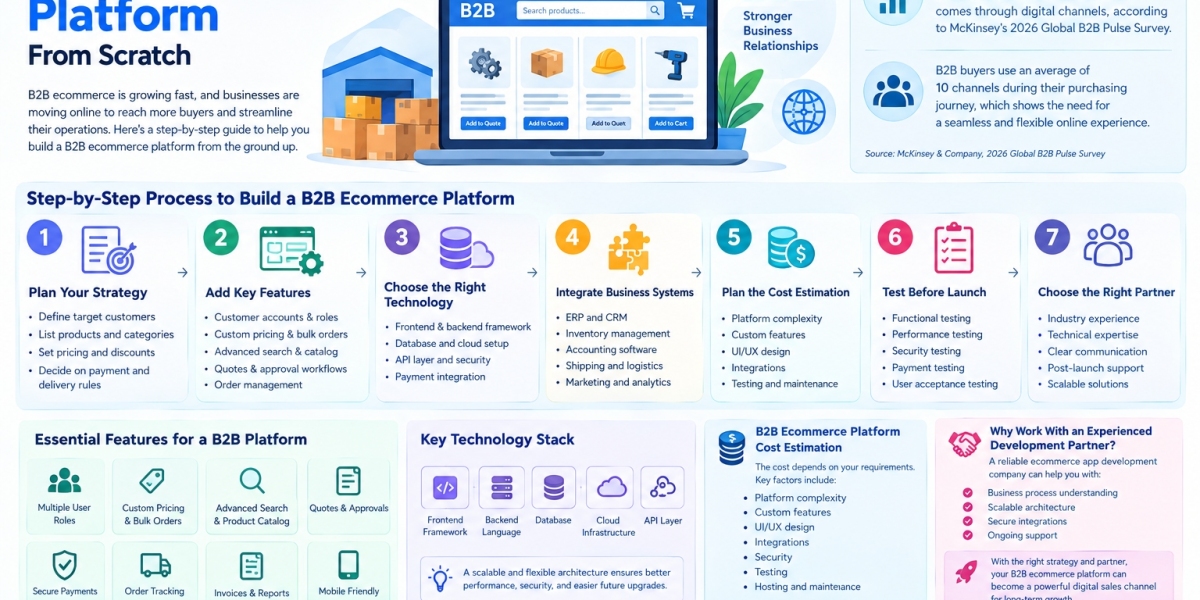

B2B ecommerce is becoming an important part of how businesses sell, purchase, and manage commercial relationships. According to McKinsey's 2026 Global B2B Pulse Survey, 71% of surveyed B2B companies now offer ecommerce, while roughly one-third of revenue among these companies flows through digital channels. This shift shows why businesses need well-planned and scalable ecommerce platforms that support complex buying processes.
Developing a successful B2B ecommerce platform requires more than creating an online product catalog. Businesses need features for bulk purchasing, custom pricing, customer accounts, approval workflows, secure payments, integrations, and efficient order management. This guide explains how to approach B2B Ecommerce Platform Development from the ground up.
Start With a Clear B2B Ecommerce Strategy
Before development begins, define what the platform needs to accomplish. Identify your target customers, products, pricing structure, sales process, payment methods, and business goals. A clear strategy helps development teams choose the right architecture and prevents unnecessary features from increasing development time and costs.
Build Features Around Real Business Buying Needs
B2B buyers usually have different requirements than individual consumers. Therefore, your platform should be designed around the way businesses actually purchase products and services.
- Customer Accounts and Multiple User Roles: Allow businesses to create accounts with different permissions for buyers, managers, and administrators.
- Custom Pricing and Bulk Orders: Support negotiated prices, quantity-based discounts, minimum order quantities, and bulk purchasing.
- Product Catalog and Advanced Search: Provide detailed product information, categories, filters, SKUs, specifications, and fast search functionality.
- Quotes and Approval Workflows: Let customers request quotations and send orders through internal approval processes when required.
- Secure Payments and Order Management: Support suitable B2B payment options and provide tools for tracking orders, invoices, shipments, and transaction history.
Choose the Right Technology Architecture
The technology stack has a direct impact on the platform's performance, scalability, security, and maintenance. Depending on the project requirements, businesses can use modern frontend frameworks, scalable backend technologies, cloud infrastructure, databases, APIs, and secure payment solutions.
During B2B ecommerce website development, the architecture should be flexible enough to handle growing product catalogs, customers, orders, traffic, and integrations. A scalable architecture also makes it easier to introduce new features as the business grows.
Connect the Platform With Existing Business Systems
A B2B ecommerce platform often needs to work with other business applications. Integrations can reduce manual work and help maintain consistent information across different systems.
- ERP systems
- CRM platforms
- Inventory management systems
- Accounting software
- Payment gateways
- Shipping and logistics systems
- Marketing and analytics tools
APIs can be used to connect these systems and synchronize important information such as product data, inventory, customer details, prices, orders, and payment information.
Plan the B2B Ecommerce Platform Cost Estimation
The total B2B ecommerce platform cost estimation depends on the scope and complexity of the platform. Instead of focusing only on the initial development price, businesses should consider the complete project lifecycle.
- Platform complexity and business requirements
- Custom features and functionality
- UI/UX design
- Third-party integrations
- Security requirements
- Testing and quality assurance
- Cloud hosting and infrastructure
- Maintenance and future upgrades
A detailed requirement document can help an ecommerce app development services provide a more realistic project estimate. Businesses should also keep a budget for post-launch improvements and technical support.
Test Before You Take the Platform Live
Testing is an important part of ecommerce app development services. Before launch, the platform should be tested across different devices, browsers, user roles, and purchasing scenarios.
- Functional testing
- Performance testing
- Security testing
- Payment testing
- API and integration testing
- Mobile responsiveness testing
- User acceptance testing
Testing helps identify problems before customers begin using the platform and reduces the risk of checkout failures, incorrect pricing, security issues, or order-processing errors.
Choose the Right Ecommerce Development Partner
Choosing the right development partner can significantly influence the success of your B2B ecommerce project. Look for an experienced team that understands B2B purchasing workflows, ecommerce architecture, integrations, security, scalability, and ongoing maintenance.
Review the company's portfolio, technical expertise, development process, communication approach, pricing model, testing practices, and post-launch support. A reliable partner should also be able to explain technical decisions clearly and align the platform with your business objectives.
Final Thoughts
Building a B2B ecommerce platform from scratch requires careful planning, the right technology, business-focused features, secure integrations, and continuous testing. From customer accounts and bulk orders to custom pricing and ERP integrations, every component should support the way your customers purchase.
Whether you are launching a new platform or upgrading an existing ecommerce system, working with an experienced ecommerce app development company can help you create a scalable solution that supports long-term business growth.