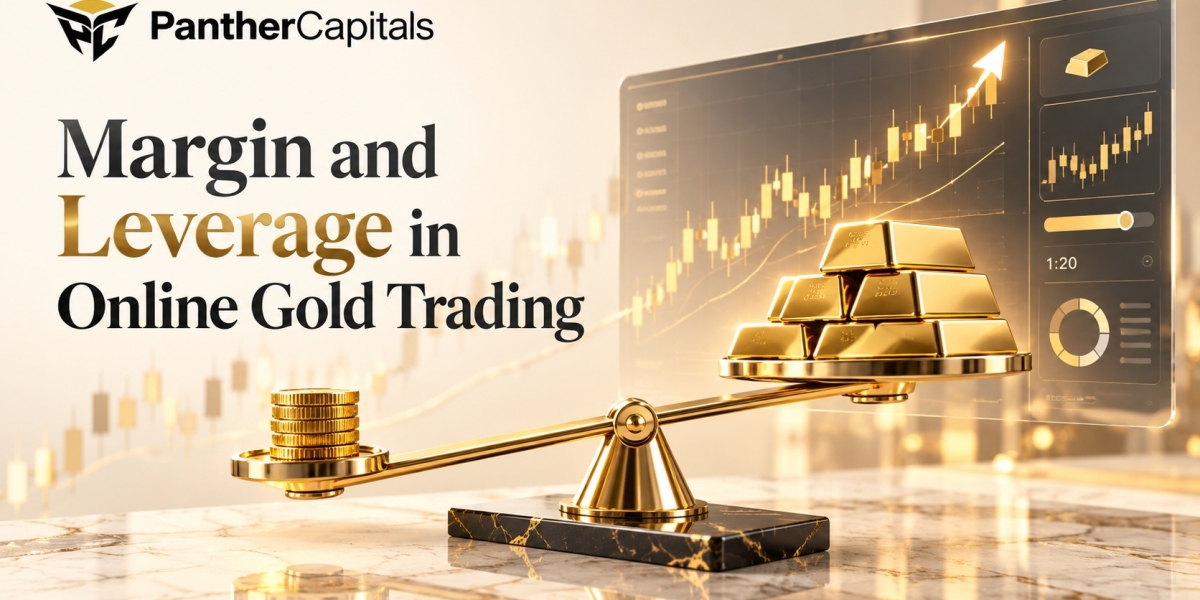

Gold attracts both investors and active traders because its price responds to currencies, interest rates, inflation expectations, geopolitical developments, central-bank policies, and changes in global demand. When gold is traded through leveraged instruments, however, price direction is only part of the decision.
Margin and leverage can significantly change the amount of market exposure a trader controls and the level of risk involved.
At Panther Capitals, we believe anyone considering leveraged gold exposure should understand how these mechanisms work before placing a position. Leverage can reduce the amount of capital required to establish exposure, but it can also magnify losses when the market moves in the opposite direction.
What Margin Means in Gold Trading
Margin is the amount of capital required to open and maintain a leveraged trading position. It is not the same as the total value of the market exposure.
Suppose a financial instrument allows a trader to control a position worth considerably more than the capital committed as margin. The trader remains exposed to price movements based on the larger position rather than only the margin amount.
This distinction is important.
Margin requirements can depend on factors such as
Gold price
Position size
Product structure
Market volatility
Account conditions
Applicable margin rate
Requirements can also change when volatility increases. Traders should therefore monitor both their positions and available account capital.
Understanding Leverage
Leverage describes the relationship between the capital committed and the overall market exposure controlled by a position.
For example, a leveraged product may allow a trader to establish a larger position using a smaller amount of capital as margin. This can make market access more capital-efficient, but it does not make the position less risky.
If the underlying gold price moves favourably, the effect on the capital committed can be magnified. The same mechanism operates when prices move against the position.
This is why leverage should not be assessed only according to how much exposure it makes available. We believe traders should first consider how much downside they can reasonably tolerate.
How Leverage Magnifies Gold Price Movements
Gold does not need to make an unusually large percentage move for leverage to have a meaningful effect on an account.
Consider a simplified example where a trader commits a portion of capital as margin while controlling a larger gold position. If gold moves 1 percent, the gain or loss is calculated according to the position exposure rather than simply the margin deposited.
A relatively modest movement in the underlying market can therefore create a much larger percentage change relative to the capital committed.
This becomes particularly important around central-bank announcements, inflation reports, employment figures, geopolitical developments, and other events capable of increasing gold volatility.
Margin Requirements Can Change
Margin should not be viewed as a permanently fixed amount.
Exchanges and providers can adjust requirements according to volatility and risk conditions. Higher margin requirements reduce the amount of leverage available for the same position size.
In the Indian derivatives market, exchange-traded gold futures operate with defined margin frameworks. Additional or special margins may also be imposed when market conditions require stronger risk controls.
For participants following the gold market in India, this demonstrates why margin needs to be monitored throughout the life of a leveraged position rather than checked only when the trade is opened.
Why Available Margin Matters
Opening a leveraged position uses part of the available account capital.
If the position moves against the trader, unrealised losses can reduce available funds. When available margin becomes insufficient relative to the requirements for open positions, the account can face restrictions or position-management consequences according to the applicable trading conditions.
Traders can therefore consider maintaining a capital buffer rather than committing the maximum amount available.
At Panther Capitals, we believe available margin should be treated as part of risk management, not simply as unused buying power.
Position Size and Leverage Work Together
Position size determines how much market exposure a trader takes. Leverage determines how much capital may be required to establish that exposure.
Using the maximum available leverage does not mean a trader needs to take the maximum possible position.
A more structured process can begin by determining
Acceptable potential loss
Intended entry level
Potential exit level
Current gold volatility
Available trading capital
Appropriate position size
The margin requirement can then be considered within that risk framework.
This approach reverses a common mistake of deciding position size according to the maximum amount a platform permits.
Following Live Gold Markets
Participants involved in gold trading live may see prices move quickly when economic expectations change.
During periods of high volatility, traders may encounter larger price ranges and rapidly changing market conditions. Margin requirements can also become more significant because leveraged exposure magnifies the financial effect of those movements.
Live market information can include bid and ask quotes, intraday highs and lows, charts, spreads, and economic-event information.
However, faster information does not remove market uncertainty. Traders still need to determine whether the potential risk associated with a position fits their strategy.
Gold and Currency Market Exposure
International gold is commonly quoted against the US dollar as XAU/USD. Changes in the dollar can therefore influence gold-market conditions.
Participants involved in forex gold trading may monitor interest rates, central-bank decisions, inflation, economic growth, bond yields, and currency movements alongside gold.
Through Forex Trading, Panther Capitals provides access to currency markets within our broader market environment.
Leverage is also widely associated with currency trading, making position sizing and margin awareness relevant across both asset categories. Each instrument should still be assessed according to its individual trading conditions.
Margin in Broader Commodity Markets
Gold belongs to the wider commodity market, where derivatives can provide exposure to precious metals, energy products, and other underlying assets.
Participants can consider commodities trading through Panther Capitals when assessing opportunities across commodity markets.
Margin requirements can differ substantially between instruments because volatility, contract size, liquidity, and market conditions vary.
A margin level applicable to one commodity should therefore not be assumed to apply to another.
Understanding the specifications of the individual instrument remains important before establishing any leveraged exposure.
Using Stop Orders With Leveraged Positions
Stop orders can form part of a trading risk process by defining a level at which an instruction is triggered to exit a position.
They can help traders establish potential exit conditions before entering the market.
However, a stop order should not be treated as a guarantee that a position will always close at the exact requested price. During rapidly changing or gapping markets, execution can occur at a different available price depending on the product and market conditions.
For leveraged gold positions, traders should therefore consider both planned exits and the possibility of unexpected price movements.
Gold Alongside Equity Markets
Changes in interest rates, inflation expectations, economic growth, and investor sentiment can influence gold and equities simultaneously.
Participants monitoring broader equity conditions can access Indices trading through Panther Capitals.
Indices can provide information about broader stock-market movements, but gold does not maintain a permanent relationship with equities.
Holding leveraged positions across multiple markets also requires attention to combined exposure. Several positions can respond to the same macroeconomic event, increasing overall portfolio risk.
Digital Gold Is Different From Leveraged Trading
People who buy digital gold online generally approach gold through a different product structure from leveraged derivatives.
Digital gold commonly involves purchasing an amount of gold electronically under provider-specific custody arrangements. Margin and leverage are not what define that ownership model.
The distinction matters because digital ownership and leveraged trading serve different purposes.
Investors considering digital gold should assess custody, redemption, pricing, spreads, taxes, provider arrangements, and regulatory status. Traders using leveraged instruments need to focus more heavily on margin, position size, volatility, execution, and potential losses.
Evaluating Digital Gold Separately
Someone searching for the best digital gold investment should avoid comparing digital gold products solely according to recent gold-price performance.
Product structure is equally important.
In India, digital gold offered through certain online platforms is distinct from SEBI-regulated gold products such as Gold ETFs, Electronic Gold Receipts, and exchange-traded commodity derivatives.
That distinction means investors should examine the regulatory structure, custody arrangements, counterparty exposure, redemption conditions, and applicable costs of the specific product being considered.
Margin-based gold trading and digital gold ownership should therefore be evaluated as separate forms of market participation.
Individual Shares and Broader Exposure
Panther Capitals also provides share trading for participants interested in individual equity-market opportunities.
When several asset classes are held or traded simultaneously, total account exposure becomes important. Gold, currencies, commodities, and equities can all react to major economic announcements.
Leverage can increase this interconnected risk if several large positions are open at the same time.
We believe traders should consider overall portfolio exposure rather than assessing each leveraged position in isolation.
Digital Assets and Leverage Risk
Digital-asset markets can experience substantial volatility of their own.
Through cryptocurrency trading, participants can consider cryptocurrency markets separately from gold and other financial instruments.
Similar risk terminology can appear across asset classes, but volatility, liquidity, trading conditions, and price drivers can differ considerably.
A risk process designed for one instrument should not automatically be transferred to another without considering these differences.
Managing Leverage More Carefully
Leverage can be useful for capital-efficient market exposure, but greater available leverage does not require greater risk-taking.
A structured approach can include
Setting a maximum position size
Maintaining sufficient available margin
Monitoring market volatility
Reviewing upcoming economic events
Defining potential exits
Considering total portfolio exposure
Avoiding excessive concentration
Understanding trading costs
Traders should also consider how quickly losses could accumulate if several leveraged positions move against them simultaneously.
Building a More Disciplined Gold Trading Approach
Margin and leverage change the mechanics of online gold trading because they separate the capital committed from the total market exposure controlled.
At Panther Capitals, we believe this distinction should remain central to risk management.
Margin determines how much capital must be committed to support a position, while leverage determines how much exposure that capital can control. Together, they can magnify the effect of gold-price movements on an account.
Gold can move rapidly in response to monetary policy, currencies, inflation, geopolitical events, economic releases, and changing investment demand. Higher volatility can also affect margin requirements and available account capital.
For that reason, traders can focus on position sizing, available margin, potential downside, market conditions, and overall exposure before deciding how much leverage to use.
Leverage does not change the direction of the gold market. It changes the financial impact that market movement can have on the trader.
Understanding that relationship can support a more measured approach to gold-market participation and help keep risk considerations central to each trading decision.