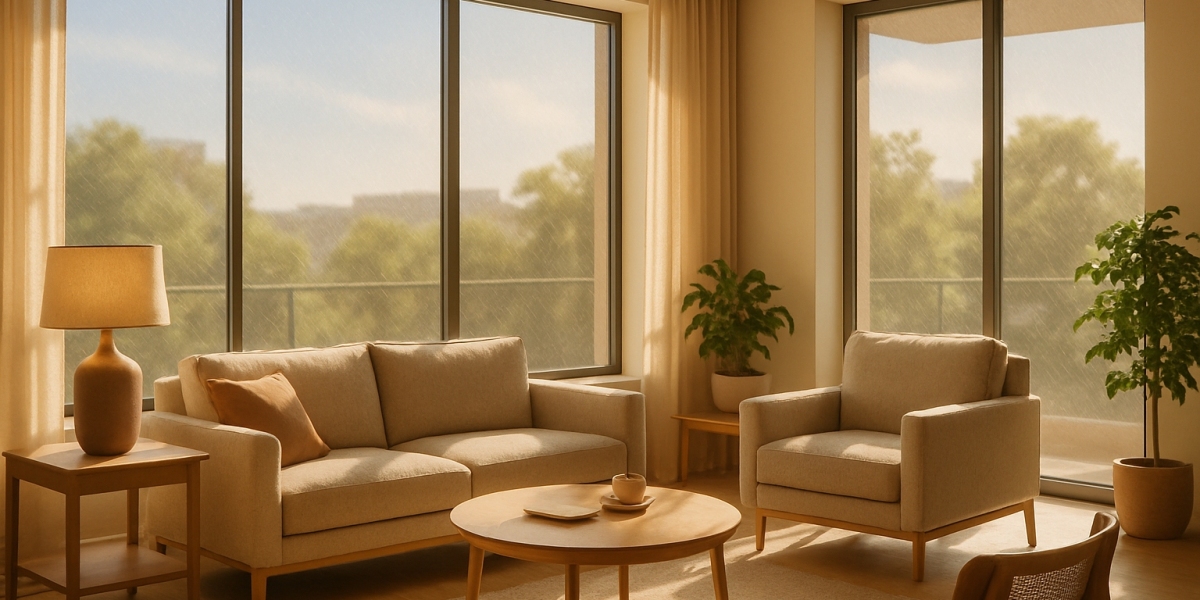

Large glass surfaces can make a room feel open and bright, but they can also create privacy concerns. Offices may have conference rooms exposed to corridors, homes may have windows facing neighbors, and businesses may have glass doors or partitions where sensitive activity should not be fully visible.
Replacing the glass is one possible solution, but it can be expensive and disruptive. Window film provides another option for changing how glass looks and functions without replacing the existing surface.
For homeowners and businesses considering window privacy film installation, the goal is often to create privacy while preserving as much natural light and openness as possible. Decorative and privacy films are specifically available in options designed to obscure views while allowing daylight to enter.
Why Privacy Does Not Have to Mean Dark Rooms
One of the biggest concerns about adding privacy to glass is losing natural light.
Traditional blinds or curtains can reduce visibility, but they may also block daylight when closed. Privacy films can provide different levels of visual obstruction while allowing light to continue entering the space.
Frosted, textured, patterned, and other translucent finishes can obscure direct views without making a room feel completely enclosed. Manufacturers such as 3M and LLumar specifically describe privacy-film options designed to maintain natural light while reducing visibility through glass.
The right choice depends on how much privacy is needed and how much transparency the space should retain.
Where Privacy Film Can Be Useful
Privacy needs can arise in many parts of a property.
At home, residents may want additional privacy in bathrooms, bedrooms, entryways, or windows facing neighboring properties.
In commercial environments, privacy may be important for:
Conference rooms
Office partitions
Reception areas
Healthcare spaces
Retail environments
Interior glass doors
Employee-only areas
The advantage of film is flexibility. It can be applied to many smooth glass surfaces and can be selected based on the desired appearance and level of privacy.
Choose the Right Level of Privacy
Not every room requires complete visual blocking.
Some spaces only need partial privacy, while others may require much stronger concealment.
Partial Privacy
A decorative pattern or gradient can obscure specific areas while keeping some visibility.
Frosted Privacy
Frosted finishes provide broader visual obstruction while allowing light to pass through.
Higher Opacity
More opaque options can be used where direct visibility needs to be significantly reduced.
Thinking about the purpose of the room helps avoid choosing a film that is either too transparent or unnecessarily restrictive.
Natural Light Can Still Shape the Space
Light is a major part of interior design.
Completely covering a window can make a room feel smaller or darker. Privacy film provides a way to modify visibility while maintaining the role glass plays in bringing daylight into the interior.
This can be especially useful in offices and commercial properties where natural light contributes to an open atmosphere.
LLumar, for example, describes decorative films as solutions that can balance privacy, daylight, and interior design.
Privacy Film Can Also Improve Appearance
Privacy does not have to look purely functional.
Modern films come in a wide range of finishes, including frosted surfaces, gradients, textures, patterns, and decorative designs. This makes it possible to treat privacy glass as part of the interior design instead of simply covering it.
A business may use a subtle pattern to complement its branding. A home may choose a soft frosted finish. An office can use a gradient to create privacy at eye level while maintaining openness above.
Consider Heat and Glare Too
Some window films are designed for privacy and decorative purposes, while others address solar heat, glare, or UV exposure.
These are separate performance considerations and should not be assumed from the word “privacy” alone.
Solar-control films, for example, can reduce heat and glare while maintaining daylight. 3M describes several window-film products that can reduce solar heat and glare while preserving natural light.
If heat or glare is also a problem, discuss those requirements separately when selecting the film.
Installation Quality Matters
The quality of the finished result depends partly on how the film is installed.
Glass should be properly prepared, the film needs to be applied evenly, and edges should be finished cleanly.
Poor installation can result in visible bubbles, lifting edges, uneven appearance, or other problems that affect the look of the glass.
Professional window privacy film installation can help ensure the film is selected and applied according to the glass surface and intended use.
Film Can Be Less Disruptive Than Glass Replacement
Replacing windows or interior glass can involve considerable work.
For many applications, film can be installed with less disruption than replacing the underlying glass. LLumar describes decorative film as an option for updating commercial spaces with minimal disruption, while allowing properties to change designs later.
That makes film worth considering when the existing glass is structurally suitable and the primary goal is changing its appearance or privacy characteristics.
Think About Visibility From Both Directions
Privacy can behave differently depending on lighting conditions.
A film that offers strong daytime privacy may not provide the same level of privacy at night when indoor lighting changes the relationship between inside and outside.
For this reason, property owners should discuss actual privacy expectations rather than assuming that every “one-way” or reflective film provides the same result under every lighting condition.
Frosted or opaque decorative films may be more appropriate when consistent visual obstruction is the priority.
Consider Maintenance and Future Changes
Window film should be treated as part of the property's finish.
Ask about cleaning requirements, expected durability, warranty coverage, and whether the film can be removed or replaced later.
This can matter in commercial spaces where layouts and branding may change over time.
Make Privacy Part of the Overall Design
The best result comes from considering privacy together with light, interior appearance, occupant comfort, and the function of each room.
A conference room may need privacy without feeling closed off. A bathroom may need strong visual obstruction. A storefront may need decorative branding while maintaining daylight.
The same film does not necessarily make sense for all three.
Conclusion
Window privacy is not simply about blocking the view. It is about finding the right balance between privacy, daylight, appearance, and the way a space is used.
Modern privacy and decorative films provide flexible options for homes and businesses, including frosted, patterned, textured, and gradient designs that can help obscure views while preserving natural light.
For property owners considering window privacy film installation, evaluating the room's privacy requirements, lighting conditions, design goals, and long-term needs can help ensure the finished result improves the space without making it feel unnecessarily dark or closed in.