
In industries where product quality, safety, and consistency are important, detecting metal contamination is a critical part of the production process. A gravity feed metal detector provides an efficient solution for inspecting free-falling products and identifying unwanted metal contaminants before they reach packaging or the final customer.
Designed for applications involving powders, granules, pellets, and other free-flowing materials, gravity feed metal detectors offer reliable and automated metal detection while helping manufacturers maintain high production and quality standards.
What Is a Gravity Feed Metal Detector?
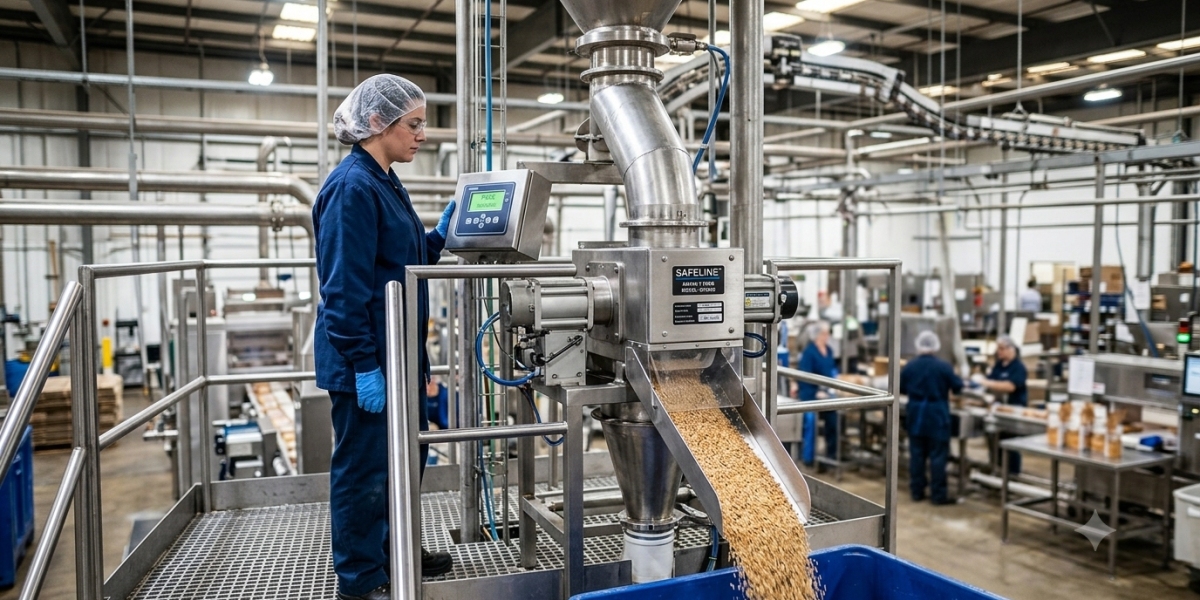
A gravity feed metal detector is an industrial inspection system designed to detect metal contaminants in products moving through a vertical pipeline or chute. The product typically falls through the detection area by gravity, allowing the system to inspect the material without requiring a conveyor.
These systems can detect common types of metal contamination, including:
- Ferrous metals
- Non-ferrous metals
- Stainless steel
- Metal fragments from processing equipment
- Small metallic particles introduced during production
When metal contamination is detected, the system can activate an automatic rejection mechanism to remove the affected product from the production line.
How Does a Gravity Feed Metal Detector Work?
The operating process is relatively simple and highly automated. Free-flowing material enters the detector through a vertical product line and passes through a sensitive electromagnetic detection field.
If a metal contaminant enters the detection zone, the detector identifies the change in the electromagnetic field. The control system then sends a signal to the rejection mechanism, which separates the contaminated material from the acceptable product.
This automated process allows manufacturers to inspect large quantities of material continuously while reducing the possibility of human error.
Key Benefits of Gravity Feed Metal Detection
1. Accurate Metal Detection
Modern gravity feed metal detectors are designed to provide high sensitivity for detecting different types of metal contamination. This helps manufacturers maintain product quality and improve contamination control.
2. Continuous Product Inspection
Because products can flow continuously through the detection system, gravity feed metal detectors are suitable for high-volume manufacturing environments.
3. Automatic Contaminant Rejection
Many systems can be integrated with automatic reject valves. When contamination is detected, the affected material can be removed without stopping the entire production process.
4. Suitable for Free-Flowing Products
Gravity feed systems are particularly useful for products such as powders, granules, seeds, plastic pellets, and other dry bulk materials that naturally flow through vertical processing lines.
5. Hygienic Design
For food, pharmaceutical, and other hygiene-sensitive industries, equipment can be designed with easy-to-clean surfaces and sanitary components to support production hygiene requirements.
6. Reduced Product Loss
Accurate detection and controlled rejection can help manufacturers remove contaminated portions while allowing compliant products to continue through the production process.
Industries That Use Gravity Feed Metal Detectors
Gravity feed metal detection technology can be used across several industries where contamination control is important.
Food Processing
Food manufacturers can use gravity feed metal detectors to inspect ingredients and free-flowing food products before packaging. Applications may include flour, sugar, grains, spices, cereals, nuts, and other dry products.
Pharmaceutical Manufacturing
Pharmaceutical production requires strict quality control. Gravity feed metal detectors can help identify metallic contaminants in powders, granules, and other pharmaceutical materials.
Plastics and Chemical Processing
Plastic pellets, resins, powders, and chemical granules can contain unwanted metal particles introduced during manufacturing or material handling. Metal detection provides an additional quality-control step.
Agricultural and Bulk Products
Seeds, grains, and other agricultural products can be inspected for metal contamination before further processing or packaging.
Why Accurate Metal Detection Matters
Metal contamination can occur due to equipment wear, damaged machinery, maintenance activities, or accidental introduction during material handling. Even a small metal fragment can affect product quality and potentially create safety concerns.
An effective metal detection system helps manufacturers identify contamination before products move further through the production process. This can support quality assurance, reduce contamination risks, and help businesses meet internal inspection requirements.
Choosing the Right Gravity Feed Metal Detector
When selecting a gravity feed metal detector, manufacturers should consider several factors:
Product characteristics: The type, density, moisture content, temperature, and flow characteristics of the material can affect detection performance.
Required sensitivity: Different production applications require different levels of detection sensitivity.
Production speed: The detector should be capable of handling the required product flow rate without creating unnecessary production restrictions.
Reject system: The rejection mechanism should be appropriate for the product and production environment.
Installation requirements: Available space, pipe dimensions, product flow direction, and integration with existing equipment should all be considered.
Cleaning and maintenance: Equipment should be easy to inspect, clean, and maintain, particularly in food and pharmaceutical applications.
Applications of Gravity Feed Metal Detectors
Gravity feed metal detectors can be installed at different points in a production process. They may be positioned after mixing, grinding, processing, or before packaging to provide an additional layer of contamination control.
Common applications include:
- Powder inspection
- Granule inspection
- Ingredient inspection
- Plastic pellet inspection
- Pharmaceutical material inspection
- Grain and seed inspection
- Dry food ingredient inspection
- Bulk material processing
Improve Quality Control With Reliable Metal Detection
A gravity feed metal detector for accurate metal detection can be an important component of an automated product inspection system. By continuously monitoring free-flowing materials and automatically rejecting contaminated products, it can help manufacturers improve quality control and reduce the risk of metal contamination reaching the final product.
For businesses handling powders, granules, pellets, and other free-flowing materials, selecting a reliable gravity feed metal detection system can provide an effective way to strengthen inspection processes while maintaining efficient production.