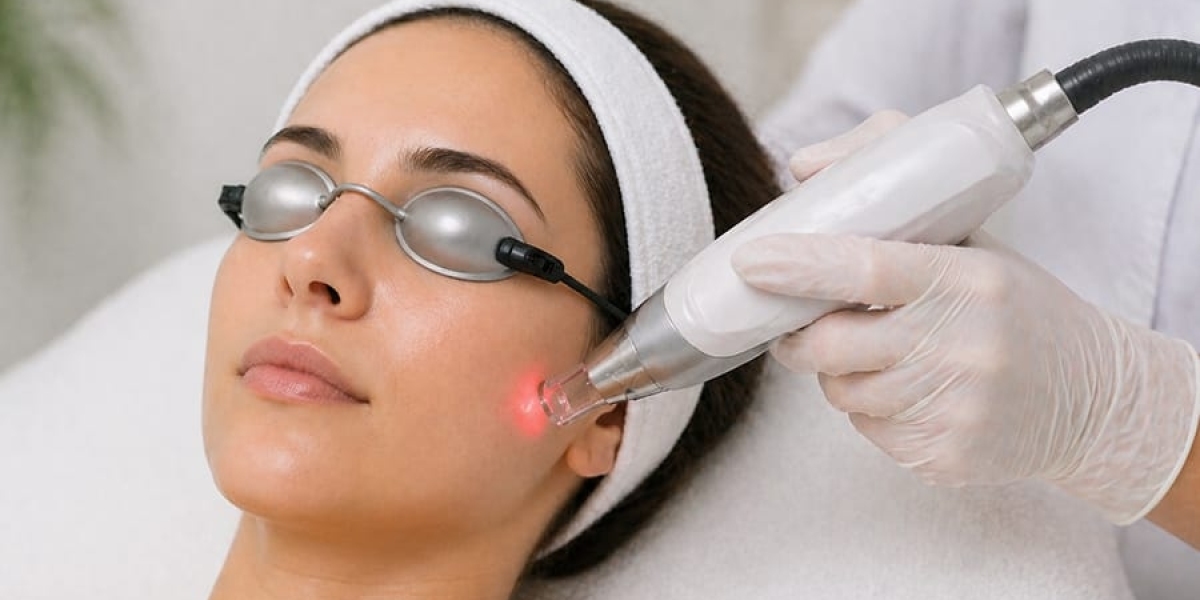

Laser Treatment in Dubai covers at least four technologies that share a word and almost nothing else: laser light tuned to a specific wavelength, intense pulsed light which is broadband rather than a laser at all, radiofrequency and ultrasound, and low-level light therapy in the cosmetic sense. They are grouped together because they are sold together, and they are grouped together by clinics that own one or two of them and offer those. Patients routinely book an IPL appointment believing they have booked a laser, and the difference is not a technicality; it determines which conditions the treatment can address and which it cannot.
The practical consequence is that the word on the price list tells a patient almost nothing about what will be done to their face. What determines suitability is the target and the wavelength, not the label. A treatment aimed at pigment uses one set of wavelengths and requires the pigment to be in the skin. A treatment aimed at a blood vessel uses another and is largely irrelevant to pigment. A treatment aimed at collagen uses a third and works through heating, which is a different mechanism again and carries a different set of risks.
What follows explains which technology does what, why the labels mislead, how a consultation should establish the target before the device, what each category can realistically achieve, and what a plan worth paying for contains. The intention is not to pick a favourite technology but to give a patient the vocabulary to evaluate a recommendation made anywhere, including by a clinic that sells only one of them.
What Each One Is Actually For
What Each One Is Actually For in One Line Each
Setting the four side by side is the fastest way to make sense of the category, because the resemblance between them is entirely at the level of the word. A laser is a precise tool aimed at a defined target: a pigment in a lesion, a vessel, a hair follicle, water in the tissue. Intense pulsed light is a broad tool that treats whatever in the skin absorbs its range, which makes it efficient for diffuse pigment and tone and less predictable when the target is not sharply defined. Energy devices are not optical at all; they heat tissue to provoke a response, which is why they address laxity and texture rather than anything discrete.
Read across those lines and the practical question resolves itself in most cases. A patient who wants a specific brown mark lightened wants a tool that absorbs that mark. A patient who wants an overall improvement in tone wants the broad tool. A patient whose jawline has softened wants heat rather than light. Almost every patient who arrives confused about laser treatment would be unconfused by thirty seconds of this comparison, and it is remarkable how rarely the comparison is made out loud during a consultation.
The reason it is rarely made out loud is that the answer sometimes rules out what the clinic sells. A patient wanting a discrete lesion treated may need a single-wavelength laser that the clinic does not have, and a clinic offering only broad-spectrum light will still be able to treat it, less precisely, but it will not volunteer that a better-targeted option exists elsewhere. That is not misconduct; it is an incomplete comparison, and it is exactly the kind of thing a patient can extract by asking the question directly. Which tool, and why that one for this mark.
There is also a fourth category that should be mentioned because it is frequently on the menu and rarely explained: low-level light therapy, which uses light at low energy for a claimed photobiological effect rather than for tissue heating or targeting. It is a different proposition from the other three, it works on a different timescale, and patients should be told which of the two they are being offered rather than discovering it from the absence of a result. The same discipline applies to every item on a menu: name the mechanism, then the timeline that follows from it.
Four Technologies, One Word
Product, Time, and the Ten Minutes Nobody Prices
A true laser emits a single wavelength and targets a specific target, which makes it precise and also limits it to targets it can reach. Intense pulsed light is a broad-spectrum source filtered into a range, which makes it versatile and less predictable. Radiofrequency and ultrasound heat tissue at depth without depending on a target at all, which makes them useful for laxity and largely irrelevant to a discrete pigmented lesion. Low-level light therapy sits at the other end again and is a different proposition entirely.
The reason this matters to a patient is that each of these fails differently. A laser aimed at the wrong target does nothing, safely. Intense pulsed light aimed at the wrong target may do something unhelpful, particularly on darker skin where the pigment in the skin competes with the pigment being treated. Energy-based devices aimed at laxity on a face that needed volume will tighten a face that should have been filled. None of these failures is dramatic and all of them are common, and they are all avoidable by establishing the target first.
The cost of getting it wrong is not usually wasted money alone, though there is plenty of that. It is time, because most of these treatments need a course, and discovering at the second session that the target was wrong means starting over with a different technology and a different clinic. It can also mean an untreated condition that was treatable throughout, which is the outcome worth worrying about, because the patient has spent months improving something that was never the problem.
Why the Labels Mislead
Per-Unit Pricing and What It Rewards
The labels mislead for a straightforward commercial reason, which is that the umbrella term is cheaper to say than the specific one. A clinic offering three technologies under one heading can advertise a range; a clinic offering one has to name it, and naming a device invites comparison. There is no incentive in the word laser beyond the association with precision and modernity, and the association is doing more work in the marketing than the technology is doing in the treatment.
Per-unit pricing compounds this. Sessions are priced, and a session priced without a target in the description can mean almost anything. A clinic selling at a fixed price per session has no particular reason to specify which device or which wavelength, since either would let a patient shop with a number in hand. A clinic pricing per area per technology has already told you what it intends to do, and its price is comparable with another clinic's on the same basis. Same-day comparability is rare in this field and it is usually a sign of a clinic that has thought about its own pricing.
It is worth being fair to the industry here. The terminology genuinely has drifted, clinics frequently believe the distinctions are understood by patients, and a clinician who says laser treatment for a broad-spectrum device is not usually attempting deception. The information asymmetry is real and it operates quietly, and the remedy is a question rather than scepticism: what device, at what wavelength or filter, aimed at what.
Cosmetic Laser Treatments Dubai and Establishing the Target First
Cosmetic Laser Treatments Dubai planning should start from the target rather than the device, and this is the single structural difference between a good consultation and a sales conversation. A pigmented lesion, a diffuse redness, a hair follicle, a scarred texture and a lax contour are five different targets requiring five different approaches, and the patient who names the target accurately before the consultation gets a different conversation out of it. Naming the target precisely is more useful than any amount of research into which machine is best, because the machine follows from the target.
The wavelength question is the technical core and it is reasonable to ask. A clinician who answers it in terms of what the light is absorbed by has understood the mechanism; one who answers in terms of brand has not. It also settles several practical questions at once, including how many sessions are needed, how much downtime to expect, and whether the treatment can be combined with something else in the same plan. A patient who knows the wavelength can reason about all three without being told.
Skin type has to enter this before the device is chosen rather than after, because it constrains the options in a way that varies enormously. On deeper skin, the pigment in the skin itself competes with the target pigment, and some approaches are effectively unavailable and others require conservative settings and more sessions. A clinic that assesses skin type as part of the consultation is doing something a clinic that has already chosen the device cannot. It is the most reliable single indicator of whether the consultation is diagnostic.
The First Visit and the Second Visit
What Should Be Included at Each
A first visit should name the target, name the technology, state the expected number of sessions and the interval, and establish a photographic baseline in consistent lighting. It should also state the realistic outcome, and in this field that means stating a ceiling as well as a floor. Some of what patients describe as laser results were never achievable with a non-invasive technology, and a clinic willing to say that before booking has done the patient a service even if it costs the appointment.
A review at four to eight weeks is appropriate for most of these treatments, and it should include photographs under the same lighting as the baseline. The value of the review is not simply to continue or stop; it is to establish whether the target is responding, which is a different question from whether the patient is pleased. Some treatments produce a temporary change that fades, and that is visible at eight weeks and not at four, which is why the earlier review is not the decisive one in the way patients assume.
The third appointment is where combinations belong, and it is rarely offered proactively because combining two devices raises the risk question and requires judgement about which risks are acceptable for which patient. Patients who arrive having had two devices recommended at two clinics are effectively being asked to do this without a clinician taking responsibility for it. A single consultation that considers the whole plan, including what other clinics have recommended and in what order, is worth a great deal more than a fourth device from a fourth clinic.
When a Lower Price Is Simply a Lower Price
When a Lower Price Is Simply a Lower Price and When It Is Not
The comparison between quotes in this field is unusually difficult, because two identical prices may represent two completely different treatments and two very different prices may represent exactly the same one. That is worth stating before any discussion of whether one clinic is better value than another, because the price is the least informative number available until the technology has been named.
Not every price difference in this market is a quality signal, and it is worth saying so, because the suspicion runs the other way. A clinic that buys in volume, rents a room cheaply, charges a consultation fee separately and reuses a well-run template can produce results indistinguishable from a clinic charging four times as much. What a low price reliably predicts is less time, and less time costs quality at the margin rather than in the middle, so a mid-priced result is usually good and a lowest-priced result is usually adequate for a straightforward target and unreliable for anything requiring a specific wavelength and conservative settings.
There are also genuine cost differences between technologies that have nothing to do with quality. A clinic with a second-hand device has a different capital position from one with a new one, and the treatment may be identical. The patient who wants to know which they are paying for should ask what the device is, whether it is maintained on a schedule, and whether there is a review. Those three questions separate a pricing difference from a care difference faster than the numbers do.
Laser Dermatology In Dubai and What a Plan Contains
Laser Dermatology In Dubai has a specific meaning that the marketing term does not, and the distinction is worth understanding. Dermatology is the specialty concerned with diagnosis, and a patient seeing a dermatologist has an assessment rather than a demonstration. The assessment can conclude that no energy device is needed, which happens regularly and is the most useful outcome a consultation in this field can produce. A clinic with no assessment capability cannot conclude that, because it has already decided what happens next.
Four items distinguish a considered plan from a package. The target named specifically. The technology and, where relevant, the wavelength. The interval with a biological reason attached rather than a schedule reason. And the review point at which continuation is decided, stated in advance. A plan containing all four was written for this patient and this target. A plan containing a device brand and a session count has been copied, and it will produce a generic result at best.
A fifth item, rarely present, is the statement of what would make the clinician stop. Every clinician in this field has patients who did not respond and every one of them has had to decide what to do next, so a plan that describes only success has not been thought through. Patients who ask what response would indicate that this is the wrong approach for them get a specific answer from a clinician who has considered the question and a vague one from a clinician who has not. Perla Dermatology Clinic establishes the target and the technology before booking, assesses skin type as part of the consultation, and photographs every patient in consistent lighting so that progress is measured rather than remembered.
There is one more distinction in the pricing that is worth making explicit, because it accounts for most of the apparent spread. A clinic that charges per area treats a defined target and can quote in advance; a clinic that charges per session charges for the appointment rather than for the work, which means the patient is paying for time regardless of how much of the face needed it. Neither is dishonest and for a small or straightforward target the per-session model is more convenient. For a large area or a full face, though, the per-area model is usually both fairer and cheaper, and a patient who asks to be quoted on the target rather than the session will frequently be quoted differently by two clinics that appeared comparable.
Frequently Asked Questions
Is IPL the same as laser?
No. Intense pulsed light is a broad-spectrum source rather than a single wavelength, which makes it more versatile and less precise. It can treat several targets in one pass and is more likely to affect surrounding pigment on deeper skin. A laser is tuned to a specific target and is the better choice when the target is well defined. Asking which one is being used is a reasonable question.
How many sessions will I need?
Three to six for most pigment and tone targets, and the number should arrive attached to a specific target and technology. A figure quoted without either is not a plan; it is the average of several different situations. It should also be reviewed at the first assessment, because the response to the first session is more informative than any pre-consultation estimate.
Is it safe on dark skin?
It depends entirely on the technology and the settings, and it is one of the most important questions to ask because the risk is real. On deeper skin, pigment in the skin competes with the target and some technologies are inappropriate altogether. A clinician who treats deeper skin regularly will have a protocol and will discuss the risk; one who does not will be treating conservatively, which is better than not asking.
What is the downtime?
Usually a few hours of redness for pigment work and up to a day or two of swelling for resurfacing approaches, and it varies with the settings. Anything involving removing skin has a longer recovery, of the order of several days, and a clinic that quotes no downtime for a resurfacing treatment is not being reassuring, it is being vague. Ask what the patient will look like on the third day, not on the first.
Can I do several laser treatments?
Sometimes, and it depends on the devices and on whether the treatments involve simultaneous inflammation. A pigment approach and an energy-based tightening approach on the same day is common. Two approaches that both cause significant inflammation in the same session is not, and spacing them is the clinician's call. This is where a single consultation covering the whole plan is worth considerably more than several single-treatment appointments elsewhere.
Conclusion
Laser treatment is four technologies under one word. Ask which one, at what wavelength or filter, aimed at what, before any price is discussed.
Establish the target before the device. A pigmented lesion, diffuse redness, hair, texture and laxity are five different problems and the technology follows from the target rather than the reverse.
Review at four to eight weeks with photographs in the same lighting as the baseline, and expect some treatments to produce a temporary change that fades.
Ask Dr. Inas Musa what response would make the clinician stop. A plan that describes only success has not been thought through, and Perla Dermatology Clinic names the target, the technology and the review point before anything is booked. The same is true of combinations, and it is worth arranging deliberately rather than by accumulation. Two patients who each receive a sensible recommendation from a different clinic can end up with a plan assembled from three devices that nobody has considered together, and the interactions between some of them are not trivial. A consultation that includes a review of what other clinics have recommended, and in what order, costs nothing and can prevent an inflammatory reaction that would have cost several weeks. Bringing the recommendations with them, written down rather than remembered, is the single most useful preparation a patient can make before attending.