
Understanding CAD and FEA
Computer-aided design, or CAD, enables engineers to create and modify digital models of components and assemblies.
These models can represent dimensions, shapes, interfaces, and relationships between parts. They also help communicate design information across engineering and manufacturing teams.
Finite element analysis, or FEA, is a numerical technique used to estimate how a component or structure responds to specified conditions.
Depending on the analysis, engineers can investigate stress, deformation, vibration, heat transfer, or other physical behaviors.
How CAD and FEA Support Each Other
CAD provides the geometry needed to define many engineering simulations.
Engineers prepare the model, assign material properties, define loads and constraints, and generate an appropriate computational mesh.
The analysis estimates the system's response under the specified assumptions.
Engineers can then examine the results to identify areas that may require further investigation or design modification.
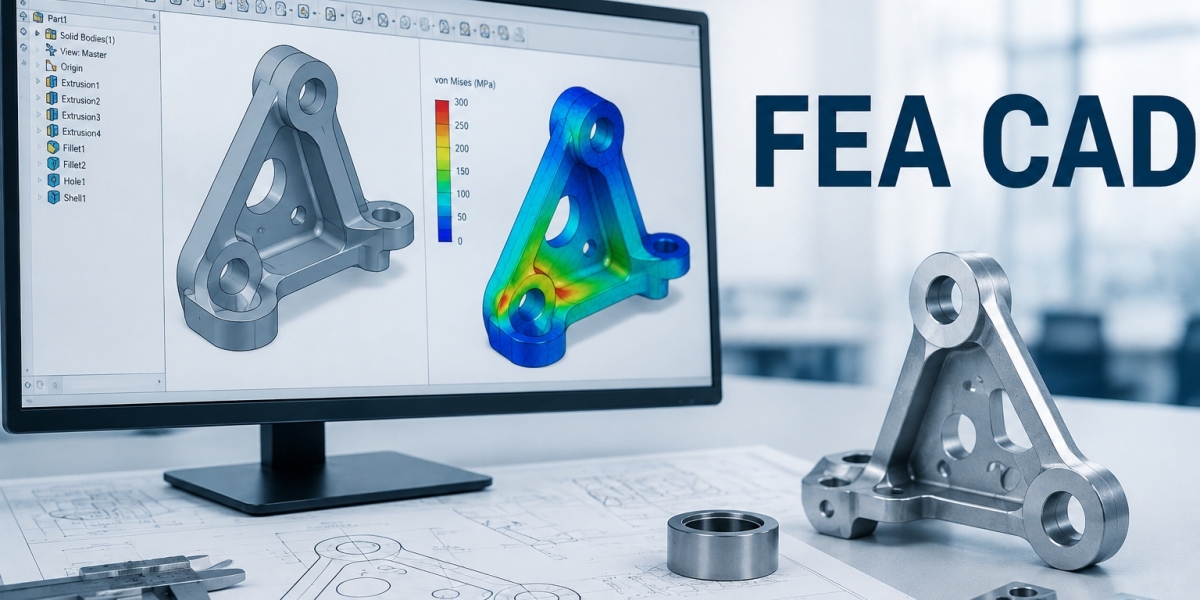
For example, a bracket subjected to a specified load may be analyzed to estimate deformation and stress distribution.
Why Engineering Validation Matters
Digital simulations can help teams compare design alternatives before manufacturing prototypes.
They may also support structural assessment, weight optimization, and informed material selection.
However, simulation results are not automatically accurate. Incorrect assumptions, unrealistic constraints, unsuitable material properties, or an inadequate mesh can affect the outcome.
Engineers should review model quality, verify important results, and use physical testing or independent calculations when appropriate.
Choosing the Right Analysis Method
The analysis should reflect the component's real operating conditions.
A static analysis may be suitable for certain steady loading situations, while components exposed to vibration, repeated loads, or temperature changes may require different methods.
Engineers should also consider manufacturing constraints and material behavior when evaluating possible design improvements.
Servotech Inc. supports engineering-related design and development activities. Businesses exploring CAD/FEA design and analysis should establish clear performance requirements and select methods appropriate to their applications.
Final Thoughts
CAD/FEA design and analysis help engineers connect digital product modeling with computational evaluation. When used with sound engineering judgment and suitable validation, these tools can support better design decisions and more efficient product development.