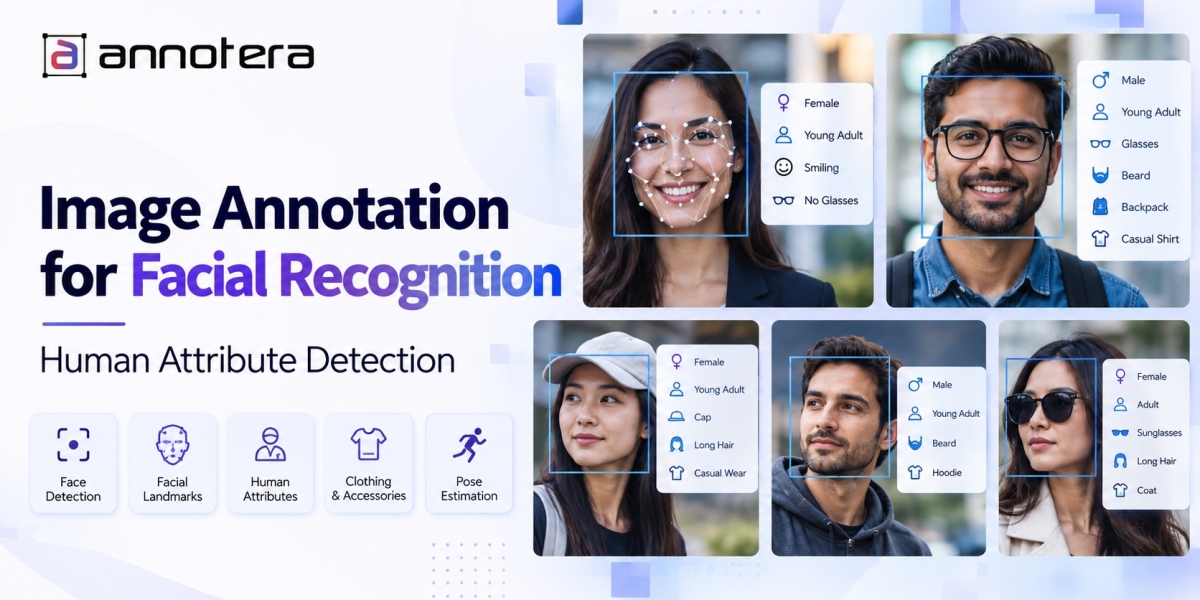

Facial recognition and human attribute detection are increasingly used in computer vision applications, from identity verification and access control to retail analytics and intelligent surveillance. However, the performance of these AI systems depends heavily on the quality, diversity, and consistency of their training data. This is where image annotation plays a critical role.
Image annotation involves labeling visual data to help machine learning models identify faces, distinguish facial features, and recognize relevant human attributes. Accurate annotations enable AI systems to learn meaningful visual patterns while accounting for variations in lighting, camera angles, occlusion, and environmental conditions.
For organizations developing computer vision solutions, partnering with an experienced image annotation company can help establish reliable datasets for training and evaluating AI models. With structured labeling workflows and quality assurance processes, businesses can improve dataset consistency and support the development of more robust visual recognition systems.
Understanding Facial Recognition and Human Attribute Detection
Although facial recognition and human attribute detection may use similar image data, they serve different purposes.
Facial recognition systems analyze facial characteristics to verify or match a person's identity, depending on the application and model design. Their training pipelines may involve face detection, facial landmark localization, alignment, and identity-labeled datasets.
Human attribute detection focuses on identifying visible characteristics or contextual features associated with people in images. Depending on the application, these may include clothing color, accessories, body posture, or the presence of particular objects. Some datasets may also include estimates of age ranges or other sensitive attributes, which require additional scrutiny and appropriate safeguards.
Both applications require carefully designed annotation guidelines. Labels must reflect what is genuinely visible in the image rather than assumptions about a person. This distinction is especially important when datasets are used in consequential settings.
Key Image Annotation Techniques for Facial Recognition
Different annotation techniques help computer vision models learn specific facial structures and visual patterns.
1. Face Bounding Boxes
Bounding box annotation identifies the location of each face within an image. Annotators draw rectangular boxes around visible faces, including faces captured at different distances, angles, and sizes.
Consistent bounding boxes help detection models locate faces in crowded environments, low-resolution images, and complex backgrounds. Annotation guidelines should clarify how to handle partially visible faces, profile views, and overlapping subjects.
2. Facial Landmark Annotation
Facial landmark annotation identifies specific points on a face, such as the corners of the eyes, nose tip, mouth corners, and jawline. These coordinates help models understand facial geometry and support applications such as face alignment and expression-related analysis.
Accurate landmark placement is particularly important when images contain unusual head poses, shadows, motion blur, or partial occlusion. Clear definitions for each landmark reduce disagreement between annotators.
3. Facial Segmentation
Facial segmentation assigns labels to individual pixels belonging to a face or selected facial regions. Depending on the project, labels may distinguish the skin region, eyes, eyebrows, nose, mouth, and hair.
This approach provides more detailed spatial information than bounding boxes and can support facial analysis applications that require precise region boundaries.
4. Identity and Image Pair Labeling
Some facial recognition systems are trained using images grouped by identity or organized into image pairs and triplets. Annotation workflows may indicate whether two images represent the same authorized subject or different subjects, based on verified dataset records.
Identity labels must be accurate and carefully governed. Incorrect matches can introduce misleading training signals, while poorly controlled access to identity-linked data can create privacy risks.
The Role of Annotation in Human Attribute Detection
Human attribute detection enables computer vision models to identify visible properties of people and their surroundings. The annotation approach depends on the intended use case.
Clothing and Accessory Annotation
Annotators can label visible clothing categories, garment colors, bags, hats, helmets, and other accessories. These labels can support inventory-independent visual search, workplace safety monitoring, and retail analytics.
For example, a workplace safety model may need annotations identifying whether a visible person is wearing a safety helmet or a high-visibility vest. Consistent labels help the model distinguish relevant objects across different camera conditions.
Human Detection and Pose Estimation
Human detection identifies people within an image, while pose annotation marks body joints or keypoints such as shoulders, elbows, hips, knees, and ankles.
These annotations support applications such as movement analysis, human-robot interaction, and activity recognition. Annotators must follow consistent keypoint conventions, especially when limbs overlap or parts of the body fall outside the frame.
Age-Range and Expression Labels
Certain projects involve visible facial expression categories or broad, carefully defined age-range estimates. Such labels are inherently uncertain and may be affected by lighting, image quality, individual variation, and annotator interpretation.
Organizations should assess whether these attributes are necessary, define appropriate limitations, and avoid presenting uncertain estimates as verified facts. Sensitive or potentially discriminatory attributes require particular care regarding lawful use, consent, and dataset governance.
Challenges in Facial and Human Attribute Annotation
Creating high-quality datasets requires more than assigning labels to images. Several challenges can affect annotation accuracy.
Lighting and image quality: Poor illumination, blur, compression, and shadows can obscure facial details.
Pose and occlusion: Side profiles, masks, glasses, and overlapping people may make some features difficult to identify.
Dataset imbalance: Underrepresentation of certain environments, skin tones, age groups, or camera conditions can contribute to uneven model performance.
Subjective labels: Attribute categories may be interpreted differently unless definitions and examples are clearly documented.
Privacy and security: Face images and identity-linked datasets can contain sensitive personal information that requires appropriate access controls and handling procedures.
Addressing these challenges requires representative datasets, explicit annotation rules, trained annotators, and continuous quality evaluation.
How Image Annotation Outsourcing Services Improve Dataset Quality
Developing a reliable annotation pipeline internally can require significant investment in trained personnel, project management, quality control, and annotation infrastructure. Image annotation outsourcing services offer organizations an alternative for managing large-scale labeling requirements.
An experienced annotation partner can help businesses implement structured workflows for face detection, facial landmarks, segmentation, and human attribute labeling. Project-specific instructions, sample annotations, reviewer feedback, and escalation procedures help maintain consistency across annotation teams.
Quality assurance should include more than random checks. Teams can use double annotation, consensus reviews, inter-annotator agreement measurements, and targeted audits of difficult images. Automated validation can also identify missing labels, invalid coordinates, and inconsistent class assignments.
Before scaling a project, organizations should conduct a pilot using representative images. The pilot helps establish realistic quality benchmarks, clarify ambiguous cases, and refine labeling instructions before processing the full dataset.
Selecting an image annotation partner should also involve evaluating data security practices, experience with computer vision projects, scalability, turnaround expectations, and the ability to follow responsible data-handling requirements.
How Annotera Supports Computer Vision Training
Annotera supports AI development through image annotation workflows designed around project-specific dataset requirements. Its services can help computer vision teams organize visual data for applications involving object detection, image segmentation, and other image-based machine learning tasks.
For facial recognition and human attribute detection projects, annotation requirements should be defined according to the intended model, permitted use case, and data governance framework. This includes specifying label taxonomies, documenting edge cases, establishing review procedures, and applying appropriate privacy and security controls.
By combining structured annotation guidelines with quality assurance, Annotera helps organizations prepare more consistent training datasets for computer vision development. The appropriate workflow depends on image complexity, annotation scope, dataset volume, and the accuracy requirements of the target application.
Conclusion
Image annotation is a foundational component of facial recognition and human attribute detection. From face bounding boxes and facial landmarks to human pose and accessory labeling, each annotation method provides information that helps AI models interpret visual data.
However, annotation quality must be supported by representative datasets, consistent labeling standards, rigorous validation, and responsible data governance. Organizations evaluating an image annotation company or considering image annotation outsourcing services should prioritize technical expertise, measurable quality controls, scalability, and privacy safeguards.
With a well-designed annotation strategy, businesses can build stronger foundations for computer vision systems while reducing avoidable dataset errors and supporting more dependable AI development.