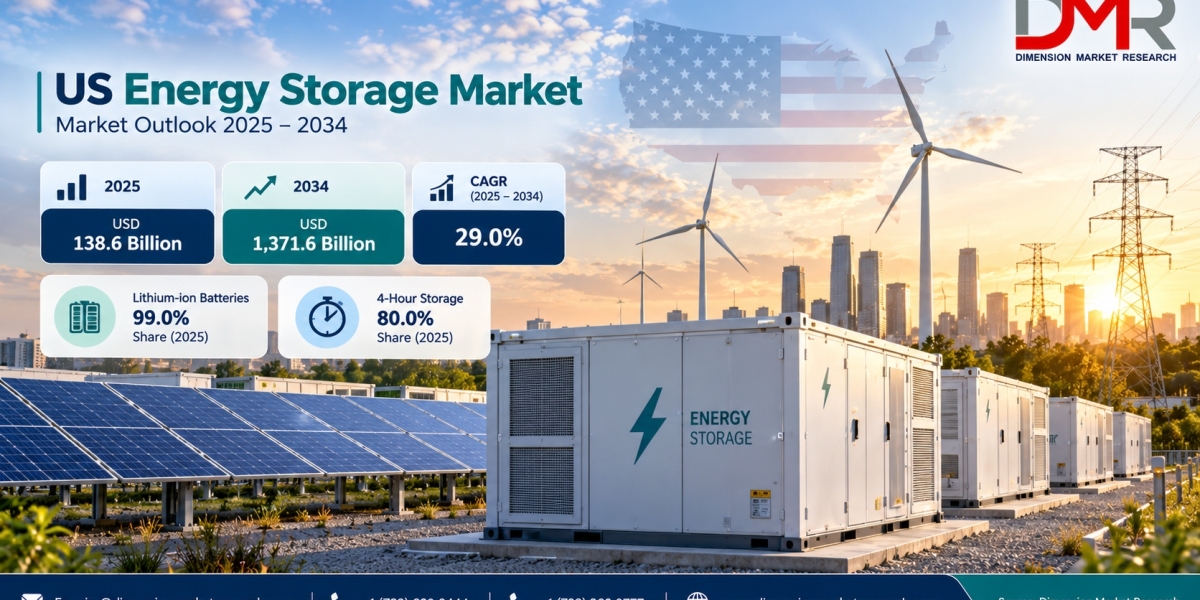

The US Energy Storage Market is undergoing rapid transformation as renewable energy expansion, growing electricity consumption, and grid modernization accelerate demand for reliable energy storage technologies. According to Dimension Market Research, the market is projected to reach USD 138.6 billion in 2025 and expand to USD 1,371.6 billion by 2034, growing at a CAGR of 29.0%.
Increasing deployment of battery energy storage systems, solar-plus-storage projects, and advanced grid management technologies is reshaping the United States power infrastructure. Utilities are investing in energy storage to manage peak electricity demand, improve renewable energy integration, and strengthen grid reliability.
Artificial intelligence, lithium iron phosphate batteries, and long-duration storage technologies are creating opportunities for battery manufacturers, utility developers, and energy technology providers.
What Is the US Energy Storage Market?
The US Energy Storage Market includes technologies and systems designed to capture energy, store it, and release it when electricity demand or operating conditions require additional power.
Major storage technologies include lithium-ion batteries, pumped hydro storage, flow batteries, and emerging long-duration storage systems.
These technologies support renewable energy integration, grid stability, peak demand management, backup electricity, and distributed energy applications.
Energy storage systems are deployed across utility-scale projects, commercial facilities, industrial operations, and residential properties.
US Energy Storage Market Size and Key Statistics
The DMR report identifies the following market indicators for 2025:
● 2025 Market Size: USD 138.6 Billion
● 2034 Market Forecast: USD 1,371.6 Billion
● Forecast CAGR: 29.0%
● Lithium-Ion Battery Share: 99.0%
● Medium-Duration Storage Share: 80.0%
● Battery Storage Share: 53.0%
● Standalone Battery Projects: 45.0%
● Energy Shifting and Peak Management: 55.0%
● Utility-Scale and Grid Projects: 98.0%
These findings highlight the importance of lithium-ion technologies, four-hour storage systems, and large-scale grid infrastructure investment.
Why Is the US Energy Storage Market Growing?
Expansion of Renewable Energy Capacity
Increasing solar and wind installations are strengthening demand for reliable energy storage.
Renewable electricity generation varies with weather conditions and time of day. Battery storage systems help balance these fluctuations by storing excess electricity and releasing it when generation declines.
Utilities are increasingly pairing solar facilities with batteries to improve energy availability during evening demand peaks.
California, Texas, Arizona, and Nevada represent important deployment markets because of renewable capacity expansion and growing grid flexibility requirements.
Increasing Demand for Grid Reliability
Energy storage is becoming an important component of electricity infrastructure modernization.
Battery systems provide fast-response grid services, including frequency regulation, voltage support, and peak demand management.
Utilities can use stored electricity to reduce dependence on expensive peak-generation facilities and improve operational flexibility.
Growing electricity demand from industrial facilities and data centers is further increasing interest in storage infrastructure.
Get a Free Sample of the US Energy Storage Market Report
Explore detailed market forecasts, battery technology segmentation, project opportunities, storage duration analysis, and competitive intelligence through the Dimension Market Research industry study.
https://dimensionmarketresearch.com/request-sample/us-energy-storage-market/
How AI and Smart Technologies Are Transforming Energy Storage
Artificial intelligence is improving how battery storage systems are monitored, controlled, and optimized.
AI-powered energy management platforms analyze electricity demand, market prices, weather forecasts, and battery performance to support charging and discharging decisions.
Predictive maintenance technologies help operators monitor battery health and identify potential equipment problems.
Important technology developments include:
● AI-powered battery performance optimization
● Intelligent energy dispatch management
● Advanced battery health monitoring
● Long-duration storage technology development
Increasing electricity requirements from AI data centers are also encouraging investment in grid-support technologies.
These developments create opportunities for integrated software platforms and advanced storage systems.
US Energy Storage Market Segmentation Analysis
Lithium-Ion Batteries Dominate Technology Demand
Lithium-ion batteries represent approximately 99.0% of the technology segment in 2025, according to the DMR report.
Their leadership reflects high efficiency, modular deployment, established manufacturing capabilities, and declining technology costs.
Lithium iron phosphate batteries are increasingly important for stationary applications because of their thermal stability, cycle life, and cost characteristics.
Flow batteries, sodium-ion technologies, and iron-air storage represent emerging alternatives for applications requiring longer discharge durations.
Four-Hour Storage Systems Maintain Leadership
Medium-duration storage, generally providing approximately four hours of discharge, accounts for 80.0% market share.
These systems are widely used to transfer solar electricity generated during the day into evening demand periods.
Their balance of performance, cost, and operational flexibility supports deployment across major utility projects.
Long-duration technologies offer opportunities as power systems require extended backup capabilities.
Battery Storage Leads Overall Storage Types
Battery storage accounts for 53.0% of the overall storage type segment.
Its modularity and compatibility with renewable energy infrastructure support broad deployment.
Pumped hydro storage remains important for large-scale and long-duration applications, although geographical constraints can limit new projects.
Standalone Projects Lead Project Development
Standalone battery projects represent 45.0% of the project type segment.
These facilities operate independently of renewable power plants and provide services such as energy arbitrage, frequency regulation, and peak demand management.
Solar-plus-storage projects are also expanding as developers seek to improve renewable electricity utilization.
Utility-Scale Projects Drive Market Demand
Utility-scale and grid-connected projects account for 98.0% of end-user demand in the report's segmentation.
Energy shifting and peak demand management represent the leading application category, holding 55.0% market share.
Residential and commercial storage solutions offer additional opportunities through backup power, demand charge management, and rooftop solar integration.
State-Level Outlook: California and Texas Lead Deployment
California and Texas are major centers of battery energy storage deployment.
California benefits from extensive solar generation, established energy storage policies, and demand for evening peak electricity management.
Texas represents an important market because of renewable energy expansion, wholesale electricity market opportunities, and growing electricity demand.
Arizona and Nevada are also attracting investment through solar-plus-storage development and utility-scale battery projects.
State-level policy frameworks, electricity pricing, and grid infrastructure requirements influence project economics and deployment strategies.
Competitive Landscape and Leading Companies
The US Energy Storage Market includes battery manufacturers, utility developers, power technology providers, and specialized energy storage companies.
Prominent companies identified by DMR include Tesla, Fluence, NextEra Energy, LS Energy Solutions, Wärtsilä, Siemens Energy, General Electric, LG Energy Solution, Panasonic, and Samsung SDI.
Other important participants include CATL, BYD, Eos Energy Enterprises, Form Energy, AES Corporation, and Enphase Energy.
Competition focuses on battery performance, system integration, storage duration, manufacturing capacity, software capabilities, and project delivery.
Companies are investing in domestic production, long-duration technologies, and integrated renewable energy solutions to strengthen their market positions.
Challenges and Future Growth Opportunities
High initial investment, critical mineral supply risks, and project financing requirements remain important market challenges.
Battery safety, grid interconnection delays, and equipment availability also influence project development.
However, long-duration storage, distributed energy systems, virtual power plants, and AI-powered grid optimization are creating opportunities.
Technologies capable of improving reliability, lowering lifecycle costs, and supporting renewable energy integration may gain importance through 2034.
Explore the Complete US Energy Storage Market Analysis
Access detailed technology forecasts, storage duration comparisons, competitive profiles, project development trends, and strategic investment insights through the complete Dimension Market Research report.
https://dimensionmarketresearch.com/checkout/us-energy-storage-market/
Frequently Asked Questions
1. What is the US Energy Storage Market size?
The US Energy Storage Market is projected to grow from USD 138.6 billion in 2025 to USD 1,371.6 billion by 2034.
2. What is the CAGR of the US Energy Storage Market?
The market is expected to grow at a CAGR of 29.0% during the 2025 to 2034 forecast period.
3. Which technology dominates the US Energy Storage Market?
Lithium-ion batteries lead with approximately 99.0% of the technology segment in 2025.
4. Which states are major energy storage markets in the United States?
California, Texas, Arizona, and Nevada are important deployment markets, supported by renewable energy development and grid modernization.
5. What are the major future growth opportunities?
Long-duration energy storage, solar-plus-storage projects, AI-powered battery management, grid modernization, and distributed energy systems represent important opportunities.
Conclusion
The US Energy Storage Market is positioned for substantial expansion as renewable electricity generation, rising power demand, and grid modernization reshape the country's energy infrastructure.
Lithium-ion batteries, four-hour storage, and utility-scale projects remain central to current market demand.
AI-enabled energy management, long-duration technologies, and integrated renewable storage projects are creating new opportunities.
Companies delivering reliable, scalable, and cost-effective storage solutions are positioned to benefit from evolving US electricity requirements through 2034.
Related Global and Regional Energy Storage Market Insights
The Energy Storage Market Size was estimated at USD 58.9 billion in 2024 and is projected to reach USD 204.8 billion by 2033, growing at a CAGR of 14.8%. Electrochemical storage leads with a 57.1% share, while North America accounts for 44.3% of the global market in the report's 2024 analysis. Increasing renewable energy integration, grid modernization, and demand for backup electricity support market development.
The Japan Energy Storage Market Share analysis projects growth from USD 3.2 billion in 2026 to USD 10.9 billion by 2035, registering a CAGR of 14.5%. Electrochemical storage represents the leading technology category, while grid energy storage dominates applications. Japan's renewable energy integration, energy security priorities, and smart grid investment support growing demand for stationary storage solutions.
The Europe Energy Storage Market Growth study forecasts revenue increasing from USD 43.1 billion in 2025 to USD 96.3 billion by 2034, at a CAGR of 9.3%. Lithium-ion batteries lead with a 95.0% share, while utility-scale projects account for 94.0% of end-user demand in 2025. Renewable energy expansion, electricity market flexibility, and growing investment in battery storage infrastructure support regional development.