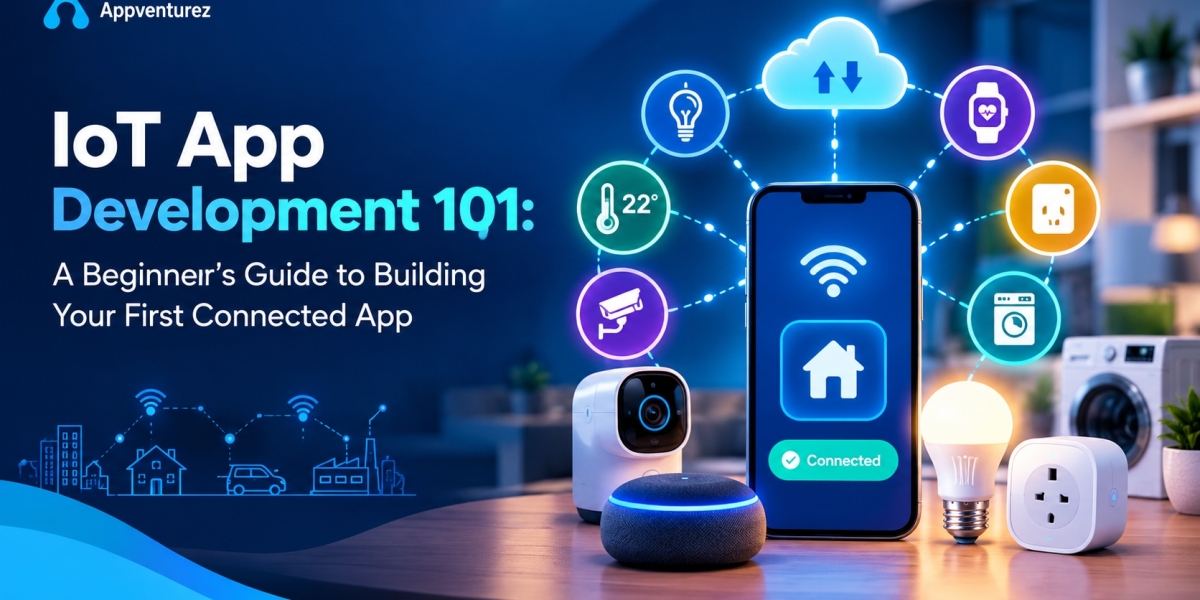

IoT App Development 101: A Beginner's Guide to Building Your First Connected App
From smart thermostats that learn your routine to industrial sensors that predict machine failures before they happen, the Internet of Things (IoT) is quietly reshaping how we live and work. Behind every one of these connected experiences sits an IoT app that gathers data from devices, processes it in the cloud, and puts useful insights and controls into the hands of users.
If you're a startup founder with a smart-device idea, a business leader planning to digitize operations, or a product manager exploring connected technology for the first time, the world of IoT can feel overwhelming. Hardware, firmware, wireless protocols, cloud platforms, mobile apps, and security all need to work together. Where do you even begin?
This beginner's guide breaks IoT app development down into simple, practical steps. We'll cover what IoT apps are, how they work, the core building blocks, the technologies involved, the step-by-step development process, cost factors, common mistakes, and how to choose the right IoT app development company to bring your idea to life. Companies like Appventurez help businesses turn connected-product ideas into scalable, secure, and market-ready solutions.
What is IoT App Development?
IoT app development is the process of creating software that connects to, monitors, and controls physical devices over the internet. These devices, such as sensors, wearables, cameras, meters, appliances, and machines, collect data and send it to a cloud platform. The IoT app then analyzes that data and presents it through a mobile or web interface, or uses it to trigger automatic actions.
In simple terms, an IoT app is the bridge between the physical world and the digital one.
For example:
A smart home app lets you switch off lights from your phone
A fleet management app shows live truck locations and fuel usage
A health app tracks heart rate from a wearable device
A factory dashboard alerts engineers when a machine overheats
A smart agriculture app monitors soil moisture and schedules irrigation
How Does an IoT App Work?
Every IoT solution, no matter how simple or complex, follows a similar flow.
Step 1: Devices Collect Data
Sensors and devices capture information such as temperature, motion, location, pressure, or usage.
Step 2: Data is Transmitted
The device sends its data through a connectivity option such as Wi-Fi, Bluetooth, Zigbee, LoRaWAN, or cellular networks, often via a gateway.
Step 3: Cloud Processes the Data
A cloud platform receives, stores, and processes the data, applying rules, analytics, or AI models.
Step 4: The App Presents Insights
The mobile or web application displays dashboards, alerts, and controls so users can understand and act on the information.
Step 5: Actions Are Triggered
Based on user commands or automated rules, the system sends instructions back to devices, such as turning on a pump, locking a door, or adjusting a thermostat.
Core Components of an IoT Solution
To build your first connected app, you need to understand its main building blocks.
Devices and Sensors
The physical hardware that captures data and performs actions. This may be custom-built or purchased off the shelf.
Embedded Software and Firmware
The low-level code running on the device that controls its behavior and communication. Many projects benefit from working with an embedded IoT app development company that understands both hardware and software.
Connectivity Layer
The network technologies that link devices to the cloud, chosen based on range, power use, speed, and cost.
Cloud Platform and Backend
The infrastructure that manages devices, stores data, runs business logic, and exposes APIs to apps.
Data Analytics Layer
Tools that turn raw data into dashboards, reports, predictions, and alerts.
User Application
The mobile app (Android, iOS, or cross-platform) and web dashboard that users interact with.
Security Layer
Encryption, authentication, secure updates, and monitoring that protect devices, data, and users.
Key Technologies Used in IoT App Development
Connectivity Protocols
Bluetooth Low Energy suits short-range, low-power devices. Wi-Fi works for home and office environments. LoRaWAN and NB-IoT support long-range, low-power deployments. Cellular networks, including 4G and 5G, support mobile and wide-area use cases.
Messaging Protocols
MQTT and CoAP are lightweight protocols designed for devices with limited resources, while HTTP and WebSockets are common for app and server communication.
Cloud IoT Platforms
Major cloud providers offer managed IoT services for device management, data ingestion, and analytics, helping teams avoid building everything from scratch.
Mobile App Technologies
Android apps are commonly built with Kotlin and Jetpack Compose, iOS apps with Swift, and cross-platform apps with frameworks such as Flutter or React Native.
Databases and Data Pipelines
Time-series databases and streaming tools handle the continuous flow of sensor data efficiently.
Artificial Intelligence and Machine Learning
AI enables predictive maintenance, anomaly detection, smart recommendations, and automation.
Edge Computing
Processing data close to the device reduces delay, saves bandwidth, and keeps systems working even when connectivity is limited.
Step-by-Step Guide to Building Your First IoT App
Step 1: Define the Problem and Goals
Start with the problem you want to solve, not the technology. Ask who the users are, what data matters, and what success looks like. A clear goal keeps the project focused and the budget under control.
Step 2: Research the Market and Validate the Idea
Study competitors, user needs, and existing solutions. Talk to potential customers early to confirm that your idea solves a real problem worth paying for.
Step 3: Choose Your Devices and Hardware Approach
Decide whether to use existing off-the-shelf devices or design custom hardware. For a first product, off-the-shelf modules are usually faster and cheaper to start with.
Step 4: Select Connectivity and Architecture
Pick connectivity technology based on distance, power consumption, data volume, and deployment environment. Then outline the overall architecture, including the cloud platform and data flow.
Step 5: Design the User Experience
IoT apps must be simple, even though the system behind them is complex. Create wireframes and prototypes for onboarding, device pairing, dashboards, alerts, and settings, and test them with real users.
Step 6: Build a Proof of Concept
A small prototype that connects one device to the cloud and displays its data in an app proves your idea is technically feasible and helps you uncover problems early.
Step 7: Develop the MVP
Build a Minimum Viable Product with only the core features. This lets you launch sooner, gather real feedback, and avoid spending on features nobody needs.
Step 8: Build Security In From the Start
Plan for unique device identities, encrypted communication, secure authentication, protected data storage, and signed firmware updates. Adding security later is far more expensive and risky.
Step 9: Test Thoroughly
IoT testing goes beyond ordinary app testing. Check device behavior, connectivity drops, battery use, data accuracy, cloud performance, and compatibility across phones and operating system versions.
Step 10: Launch, Monitor, and Improve
Roll out in phases, monitor performance and usage, collect user feedback, push over-the-air updates, and keep improving the product.
Must-Have Features for Your First IoT App
User registration and secure login with multi-factor authentication where appropriate
Easy device onboarding and pairing that works in a few taps
Real-time dashboards that show device status and data clearly
Remote control of connected devices
Push notifications and alerts for important events
Automation rules and scheduling
Historical data and reports to show trends over time
Multi-device and multi-user management
Offline handling for when connectivity drops
Over-the-air firmware updates
Admin panel for managing users, devices, and settings
Integration options with third-party tools and services
Popular IoT App Use Cases and Industries
Smart Home and Consumer Devices
Lighting, security, appliances, and energy management controlled from a smartphone.
Healthcare and Wearables
Remote patient monitoring, fitness tracking, and connected medical devices.
Manufacturing and Industrial IoT
Machine monitoring, predictive maintenance, quality control, and production analytics.
Logistics and Fleet Management
Vehicle tracking, route optimization, cold-chain monitoring, and asset visibility.
Agriculture
Soil and weather sensing, automated irrigation, and livestock monitoring.
Retail
Smart shelves, inventory tracking, footfall analytics, and personalized offers.
Energy and Utilities
Smart meters, grid monitoring, and consumption analytics.
Smart Buildings and Cities
HVAC control, occupancy sensing, smart lighting, and environmental monitoring.
How Much Does It Cost to Build an IoT App?
The cost of an IoT app varies widely based on several factors:
Complexity and number of features
Number and type of connected devices
Custom hardware versus off-the-shelf devices
Connectivity technology
Cloud infrastructure and ongoing usage fees
Platform choice (Android, iOS, or both)
UI/UX design requirements
Security and compliance needs
Team size, expertise, and location
A simple prototype or basic app costs far less than an enterprise-grade platform with AI analytics and thousands of connected devices. Remember to budget for ongoing costs too, including cloud services, connectivity, maintenance, and updates. Requesting a detailed estimate from a trusted partner is the best way to get accurate numbers for your specific idea.
Common Mistakes Beginners Should Avoid
Starting With Technology Instead of the Problem
Choosing fancy tools before understanding user needs often leads to products nobody wants.
Trying to Build Everything at Once
Overloading the first version with features increases cost and delays launch. Start with an MVP.
Ignoring Security Until Late
Security gaps in connected devices can cause serious damage. Plan for protection from day one.
Underestimating Connectivity Challenges
Real-world networks are unreliable. Design for dropped connections and low battery from the start.
Skipping Real-World Testing
Lab results rarely match field conditions. Test in the environments where devices will actually be used.
Forgetting Scalability
A system that works for ten devices may fail with ten thousand. Choose architecture that can grow.
Neglecting Maintenance and Updates
IoT products need ongoing support, patches, and updates throughout their lifetime.
Choosing the Wrong Development Partner
A team without IoT experience can cause costly delays and rework. Evaluate partners carefully.
Why India is a Preferred Destination for IoT App Development
India has become a global hub for software and connected-technology development, and many businesses choose to work with the best IoT app development in India for several reasons.
Skilled Engineering Talent
India produces thousands of engineers every year with expertise in embedded systems, mobile development, cloud platforms, data engineering, and AI. These IoT application developers are experienced in both hardware-level and software-level challenges.
Cost-Effective Development
Compared to North America and Europe, businesses can significantly reduce development costs while maintaining high-quality standards.
Strong Technology Ecosystem
India hosts a large community of IoT software development companies offering consulting, design, development, testing, and support.
Flexible Engagement Models
Businesses can choose from:
Dedicated development teams
Fixed-price projects
Hourly hiring
Staff augmentation
Offshore development centers
Global Project Experience
Indian companies work with clients across the US, UK, Europe, Australia, and the Middle East, making them familiar with international compliance standards and agile project management. This is why an IoT app development agency based in India is often a strong choice for startups and enterprises alike.
How to Choose the Right IoT App Development Partner
Picking the right team is one of the most important decisions in your IoT journey. When comparing IoT app development services providers, look for:
Proven experience in IoT and connected-device projects
Expertise across hardware integration, cloud, mobile, and analytics
A portfolio of relevant case studies
Knowledge of IoT protocols such as MQTT, BLE, and LoRaWAN
A documented secure development process
Transparent pricing and realistic timelines
Agile development methodology
Post-launch maintenance and support
Scalability planning
Client testimonials and reviews
Whether you are looking for the best IoT app development company or a specialized team for a niche project, choose a partner who understands your business goals rather than one that simply builds features. A reliable provider of IoT application development services will guide you from idea validation to launch and beyond. The strongest IoT application development services company will also be open about risks, costs, and trade-offs from the very beginning.
Why Choose Appventurez as Your IoT App Development Company?
When businesses plan to build connected products, choosing the right technology partner becomes crucial. Appventurez has established itself as a trusted software development company offering innovative mobile, cloud, and IoT solutions tailored to different industries.
As an experienced IoT application development company, Appventurez focuses on delivering scalable, secure, and business-oriented applications that help organizations connect devices, monitor operations in real time, and make smarter decisions. Whether it's developing a smart-device companion app, an industrial monitoring platform, a fleet tracking solution, or a complete end-to-end IoT ecosystem, the team combines technical expertise with a deep understanding of business needs.
By leveraging modern frameworks, cloud technologies, AI capabilities, and agile methodologies, Appventurez ensures every IoT solution is designed for long-term scalability, seamless integration, strong security, and measurable business outcomes. For companies searching for internet of things app development services with a dependable partner, this balance of innovation and reliability makes Appventurez a strong choice.
What Makes Appventurez Different
End-to-end IoT expertise: From idea validation and architecture to development, launch, and support
Custom IoT app development solutions designed around your specific industry and goals
Scalable cloud-ready architecture that grows with your device network
Security-first approach covering devices, data, APIs, and applications
Agile delivery with transparent communication and regular progress updates
Cross-industry experience across healthcare, logistics, retail, manufacturing, and smart living
Dedicated Appventurez IoT developers available through flexible hiring models
Post-launch maintenance and support to keep your connected product reliable and up to date
Appventurez IoT Services at a Glance
IoT consulting and strategy
IoT mobile app development (Android, iOS, and cross-platform)
IoT web dashboard and admin panel development
IoT cloud integration and backend development
Embedded software and device integration
IoT data analytics and AI integration
IoT testing and quality assurance
IoT maintenance, upgrades, and support
Future Trends in IoT App Development
The IoT landscape is evolving quickly, and beginners should keep these trends in mind when planning a product.
Key trends include:
Edge computing for faster, on-device data processing
AI and machine learning embedded in IoT platforms
5G connectivity for low-latency, high-volume device networks
Digital twins for virtual monitoring and simulation
Predictive maintenance as a standard feature
Stronger regulations and security standards for connected devices
Low-code and no-code IoT platforms
Energy-efficient and sustainable IoT solutions
Generative AI interfaces for device control and analytics
Interoperability standards that simplify device integration
Businesses that plan for these trends early can build more future-proof solutions and avoid expensive redesigns later.
Conclusion
Building your first connected app may seem complex, but it becomes manageable when you break it into clear steps: define the problem, validate the idea, choose the right devices and connectivity, design a simple user experience, build a proof of concept, launch an MVP, and keep security and scalability in focus throughout. Avoiding common beginner mistakes and learning from real user feedback will help you create a product that people truly value.
India continues to stand out as a preferred destination for IoT development thanks to its exceptional engineering talent, cost-effective delivery models, and growing expertise in AI, cloud, and embedded technologies. By partnering with an experienced development company like Appventurez, businesses can build scalable, secure, and future-ready IoT solutions tailored to their specific goals.
Whether you're launching a smart-device startup, modernizing industrial operations, or exploring connected technology for the first time, the right knowledge and the right partner will help you turn your IoT idea into a successful product.