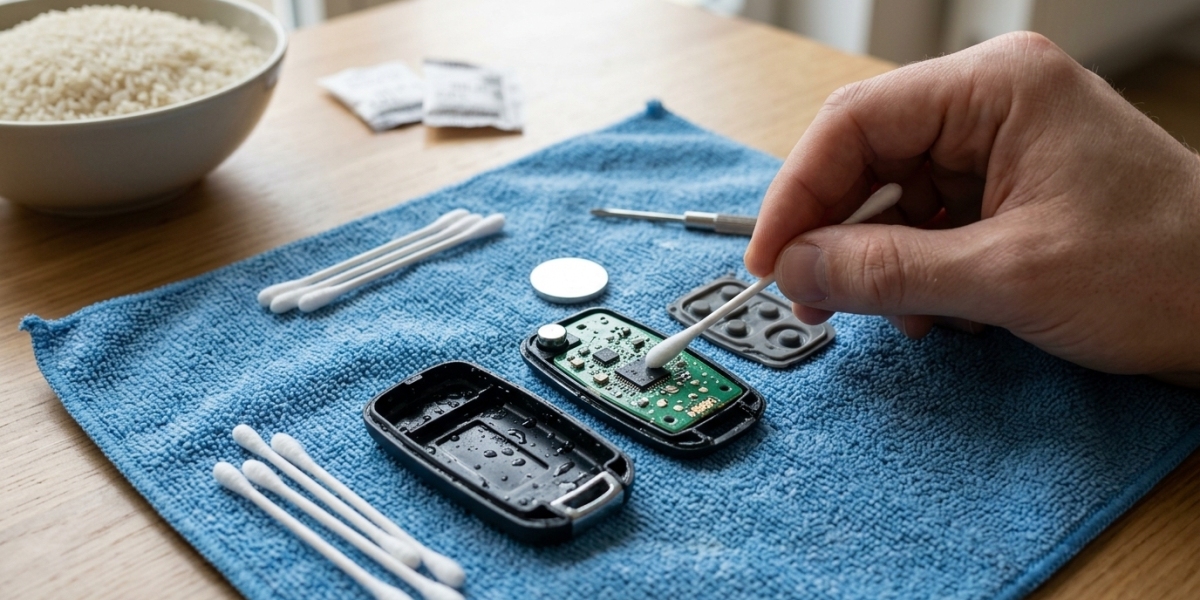

You accidentally leave your car keys in a jeans pocket before putting them in the washing machine. Halfway through the cycle, you remember the key fob. When you finally get it out, the buttons don't respond, and the car refuses to unlock. The fob looks normal from the outside, but the electronics inside may already be affected.
Water damage doesn't always mean you need a new key. Sometimes, the problem is limited to a wet battery compartment or contaminated electrical contacts. Other times, moisture reaches the circuit board and causes damage that ordinary drying cannot correct. What matters most is the type of exposure, how quickly the fob was disconnected from power, and whether its internal components remain functional.
There are a few useful things you can do before replacing the fob. The trick is knowing which actions might help and which ones could turn a repairable problem into permanent damage.
What Happens Inside a Key Fob When Water Gets In?
A car key fob contains more than a battery and plastic buttons. Depending on the model, it may have a small circuit board, battery contacts, electronic switches, a radio transmitter, and components that communicate with the vehicle's security system. These parts are designed to operate with specific electrical connections. When water reaches the circuit board, it can create unintended conductive paths between components that should remain electrically separate.
The problem becomes more serious when the liquid contains dissolved minerals, salt, or cleaning chemicals. These substances can remain on the electronic components after the visible moisture evaporates. Residue may interfere with electrical contact or contribute to corrosion, causing the fob to work intermittently before failing completely. This explains why a remote can seem normal immediately after getting wet but develop problems several days later.
Not every fob has the same resistance to moisture. Some models have sealed housings that provide limited protection against splashes, while others allow water to enter through button openings, case seams, or damaged seals. A waterproof-looking plastic shell should not be treated as proof that the electronics are protected. The manufacturer's instructions are the best reference for understanding the limitations of a particular key.
What Should You Do Immediately After Getting the Fob Wet?
The first priority is to stop using the remote until you know whether water has entered it. Pressing buttons while moisture remains inside can energize affected circuits and contribute to further electrical damage. Dry the outside with a clean cloth and move the fob away from the liquid. Avoid shaking it aggressively, forcing open the housing, or repeatedly testing the buttons to see whether they have recovered.
If the manufacturer provides instructions for replacing the battery, check whether you can safely access the battery compartment. Some remotes use a removable coin-cell battery, while other electronic keys have sealed or more complicated constructions. Follow the documented opening procedure rather than using force. If the battery appears swollen, leaking, unusually hot, or otherwise damaged, do not attempt to handle or reuse it. Arrange safe disposal or professional assistance as appropriate.
For a conventional fob with an accessible, undamaged removable battery, the immediate response is relatively simple:
Stop pressing the buttons. Do not continue testing a fob that may contain moisture.
Dry the exterior. Gently absorb visible water using a clean, soft cloth.
Remove the battery if permitted. Follow the manufacturer's battery replacement instructions.
Inspect the accessible compartment. Look for moisture, discoloration, or deposits around the contacts.
Allow proper drying and assessment. Keep the battery disconnected until the accessible components are completely dry and any contamination has been addressed.
These steps cannot guarantee recovery. Their purpose is to reduce additional damage while determining whether the fob needs further attention. If water has entered a sealed electronic assembly, opening it without the appropriate instructions may break clips, damage seals, or disturb delicate components. A technician familiar with electronic automotive keys may be better equipped to assess that condition.
Why Putting a Wet Key Fob in Rice Is Not a Good Repair Method
Dropping wet electronics into a container of uncooked rice is a familiar household suggestion. Unfortunately, rice does not remove minerals, detergent, or corrosion deposits from a circuit board. Even if the exterior becomes dry, contamination can remain around electrical contacts and beneath electronic components. A fob may appear recovered while its internal condition continues deteriorating. Rice dust and small particles can also enter openings in the housing.
Air-drying in a clean, dry, ventilated location is preferable to exposing the fob to unnecessary heat or particles. However, drying alone is not always sufficient when liquid has reached the circuitry. The amount of time required depends on how the fob is constructed and how much water entered it. There is no reliable universal drying period that proves every internal component is safe to power again.
Avoid trying to speed things up with a hair dryer, oven, or direct sunlight. Excessive heat can damage the plastic housing, seals, electronic components, or battery. Strong airflow from a hot appliance may also push moisture toward areas that are difficult to inspect. If the fob was submerged rather than lightly splashed, professional inspection is often more useful than experimenting with household drying methods.
Does the Type of Water Make a Difference?
A fob exposed to a few drops of clean water may have a better chance of recovery than one left in a washing machine or submerged in seawater. The difference comes from the substances carried by the liquid. Laundry detergent can leave residue around buttons and circuit contacts, while saltwater introduces dissolved salts that can accelerate corrosion. Floodwater may contain dirt, chemicals, and other contaminants that make cleaning more complicated.
Consider a remote dropped briefly into a clean sink compared with one washed inside a pocket for an entire laundry cycle. The first may have limited internal exposure, depending on its design. The second has experienced prolonged water contact, agitation, and detergent exposure. Treating both situations as identical would overlook important differences in potential damage. The history of the exposure should guide the repair assessment rather than the appearance of the housing alone.
If the fob encountered saltwater, detergent, or a sugary drink, tell the technician exactly what happened. Contaminated electronics may require suitable professional cleaning rather than ordinary drying. Household sprays, cleaners, or unapproved solvents should not be applied directly to an assembled key fob. Some liquids can damage protective coatings, plastic components, or adhesives, creating additional problems.
How Can You Tell Whether the Fob Is Recoverable?
The answer depends on which components were affected and whether they can be restored to proper operation. Damage limited to a replaceable battery or accessible contacts may be relatively straightforward. A fob with a cracked housing may also be repairable if the electronic board and security components are still functional. Problems become more difficult when corrosion has damaged circuit traces, switches, or components that are not easily replaceable.
The way the fob behaves can provide clues, but it cannot confirm the internal damage. A remote that works only when a button is pressed several times may have worn or contaminated contacts. A fob that unlocks the car but cannot start it may have a different problem from one that cannot transmit any signal. A technician needs to determine whether the issue lies in the fob or the vehicle before recommending replacement.
The Buttons Work Sometimes, but Not Consistently
Intermittent button response may indicate contamination around the switches, poor battery contact, or damage to the electronic board. A wet button pad can also interfere with the movement or operation of a switch. However, an inconsistent response does not identify one specific failed component. The fob may require contact inspection and signal testing to establish whether repair is practical.
A common mistake is treating intermittent operation as proof that the remote has recovered. If moisture or contamination remains inside, the problem can return without warning. Once a fob has been exposed to significant water, it should be assessed before being trusted as the only means of accessing or starting the vehicle. A working spare provides valuable protection against an unexpected failure.
The Remote Unlocks the Door but Will Not Start the Car
Some automotive keys contain separate functions for remote locking and engine-start authorization. A conventional remote-head key may use a passive transponder for the immobilizer, while the battery-powered portion operates the door locks. Smart keys can use different combinations of electronic components and communication methods. Consequently, one function may continue working after another has failed.
If a water-exposed fob still operates the door locks but cannot start the vehicle, the cause should not automatically be described as a programming problem. The vehicle's battery, immobilizer communication, fob electronics, and starting system may need checking. Reprogramming cannot repair physically damaged circuitry. Identifying which function has actually failed prevents unnecessary programming attempts and replacement purchases.
Can the Battery Be Replaced After Water Exposure?
A battery change may solve the problem if the battery is discharged or damaged but the remaining electronics are unaffected. The replacement must match the specification provided by the vehicle manufacturer. Similar-looking coin cells are not necessarily interchangeable, and the battery must be installed with the correct polarity. If the compartment contains visible moisture, corrosion, or deposits, fitting a new battery immediately may not resolve the underlying fault.
Inspecting the contacts is particularly important because even a working battery cannot deliver power properly through damaged electrical connections. Minor surface contamination may be removable using appropriate electronics-cleaning methods, but cleaning must be compatible with the manufacturer's instructions and the fob's materials. Significant corrosion, loose contacts, or damage extending onto the circuit board should be assessed professionally.
If the battery compartment is dry, undamaged, and accessible under the manufacturer's instructions, replacing the battery can be a reasonable first check. Keep removed coin cells away from children and dispose of them safely. If the old cell shows leakage, swelling, or heat damage, do not attempt to recharge or reuse it.
What Does a Locksmith Check Before Recommending Replacement?
A proper diagnosis starts with the condition of the key and the circumstances of its failure. The technician should ask whether the fob was briefly splashed, completely submerged, or exposed to detergent or saltwater. They may inspect accessible battery contacts, look for visible corrosion, and evaluate whether the fob produces the expected electronic signal. The assessment also needs to consider whether a known working spare operates normally with the vehicle.
Professional water-damaged key fob repair may involve identifying an electrical contact problem, replacing suitable components, or determining whether a compatible replacement is necessary. Not every locksmith performs circuit-board-level repairs, so the available repair options depend on the provider and the fob model. An assessment should distinguish between a simple battery issue, a repairable hardware defect, and damage that makes replacement the more dependable choice.
Electronic signal testing is useful because a button click does not establish that the transmitter is working correctly. A technician may use suitable equipment to evaluate the remote's output and compare it with the functions expected for that vehicle. If a signal is present but the vehicle does not respond, further vehicle-side diagnosis may be necessary. Replacing the fob without checking this distinction could leave the original problem unresolved.
When Is Repair No Longer the Better Choice?
Repairing a damaged fob makes sense when the defect can be identified, the necessary components are available, and the completed repair can be tested. Replacing a battery or suitable outer housing may cost less than obtaining an entirely new electronic key. However, water-damaged circuit boards can develop recurring problems, particularly when corrosion has affected small electronic connections. A remote that works briefly after cleaning is not necessarily dependable for long-term use.
Replacement becomes more reasonable when the electronic board has extensive corrosion, multiple functions have failed, or the security-related components cannot be restored reliably. The decision should also consider the value of the repair compared with the cost of a compatible replacement and required programming. The cheapest immediate option is not necessarily the best choice if another failure could leave the vehicle inaccessible.
A professional car key repair service assessment should therefore explain what failed and whether the existing key can be returned to dependable operation. If replacement is recommended, ask whether it includes the complete electronic fob, an emergency mechanical blade where applicable, and all necessary programming. These details help avoid paying for a replacement that lacks an important function.
Will a Replacement Fob Need Programming?
Many modern replacement fobs need to be registered with the vehicle before their electronic functions will work. The exact requirements depend on the manufacturer, model year, and security system. Some remote locking functions and immobilizer functions may have separate enrollment procedures. A technician must verify that the replacement is compatible and determine which operations are required.
Not every repair requires reprogramming. Replacing a removable battery in a compatible, previously authorized fob generally does not erase the key's immobilizer authorization. Similarly, changing an outer shell while preserving the original working electronics may not require new programming. However, transferring components between housings should only be done when the particular key design supports it.
A replacement involving a new electronic board or smart-key assembly may require the vehicle to recognize the new device. The technician should complete the appropriate registration and confirm that the original keys remain functional. If the water-damaged fob was lost or cannot be accounted for, the vehicle's supported security procedures may also allow its authorization to be removed.
What if You Cannot Unlock or Start the Vehicle?
A damaged remote does not always mean there is no way to use the vehicle. Many smart keys include a concealed mechanical emergency blade that can unlock a door when the remote buttons fail. Certain vehicles also provide a manufacturer-specified emergency starting method for situations involving a weak fob battery. These features vary, and they may not work when internal security-related circuitry has been seriously damaged.
Check the vehicle owner's manual before attempting an emergency starting procedure. Using instructions intended for another model can lead to confusion or unnecessary attempts. If the vehicle is safely parked and a working spare is available, use that key while arranging an assessment. Avoid relying on a water-damaged fob for essential travel until its operation has been checked.
When no working key remains, an automotive locksmith or authorized dealer may need to verify ownership and provide a compatible replacement. The service may involve cutting a mechanical blade, registering electronic functions, and testing the vehicle's security system. Knowing the vehicle's make, model, year, and identification number helps the technician establish the correct replacement requirements.
How Can You Protect a Replacement From Future Water Damage?
Key fobs are easy to overlook because they spend much of their time inside pockets, bags, and vehicle compartments. The most effective prevention is to keep them away from unnecessary moisture exposure and check clothing before doing laundry. Avoid leaving a fob where rain can enter through an open window or where liquid containers may spill. If the outer shell is cracked or the buttons no longer fit properly, arrange a suitable repair before moisture reaches the electronics.
Florida's humid conditions make careful storage worthwhile, particularly when a vehicle or bag is exposed to rain and condensation. High humidity does not automatically damage a properly functioning key, but moisture entering a compromised housing can contribute to corrosion. A protective cover may reduce scratches and minor exposure, although it should not be treated as a guarantee of waterproofing.
Keeping a tested spare is also useful. If the primary fob is damaged, a working backup can prevent an inconvenient failure from turning into a complete vehicle lockout. The spare should be stored in a secure, dry location and checked periodically for normal operation. If its battery is replaceable, follow the manufacturer's recommendations instead of waiting until it fails during an emergency.
Conclusion
A wet key fob is not automatically beyond repair, but successful recovery depends on the exposure and the condition of its electronic components. Removing accessible battery power safely, avoiding repeated button presses, and arranging appropriate inspection can help prevent further damage. One relevant failure mechanism is electrochemical migration, where moisture and electrical potential can cause metal ions to move across circuit-board surfaces and form unwanted conductive paths. This helps explain why some wet electronics develop delayed faults even after the visible water disappears. The sensible choice is to identify the damage first, repair what can be restored dependably, and replace the fob when its electronics can no longer be trusted.