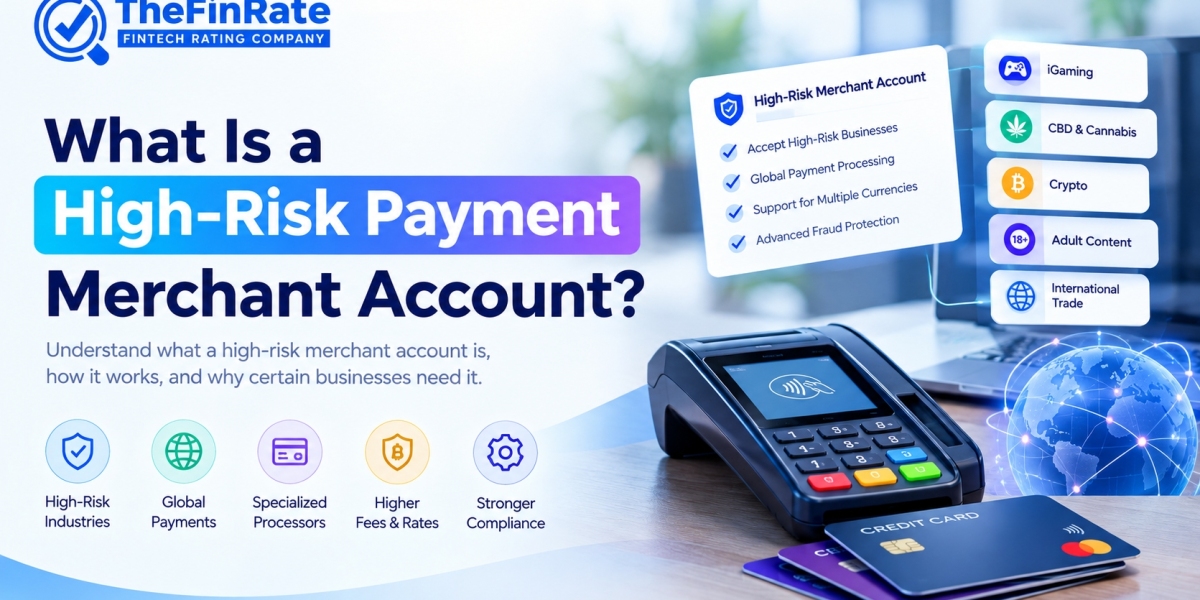

A high-risk payment merchant account is a payment processing account for businesses that banks and processors see as more likely to create chargebacks, fraud, or compliance problems. It lets these merchants keep accepting card payments when standard providers would decline, freeze, or close their accounts. If you are comparing options, start with our list of high-risk merchant account providers.
Quick answer
- It works like a normal merchant account, on the same card networks.
- The difference is stricter underwriting, higher costs, and added protections such as reserves.
- It is aimed at businesses more prone to chargebacks, fraud, or regulatory scrutiny.
- High risk does not mean the business is doing something wrong.
How a high-risk merchant account works
A merchant account is the account that lets a business accept card payments and receive payouts to its bank. In a high-risk setup, the account is held at an acquiring bank that has agreed to take on higher-risk businesses. The high-risk label comes from the acquiring bank's own underwriting assessment, not from card networks or regulators.
For more guides on payment gateways, merchant accounts, and fintech providers, visit TheFinRate.
Why businesses are classified as high risk
Classification usually comes from a mix of factors:
- Industry: categories with regulatory exposure, high dispute history, or reputational concern.
- Chargebacks and refunds: a high dispute or refund rate raises concern even in a normally low-risk category.
- Business model: recurring billing, delayed delivery, high average order value, and cross-border sales all raise exposure.
- History: a prior account termination or a lack of processing history.
The decision is about the category and your profile together, so a clean record does not always avoid it.
High-risk vs standard merchant accounts
| Area | Standard account | High-risk account |
|---|---|---|
| Underwriting | Lighter review | More detailed documentation |
| Reserves | Uncommon | Rolling reserves may apply |
| Pricing | Simpler, usually lower | Often higher, with more fee types |
| Account reviews | Occasional | More frequent monitoring |
| Contract terms | Flexible | May include early termination or clawback clauses |
What a high-risk merchant account costs
Exact pricing varies by provider and profile, so confirm every figure in writing. Typical cost areas include:
- Transaction and gateway fees
- Monthly and compliance fees
- Chargeback fees
- Rolling reserves, which act as collateral against future disputes and can affect cash flow. Reserves can often be reduced after a clean track record.
What underwriting looks at
Expect a deeper review than for standard merchants. It commonly covers processing history (chargebacks, refunds, average ticket size), business documentation, ownership details, and your website and policies. High-risk underwriting usually calls for more extensive documentation than standard applications.
Choosing a high-risk provider
Not every processor can handle high-risk merchants, so look for these:
- Real high-risk experience. Ask which acquiring banks sit behind the account.
- Clear contract terms. Check reserves, termination fees, and holds before signing.
- Fraud and chargeback tools. These matter more in higher-dispute categories.
- Gateway compatibility. Your merchant account and gateway must work together smoothly. Our payment gateway reviews help you compare gateway options.
- Compliance fit. Rules vary by industry and country, so confirm your business is permitted.
How to reduce your risk profile
- Track and lower your chargeback ratio.
- Use clear product descriptions, delivery timelines, and responsive support.
- Add fraud screening and 3D Secure where available.
- Keep refund and cancellation policies visible.
High-risk classification is not permanent, so improving these metrics can open better terms over time.
Common mistakes to avoid
- Hiding your real business model during application. Misrepresentation can lead to termination.
- Ignoring reserve terms until payouts are delayed.
- Signing long contracts without understanding exit fees.
- Assuming a clean record guarantees a standard account.
Verdict
A high-risk merchant account is a specialized but legitimate route to accept card payments when your category or profile carries added risk. The right provider balances approval odds, transparent terms, and fraud controls.
Next step: Compare providers using TheFinRate's reviews and ratings to shortlist options that match your business type.