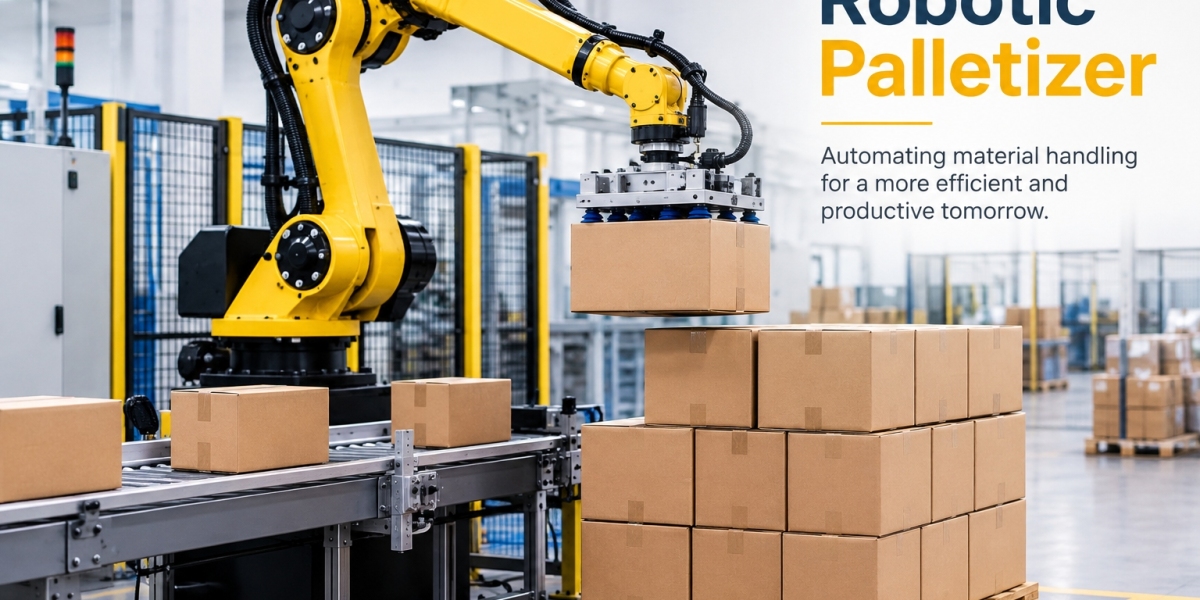

A robotic palletizer uses an industrial robot to arrange products on pallets according to a predefined pattern. It can handle different types of products, including cartons, bags, containers, and packaged goods. By automating the palletizing process, manufacturers can improve workflow consistency and make better use of available production resources.
Understanding how robotic palletizing works, its benefits, and its applications can help businesses determine whether this technology is suitable for their operations.
What Is a Robotic Palletizer?
A robotic palletizer is an automated system that uses a robotic arm, specialized gripping equipment, sensors, and control software to place products onto pallets. The system follows programmed instructions to pick up individual products or groups of products and arrange them in a specified pattern.
Unlike conventional palletizing equipment designed for particular product arrangements, robotic palletizers can often be programmed for different pallet patterns and product configurations. The flexibility depends on the robot, end-of-arm tooling, control system, and application requirements.
A typical robotic palletizing system includes the following components:
- Industrial robot: Moves products from a conveyor or designated pickup location to the pallet.
- End-of-arm tooling: Grips and releases products using suitable mechanisms such as clamps, suction cups, or specialized grippers.
- Sensors and vision systems: Help detect product positions, verify conditions, or support accurate picking when required.
- Control system: Coordinates robot movements, safety functions, and communication with other equipment.
- Conveyor system: Transports products to the palletizing area.
- Pallet handling equipment: Positions, supplies, or removes pallets as part of the overall workflow.
Together, these components help automate product stacking and support consistent material handling.
How Does a Robotic Palletizer Work?
A robotic palletizer follows a coordinated sequence of operations to move products from a production line onto pallets.
1. Product Identification
Products arrive at the palletizing station through a conveyor or another material-handling system. Depending on the application, sensors or vision technology may identify product positions, dimensions, or orientation.
This information helps the control system determine how the robot should approach the product.
2. Product Picking
The robot moves to the pickup location and uses its end-of-arm tooling to grip the product securely. The gripping mechanism must be suitable for the product's size, weight, shape, and packaging material.
Proper tool selection helps reduce product damage and improve handling consistency.
3. Pattern-Based Placement
After picking up the product, the robot moves it to the pallet and places it according to a predefined stacking pattern.
The pattern may be designed to improve pallet stability, use available space efficiently, and meet transportation requirements.
4. Pallet Completion
The robot repeats the picking and placement sequence until the required pallet configuration is complete.
Depending on the installation, the system may communicate with conveyors, pallet dispensers, wrapping equipment, and warehouse handling systems.
5. System Monitoring
The control system monitors the operation and responds to relevant signals, alarms, or process conditions. Proper integration and testing help ensure that the robotic cell operates according to its intended requirements.
Benefits of Robotic Palletizer Technology
Robotic palletizing offers several potential advantages for manufacturing and distribution businesses.
Improved Productivity
Robotic systems can perform repetitive palletizing tasks with consistent movements and programmed sequences. Depending on the application and system design, automation can help increase production throughput and reduce delays caused by manual handling.
Consistent Product Stacking
Manual palletizing can produce variations in product placement. A properly configured robotic palletizer follows defined placement instructions, helping maintain consistent stacking patterns.
This consistency can improve pallet organization and support more predictable downstream handling.
Reduced Manual Handling
Palletizing often involves repetitive lifting and movement of heavy or awkwardly shaped packages. Automating suitable tasks can reduce workers' exposure to these physical demands.
Safety still depends on appropriate machine guarding, risk assessment, training, and compliance with applicable workplace requirements.
Flexible Production Operations
Robotic palletizers can often accommodate multiple products and pallet patterns through programmed changes and suitable tooling.
This flexibility can be valuable for manufacturers that operate several packaging lines or regularly change product configurations.
Better Space Utilization
Some robotic palletizing systems can be designed for compact production environments. The actual space requirements depend on the robot's reach, pallet dimensions, conveyor layout, guarding, and maintenance access.
Careful cell design can help businesses make effective use of their available floor space.
Applications of Robotic Palletizers Across Industries
Robotic palletizing systems are used in a variety of industrial environments.
Food and beverage: Systems can stack cartons, packaged bottles, cans, and other products for storage or transportation.
Pharmaceuticals: Automated handling can support the palletizing of suitable packaged products while meeting the facility's operational and hygiene requirements.
Consumer goods: Manufacturers can automate the stacking of household products, personal care items, and packaged merchandise.
Chemical manufacturing: Suitable robotic systems can handle selected bags, containers, and packaged materials, subject to product-specific safety requirements.
Logistics and distribution: Distribution facilities can use robotic palletizing to organize cartons and other packaged goods for storage and shipment.
Each application requires an assessment of product characteristics, operating conditions, throughput requirements, and safety considerations.
Important Factors When Selecting a Robotic Palletizer
Choosing the right robotic palletizer requires more than comparing robot specifications. Businesses should evaluate the complete application.
Payload capacity: The robot must handle the product and gripping equipment within its specified operating limits.
Cycle time: The system should meet the required production rate without compromising safe operation.
Gripper design: End-of-arm tooling must securely handle the products without causing unnecessary damage.
Pallet pattern: The stacking arrangement should support load stability and efficient use of pallet space.
Integration requirements: The robot may need to communicate with conveyors, programmable logic controllers, production equipment, and warehouse systems.
Safety considerations: Risk assessment, protective guarding, emergency stops, and appropriate safety controls are essential parts of system design.
Maintenance and support: Businesses should consider spare parts, technical support, training, and the ease of diagnosing faults.
Evaluating these factors helps organizations select equipment that fits their production needs and long-term operating objectives.
The Role of Software and System Integration
A robotic palletizer depends on coordinated interactions between mechanical equipment, electrical components, and control software.
Robot programs define movement paths and product placement sequences, while control systems coordinate signals from sensors, conveyors, and other machinery. Depending on the application, communication interfaces may be required to exchange operating information between equipment.
Simulation and offline programming can also help engineering teams evaluate robot movements, check reachability, and identify potential layout issues before physical commissioning.
Thorough testing is important to verify that the complete system performs as expected under its intended operating conditions. Good documentation and maintenance planning can further support reliable operation over time.
Conclusion
Robotic palletizers have become valuable tools for businesses seeking to automate repetitive material-handling operations. By combining industrial robots, suitable gripping equipment, sensors, and control systems, manufacturers can improve palletizing consistency and support more efficient production workflows.
However, successful implementation depends on choosing the right robot, designing an appropriate gripping mechanism, integrating the equipment correctly, and addressing safety requirements. Businesses should evaluate their product characteristics, production targets, available space, and long-term support needs before investing in a robotic palletizing system.