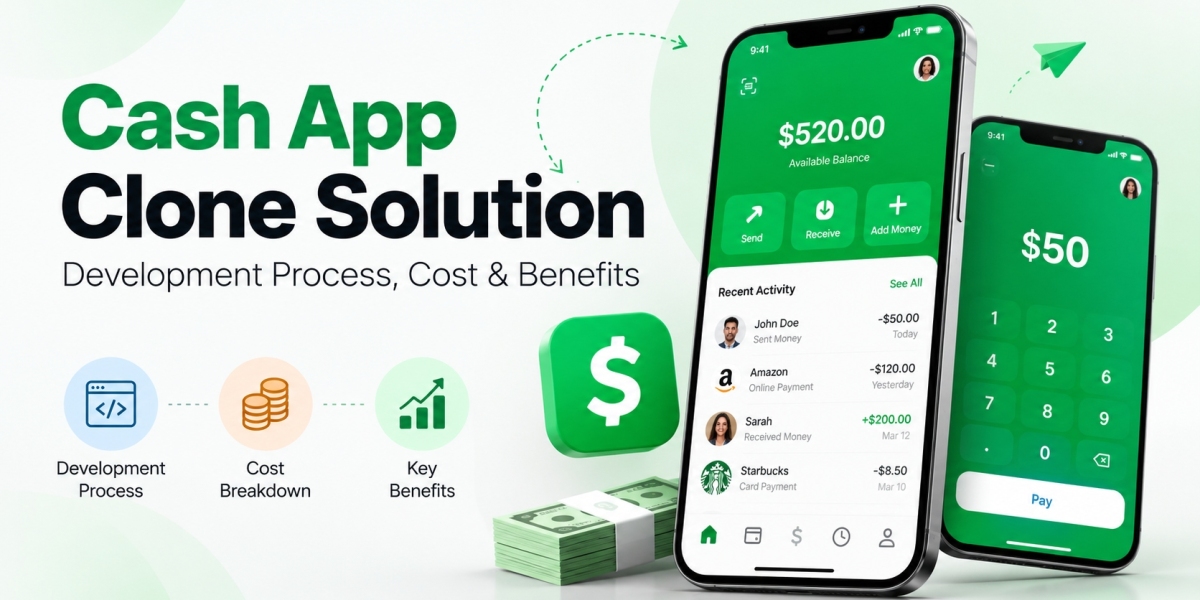

Digital payments have become an essential part of everyday life. From sending money to friends to paying merchants and managing digital transactions, users increasingly expect financial services to be fast, convenient, and accessible through their smartphones. This shift has created opportunities for startups and businesses interested in launching their own digital payment platforms.
A cash app clone solution offers a practical starting point for businesses that want to enter the digital payments market without building every feature from scratch. It provides a foundation for developing a peer-to-peer payment application with features such as user registration, digital wallets, transaction tracking, and payment notifications.
However, launching a successful payment platform requires more than copying an existing application's interface. Businesses must consider security, regulatory requirements, payment infrastructure, user experience, and long-term scalability. Understanding the development process, cost factors, and business benefits can help entrepreneurs make better decisions before investing in a new fintech product.
What Is a Cash App Clone Solution?
A cash app clone solution is a customizable software application designed to support digital payment services similar to those offered by popular peer-to-peer payment platforms. It can be adapted to a business's requirements, target audience, supported payment methods, and operational model.
Depending on the project scope, the application may include account creation, identity verification, wallet management, money transfers, transaction history, payment requests, and administrative controls. Advanced versions can also support merchant payments, recurring transactions, analytics, and integrations with third-party financial services.
The purpose is not to duplicate another company's branding or proprietary technology. Instead, businesses use an existing software foundation to create an independently branded payment platform with its own features, design, and business strategy.
This approach can be particularly useful for fintech startups, payment service providers, and entrepreneurs who want to validate a digital payment concept before committing to a fully custom development project.
Development Process for a Cash App Clone
Building a reliable payment application requires a structured development process. Each stage contributes to the application's usability, security, and ability to support future growth.
1. Define the Business Model
The first step is to identify the payment services the platform will provide. Some businesses may focus on person-to-person transfers, while others may prioritize merchant payments, digital wallets, or payments within a specific customer community.
At this stage, businesses should identify their target audience, revenue model, operating regions, supported currencies, and transaction requirements. They should also determine whether the platform will work with licensed financial partners or require additional regulatory arrangements.
A clear business model helps prevent unnecessary features from increasing the initial development budget.
2. Select the Essential Features
The feature set should reflect the needs of the intended users. A basic application may include registration, account verification, wallet balances, transfers, transaction history, notifications, and customer support.
More advanced platforms may require QR-code payments, merchant accounts, recurring payments, spending insights, or integration with external financial services.
An administrative dashboard is equally important. It allows authorized staff to monitor transactions, manage user accounts, investigate suspicious activity, and review operational reports.
Launching with a focused minimum viable product can help businesses test demand before investing in more complex functionality.
3. Choose the Right Development Approach
Businesses generally choose between fully custom development and a ready-made or white-label solution.
Custom development provides greater control over the architecture and feature set, but it usually requires more time, planning, and investment. A ready-made solution can reduce the amount of development required because common application components may already be available.
A white label fintech app can be customized with a company's branding, user interface, business rules, and selected integrations. This approach may be suitable for organizations that want to establish a fintech presence without developing every component independently.
Before choosing a solution, businesses should review source code ownership, documentation, customization options, third-party dependencies, maintenance arrangements, and the provider's security practices.
4. Design the User Experience
Payment applications should make financial activities straightforward. Users need to understand their available balance, payment status, transaction details, and any applicable fees without navigating confusing screens.
The design process typically includes wireframes, interface prototypes, user testing, and accessibility reviews. Important actions such as confirming a transfer or adding a payment method should be easy to understand.
Clear error messages and transaction confirmations also help users identify whether a payment succeeded, failed, or requires additional action.
5. Develop the Application and Integrations
The development team builds the required application components and connects them to the relevant payment infrastructure. Depending on the business model, integrations may include payment gateways, banking APIs, identity verification services, notification systems, and fraud monitoring tools.
The backend must handle transaction processing, account records, authentication, and application logic consistently. Financial records should be reconciled carefully, and the system should prevent duplicate processing when users retry a payment.
Businesses should also plan for performance, backups, monitoring, and recovery procedures before releasing the application to customers.
6. Implement Security and Compliance Measures
Security is one of the most important parts of fintech development. Payment platforms handle sensitive personal and financial information, making access control, encryption, secure authentication, and monitoring essential.
Depending on the jurisdiction and services offered, the business may need to address customer verification, anti-money-laundering obligations, data protection rules, payment regulations, and applicable payment-card security standards.
Working with qualified legal and compliance professionals can help determine which requirements apply. Using a software solution does not automatically make a business compliant with financial regulations.
7. Test, Launch, and Improve
Before launch, the application should undergo functional, usability, performance, integration, and security testing. The team should test successful and failed transactions, network interruptions, refund scenarios, duplicate requests, and account recovery.
A controlled rollout can help identify issues before the platform reaches a larger audience. After launch, businesses should monitor transaction failures, application performance, customer feedback, and suspicious activity.
Regular updates are necessary to address vulnerabilities, improve the user experience, and accommodate changing business requirements.
How Much Does Cash App Clone Development Cost?
The cost of developing a payment application depends on its complexity, feature set, integrations, security requirements, and development approach. There is no single price that applies to every project.
A basic application with essential wallet and transaction functionality will generally cost less than a platform that supports multiple currencies, merchant services, advanced fraud detection, and complex financial integrations.
The following figures are illustrative planning estimates, not verified vendor quotations.
| Development level | Estimated cost (USD) |
|---|---|
| Basic MVP | $15,000–$30,000 |
| Mid-level application | $30,000–$70,000 |
| Advanced fintech platform | $70,000–$150,000+ |
These ranges can vary considerably by country, team experience, project scope, and technology choices. Some ready-made solutions may have lower initial implementation costs, while licensing, customization, and integration fees can increase the final amount.
Factors That Influence the Budget
Feature complexity: Digital wallets, payment requests, merchant accounts, analytics, and multi-currency support require different levels of development effort.
Third-party integrations: Banking connections, payment processors, identity verification, and fraud prevention services may involve setup fees or recurring charges.
Security and compliance: Security reviews, penetration testing, legal advice, and compliance-related work can represent a significant part of the budget.
Platform selection: Developing for Android, iOS, and the web may require additional design, testing, and maintenance.
Ongoing maintenance: Hosting, monitoring, bug fixes, customer support, and software updates should be included in the long-term financial plan.
Businesses should request a detailed estimate that separates initial development, third-party services, recurring expenses, and post-launch support. This makes it easier to compare providers and understand the total cost of ownership.
Benefits of a Cash App Clone Solution
Faster Time to Market
A ready-made software foundation can reduce the time required to implement common application features. Businesses can concentrate on their target audience, payment use cases, branding, and launch strategy rather than starting every component from zero.
The actual timeline still depends on customization, financial integrations, testing, and compliance requirements.
Lower Initial Development Effort
Reusing existing components may reduce the amount of work required for an initial release. This can be helpful for startups with limited resources that want to test a payment service before expanding its functionality.
However, businesses should evaluate the full cost of licensing, customization, integrations, and ongoing maintenance instead of comparing development fees alone.
Flexible Branding and Customization
A cash app clone can be tailored to a specific market or business model. Companies can customize the interface, supported services, transaction limits, notifications, and customer onboarding process.
This flexibility helps businesses create a distinct product rather than offering a generic payment experience.
Opportunities for Revenue Generation
Depending on applicable regulations and the services provided, a payment platform may generate revenue through merchant service fees, business subscriptions, premium features, or value-added financial services.
The business model should remain transparent. Any charges, transfer limits, and account conditions should be clearly communicated to customers.
Easier Future Expansion
A well-designed application can be extended with additional features as the business grows. These might include merchant tools, business payment workflows, analytics, or integrations with other financial services.
Scalability depends on the underlying architecture and the provider's ability to support customization, so businesses should evaluate these factors before selecting a solution.
How to Choose the Right Development Partner
Selecting a development partner can influence the project's cost, delivery timeline, and long-term reliability. Businesses should look beyond attractive pricing and assess the provider's technical capabilities.
Start by reviewing previous fintech projects, the team's experience with payment integrations, and its approach to application security. Ask for a clear breakdown of deliverables, development milestones, testing procedures, and post-launch support.
It is also important to understand whether the business will receive the source code, documentation, deployment access, and rights to customize the product. Confirm how third-party licenses and recurring fees are handled.
Businesses exploring a cash app clone can evaluate providers such as CloneAppz for customizable clone application solutions and fintech product development support. Before making a decision, request a demonstration, review the proposed scope, and confirm which payment integrations and compliance-related responsibilities are included.
The best partner is one that understands both the technical requirements and the operational realities of running a financial application.
Final Thoughts
A cash app clone solution can provide a practical foundation for businesses planning to enter the digital payments market. It may help reduce initial development effort, accelerate implementation, and provide room for customization as the business evolves.
Success, however, depends on more than launching an application. A sustainable payment platform needs reliable transaction processing, strong security, a clear revenue model, suitable financial partnerships, and a plan for meeting applicable regulatory requirements.
By defining the business model early, choosing the right development approach, and evaluating the complete cost of ownership, entrepreneurs can make informed investment decisions. Whether building from scratch or adopting a white label fintech app, the goal should be to deliver a secure, useful, and dependable payment experience that meets real customer needs.
Frequently Asked Questions
1. What is a cash app clone solution?
It is a customizable software foundation for building a digital payment application with features such as user accounts, money transfers, wallet management, and transaction tracking.
2. How long does it take to develop a cash app clone?
The timeline depends on the feature set, integrations, and compliance requirements. A basic MVP may take a few months, while a more advanced platform can require considerably longer.
3. Is a white-label payment application suitable for startups?
It can be suitable for startups that want to reduce initial development effort and customize an existing software foundation. They should still evaluate licensing, security, integrations, and regulatory responsibilities.
4. What features should a payment application include?
Common features include secure registration, identity verification, payment transfers, wallet or account management, transaction history, notifications, customer support, and administrative controls.
5. What affects the cost of a cash app clone?
Major factors include application complexity, platform selection, payment integrations, security requirements, customization, testing, and ongoing maintenance.
6. Can a cash app clone support future business growth?
Yes, if the underlying architecture supports additional users, transaction volume, integrations, and new features. Scalability should be evaluated during solution selection and technical planning.